

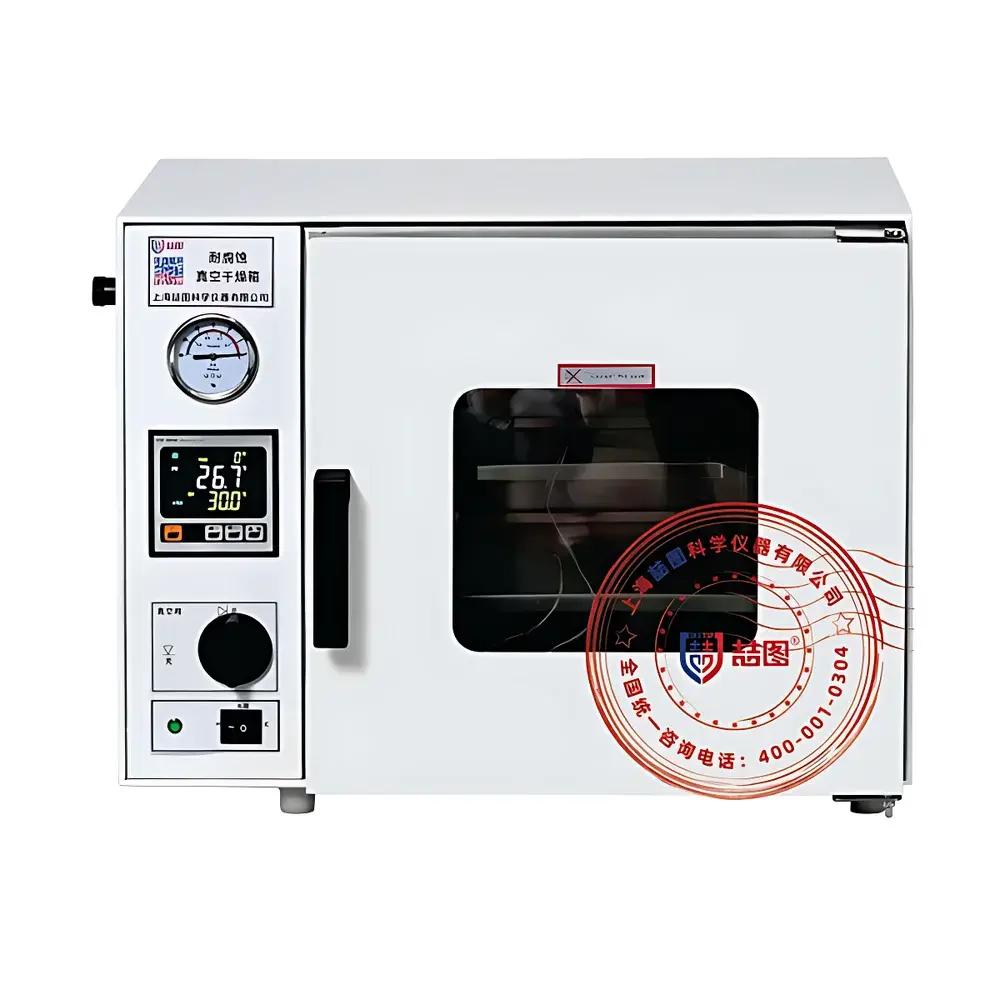
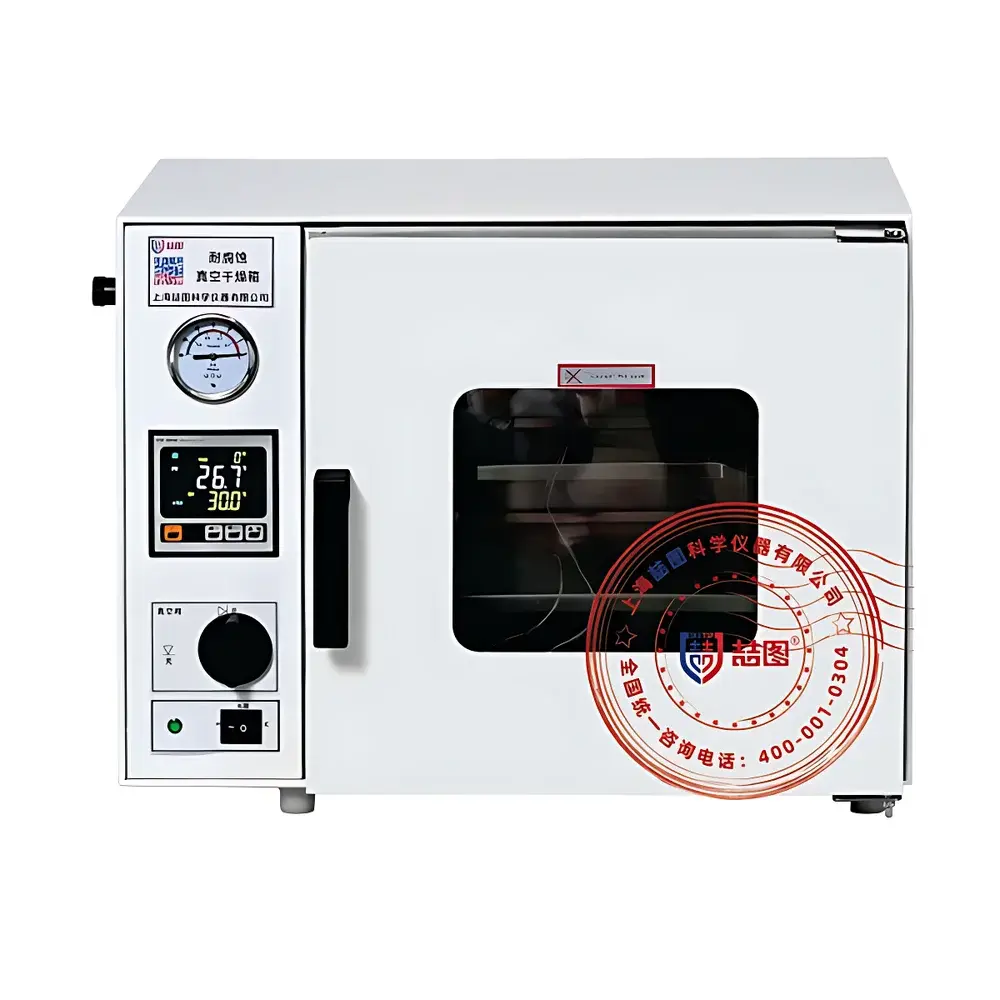
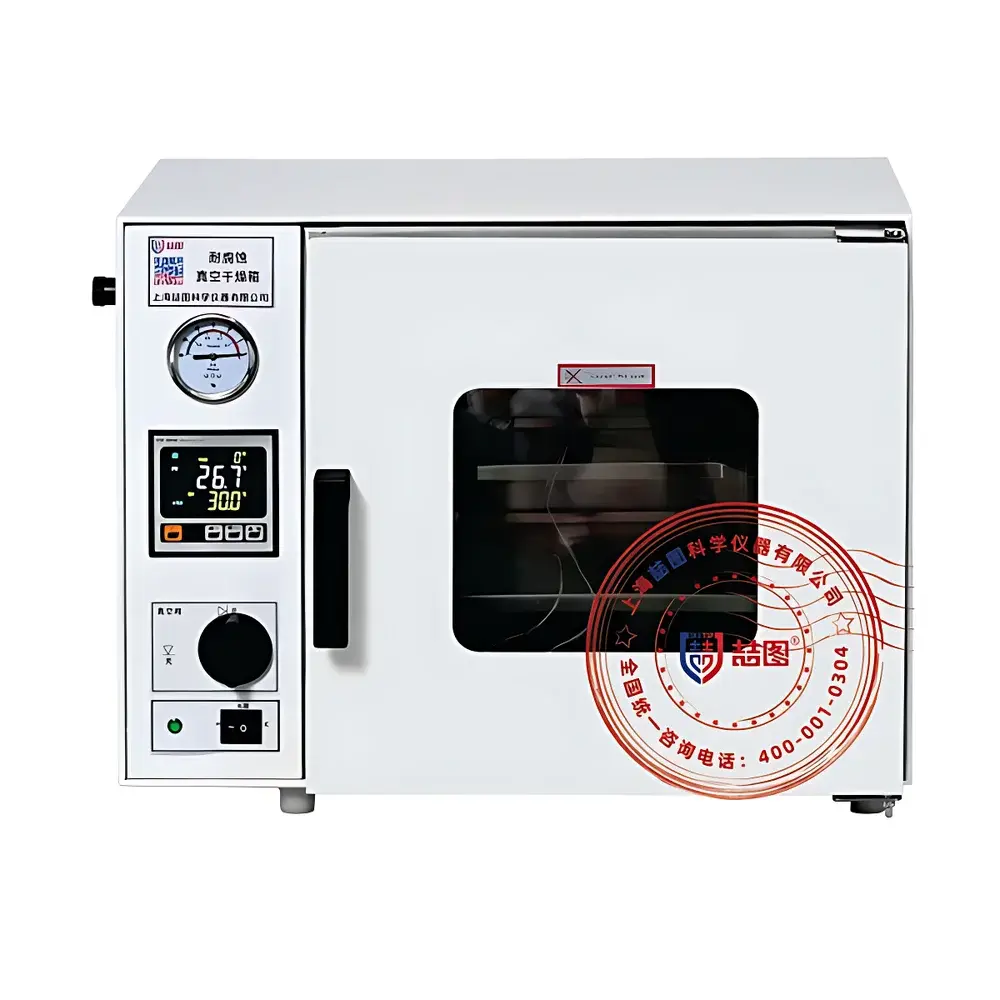
DRETOP TRA-50VC Corrosion-Resistant Vacuum Drying Oven
| Brand | DRETOP |
|---|---|
| Origin | Shanghai, China |
| Manufacturer Type | Direct Manufacturer |
| Product Category | Domestic |
| Model | TRA-50VC |
| Instrument Type | Vacuum Oven |
| Temperature Range | RT+10 to 250 °C |
| Temperature Fluctuation | ±0.5 °C |
| Control Range | RT+10 to 250 °C |
| Chamber Dimensions (W×D×H) | 415 × 370 × 345 mm |
| Temperature Resolution | 0.1 °C |
| Operating Ambient Temperature | 5–45 °C |
| Interior Material | 316 Stainless Steel |
| Heating Method | Forced-Air Circulation |
| Vacuum Level | ≤133 Pa |
Overview
The DRETOP TRA-50VC Corrosion-Resistant Vacuum Drying Oven is an engineered solution for thermal processing of chemically sensitive, oxidation-prone, or ultra-high-purity materials under controlled low-pressure environments. Utilizing vacuum-assisted dehydration—where reduced ambient pressure lowers the boiling point of solvents and moisture—the unit enables gentle, uniform drying without thermal degradation or atmospheric contamination. Its core architecture integrates a fully welded 316 stainless steel interior chamber, selected for superior resistance to chloride-induced pitting, acidic fumes, alkaline condensates, and organic solvent vapors commonly encountered in fine chemical synthesis, pharmaceutical active ingredient (API) purification, battery electrode slurry conditioning, and semiconductor precursor handling. Unlike standard carbon steel or 304 stainless ovens, the TRA-50VC eliminates galvanic corrosion pathways and minimizes metallic leaching—critical for applications governed by USP , ISO 10993, or ICH Q5D requirements.
Key Features
- 316 stainless steel interior chamber with electropolished finish, ensuring long-term structural integrity and minimal surface reactivity in aggressive chemical atmospheres.
- Forced-air circulation heating system with PID-controlled dual-zone heating elements, delivering consistent thermal distribution across the 50 L working volume (415 × 370 × 345 mm).
- High-integrity vacuum sealing using fluoropolymer-impregnated silicone gaskets, rated for continuous exposure to HCl, H₂SO₄, NaOH, and acetone vapors at temperatures up to 250 °C.
- Front-mounted tempered glass observation window with anti-fog coating, enabling real-time visual monitoring without vacuum break or thermal disturbance.
- Two adjustable, load-bearing stainless steel shelves (standard), compatible with sample trays, crucibles, or custom fixtures; shelf spacing optimized for laminar airflow and cross-sectional temperature uniformity.
- Integrated over-temperature cut-off, ground-fault circuit interruption (GFCI), and vacuum-loss alarm—meeting IEC 61010-1 safety compliance for laboratory equipment.
Sample Compatibility & Compliance
The TRA-50VC supports diverse sample formats—including powders, thin films, coated wafers, catalyst pellets, and hygroscopic crystalline APIs—without introducing metallic contaminants or promoting hydrolytic decomposition. Its 316 SS chamber meets ASTM A240 and EN 10088-1 specifications for corrosion-resistant austenitic alloys. When operated within its validated vacuum range (≤133 Pa) and temperature envelope (RT+10 to 250 °C), the oven complies with drying protocols referenced in USP , ISO 554, and JP 20 Annex 5 for residual solvent removal. Optional PTFE or PFA-lined variants (e.g., PFA-50VC-II) extend compatibility to concentrated oxidizers (e.g., 98% H₂SO₄), halogenated solvents (e.g., CH₂Cl₂), and ultra-low-metal applications requiring ≤1 ppb metal ion release—making it suitable for GMP-compliant cleanroom environments and ISO/IEC 17025-accredited testing labs.
Software & Data Management
Equipped with a programmable 7-inch TFT-LCD controller featuring real-time graphing, multi-segment ramp-soak profiles, and password-protected parameter locking, the TRA-50VC supports audit-ready data integrity. All temperature setpoints, vacuum readings, elapsed time, and alarm events are timestamped and stored internally (≥10,000 records). Optional RS485 Modbus RTU or USB-C data export enables integration with LIMS or electronic lab notebooks (ELN). The firmware adheres to ALCOA+ principles and supports 21 CFR Part 11-compliant user authentication, electronic signatures, and immutable audit trails when paired with validated third-party software platforms.
Applications
- Pharmaceutical: Residual solvent removal from lyophilized intermediates and sterile-filtered APIs under inert vacuum conditions.
- Electrochemical Materials: Drying cathode/anode slurries for Li-ion batteries without binder migration or particle agglomeration.
- Advanced Ceramics: Debinding and pre-sintering of polymer-derived ceramic green bodies in acid-vapor-rich atmospheres.
- Research Chemistry: Solvent-free crystallization of air-sensitive organometallics and moisture-scavenging of Grignard reagents.
- Microelectronics: Outgassing of photomask blanks and wafer carriers prior to thin-film deposition.
FAQ
What vacuum pumps are compatible with the TRA-50VC?
DRETOP supplies light-duty corrosion-resistant oil-sealed rotary vane pumps (VC series) or chemically resistant diaphragm pumps (GC/GF series) as standard options. For extended service life in high-humidity or solvent-laden applications, we recommend pairing with a PTFE-coated diaphragm pump and cold trap.
Can the TRA-50VC be used for inert gas purging?
Yes—the chamber includes dedicated inlet/outlet ports for N₂ or Ar backfilling, enabling hybrid vacuum-inert drying protocols per ASTM E145 Annex A5.
Is temperature uniformity data available per ISO 17025 requirements?
Upon request, DRETOP provides factory-calibrated temperature mapping reports (9-point sensor grid) performed under load at 100 °C and 200 °C, traceable to NIM (China) standards.
How is maintenance performed on the vacuum seal under corrosive operation?
The fluorosilicone gasket is rated for >5,000 vacuum cycles in pH 1–14 environments; replacement kits and torque specifications are included in the maintenance manual.
Does the unit support validation documentation (IQ/OQ/PQ)?
Yes—DRETOP delivers comprehensive validation templates, calibration certificates, and material traceability dossiers aligned with EU Annex 15 and FDA Process Validation Guidance.



