
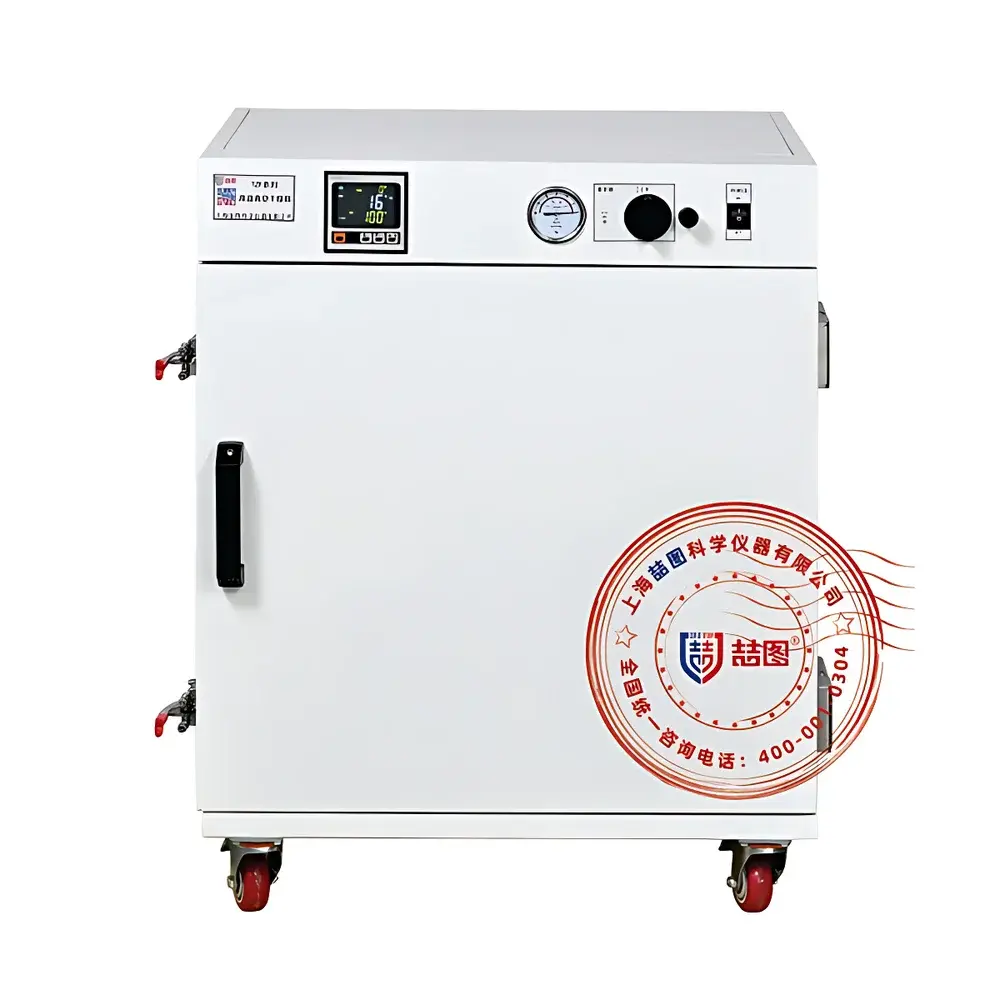
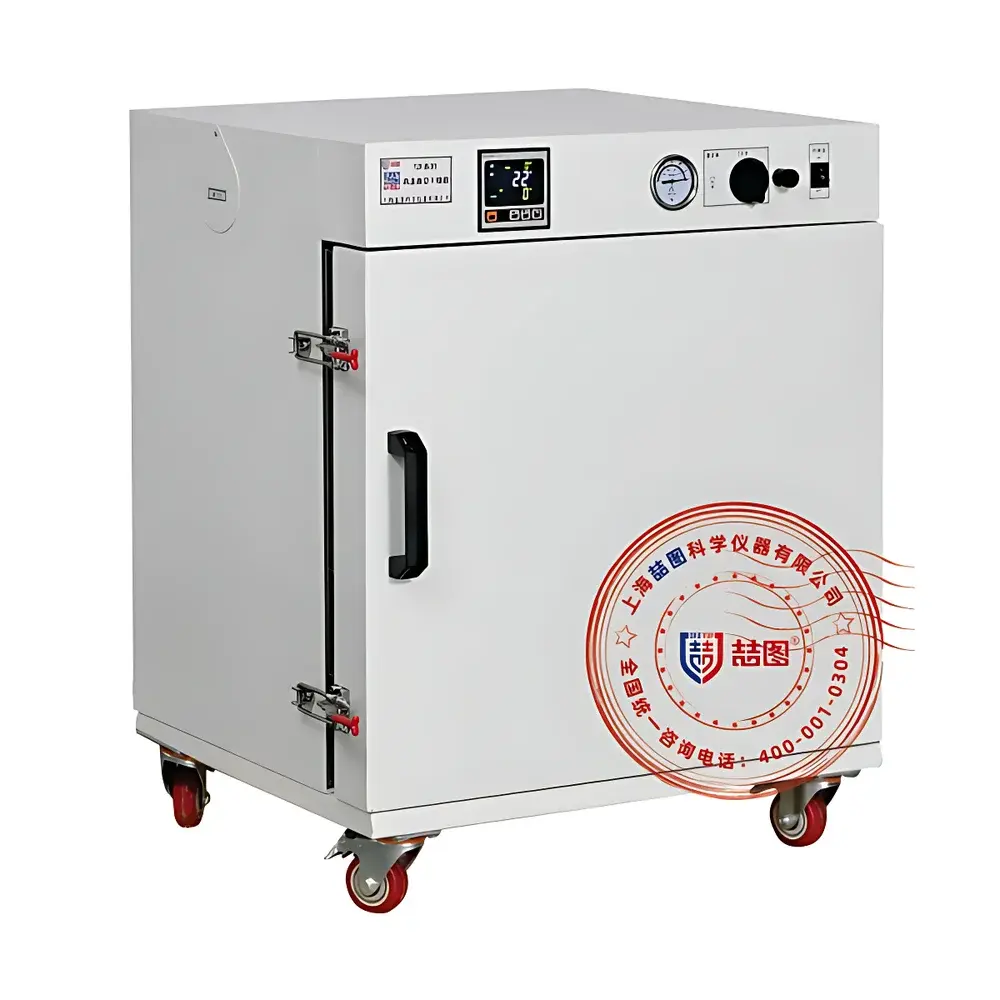
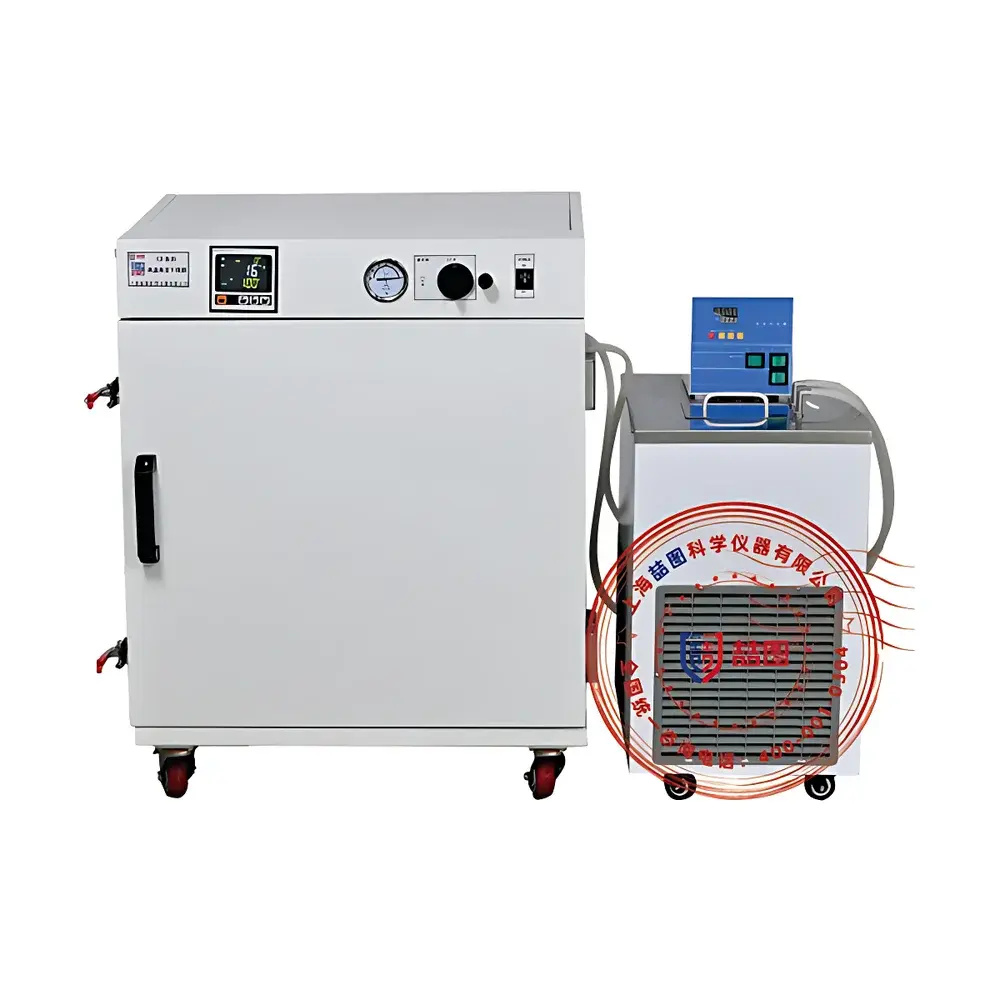
DRETOP UR4-90JVS Programmable High-Temperature Vacuum Drying Oven
| Brand | DRETOP |
|---|---|
| Origin | Shanghai, China |
| Manufacturer Type | Direct Manufacturer |
| Model | UR4-90JVS |
| Instrument Type | Vacuum Drying Oven |
| Temperature Range | RT+10 to 400 °C |
| Temperature Uniformity | ±1 °C |
| Temperature Fluctuation | ±1 °C |
| Temperature Resolution | 0.1 °C |
| Vacuum Level | ≤133 Pa |
| Internal Chamber Dimensions (W×D×H) | 450×450×450 mm |
| Chamber Material | Stainless Steel (AISI 304) |
| Heating Method | Forced-Air Circulation with Dual-Wall Insulation |
| Operating Ambient Temperature | 5–40 °C |
| Power Supply | AC 220 V / 50 Hz |
| Rated Power | 4000 W |
| Safety Features | Overtemperature Protection, Leakage Current Protection, Short-Circuit & Overload Protection, Parameter Memory Function |
Overview
The DRETOP UR4-90JVS Programmable High-Temperature Vacuum Drying Oven is an engineered solution for thermal processing under controlled low-pressure environments. It operates on the fundamental principle of vacuum-assisted drying—reducing ambient pressure to lower the boiling point of volatile components (e.g., solvents, moisture, or residual monomers), thereby enabling efficient, low-thermal-stress removal from heat-sensitive or oxidation-prone materials. Unlike conventional convection ovens, this system eliminates convective airflow inside the chamber, minimizing particle dispersion and mechanical disturbance—critical for powder metallurgy, ceramic green-body drying, semiconductor wafer baking, and cathode/anode electrode conditioning in lithium-ion battery R&D. Its operational envelope spans from ambient +10 °C up to 400 °C, with precise regulation maintained via a microprocessor-based PID controller, making it suitable for applications requiring strict thermal history control, such as annealing, degassing, curing, and inert-atmosphere stabilization.
Key Features
- Programmable dual-display controller: S-type split configuration featuring a digital vacuum gauge and high-resolution LCD temperature controller with real-time data logging capability.
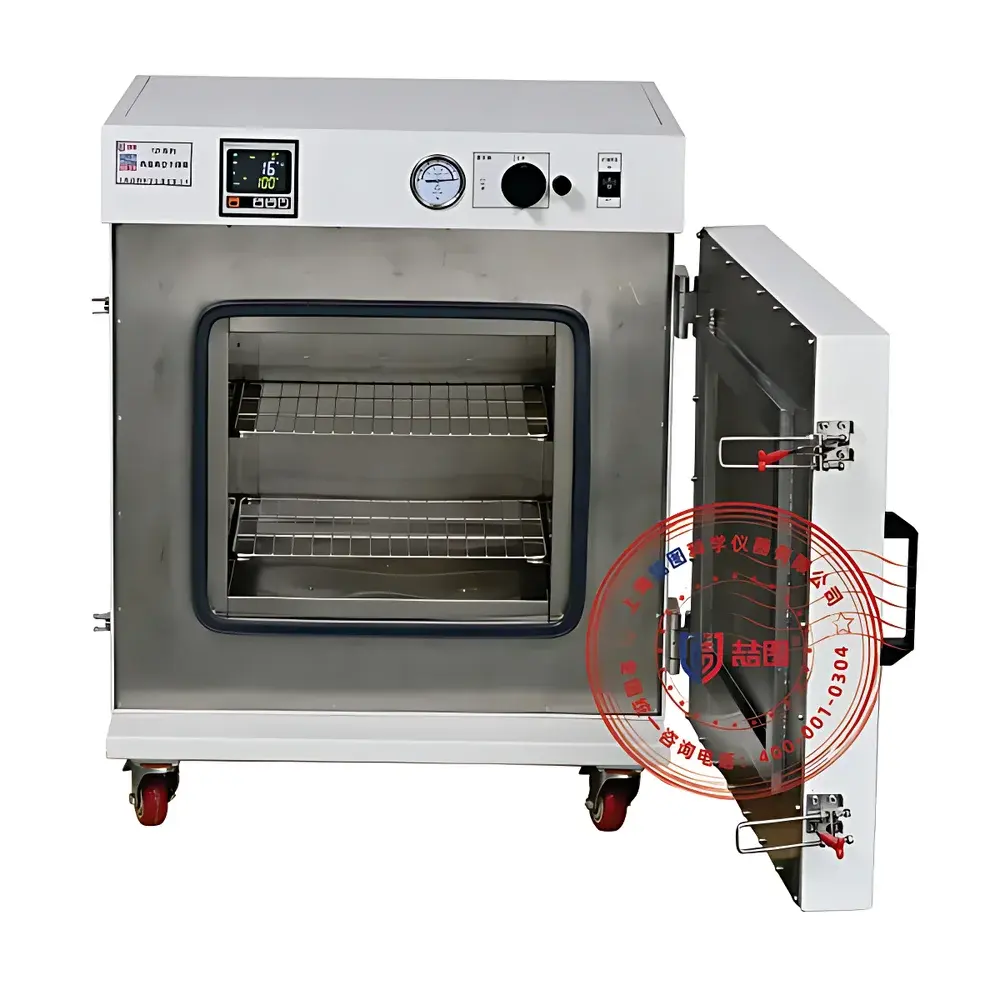
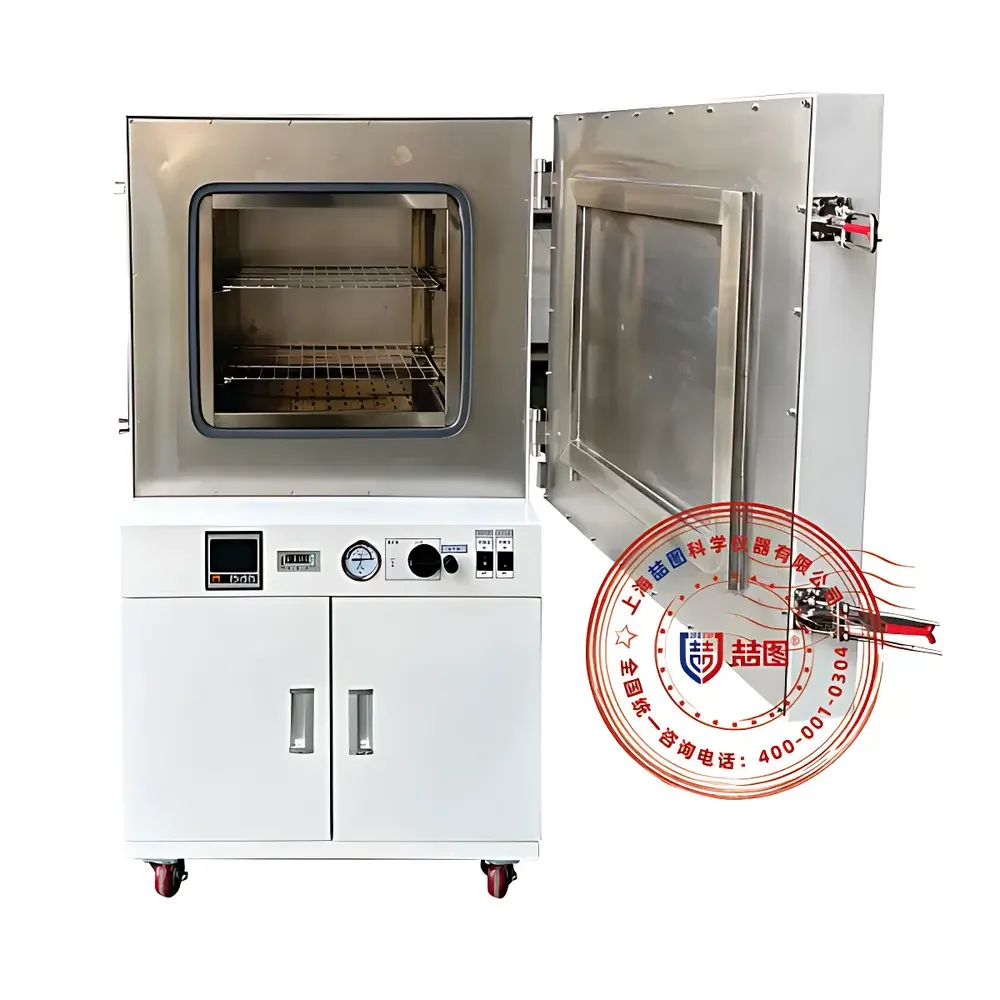
- Stainless steel (AISI 304) double-walled inner chamber with argon arc welding seams ensures structural integrity and long-term vacuum integrity; reinforced door seal with high-temperature silicone gasket and dual-stage rotary latch mechanism achieves uniform compression across the sealing surface.
- Integrated water-cooled jacket system cools vapor condensate at the chamber door interface, preventing thermal degradation of the sealing ring and sustaining stable vacuum performance over extended cycles.
- Forced-air circulation heating system with optimized duct design ensures rapid thermal response and uniform temperature distribution (±1 °C) throughout the 90 L working volume (450 × 450 × 450 mm).
- Comprehensive safety architecture includes overtemperature deviation alarm, parameter memory function for power interruption recovery, and multi-layer electrical protection (leakage current, short-circuit, overload, and thermal runaway safeguards).
- Tempered double-glazed observation window with anti-fog coating enables non-intrusive visual monitoring without compromising vacuum stability or thermal insulation.
Sample Compatibility & Compliance
The UR4-90JVS accommodates a broad range of sample formats—including powders, thin films, coated substrates, battery electrodes, ceramic precursors, and polymeric composites—without risk of oxidation, volatilization loss, or morphological distortion. Its vacuum environment (≤133 Pa) supports processes aligned with ASTM E145 (Standard Practice for Gravity-Convection and Forced-Ventilation Ovens), ISO 17025 traceability requirements for calibration, and GLP-compliant documentation workflows. When integrated with optional nitrogen purge modules and Q-type dual-stage condensate traps, it meets stringent moisture- and oxygen-control demands typical in photovoltaic cell fabrication and advanced packaging qualification per JEDEC J-STD-033. The stainless steel construction complies with FDA-recommended material standards for non-product-contact laboratory equipment.
Software & Data Management
The embedded controller supports up to 32 programmable steps per profile, with independent setpoints for temperature ramp rate, dwell time, vacuum hold duration, and inert gas introduction timing. All operational parameters—including actual chamber temperature, vacuum pressure, elapsed time, and fault codes—are timestamped and stored internally for ≥10,000 cycles. Optional RS485/Modbus RTU interface enables integration into centralized lab management systems (LIMS) and supports audit-trail generation compliant with 21 CFR Part 11 when paired with validated third-party software. Data export is available via USB flash drive in CSV format for post-processing in MATLAB, Python, or statistical analysis platforms.
Applications
- Battery R&D: Electrode drying and binder crosslinking under nitrogen/vacuum to prevent electrolyte decomposition and ensure consistent SEI formation.
- Semiconductor manufacturing: Wafer-level outgassing prior to thin-film deposition or encapsulation, minimizing void formation and interfacial delamination.
- Materials science: Thermal treatment of MOFs, aerogels, and nanocomposites where atmospheric oxidation must be avoided during solvent removal.
- Pharmaceutical development: Low-temperature drying of thermolabile APIs and excipients while preserving crystallinity and polymorphic stability.
- Aerospace component testing: Simulated vacuum bake-out of composite layups and adhesive-bonded assemblies to verify outgassing profiles per ECSS-Q-ST-70-02C.
- Environmental analysis: Preparation of soil/sediment samples for VOC extraction and heavy metal quantification under inert conditions.
FAQ
What vacuum level can the UR4-90JVS achieve, and how is it monitored?
The system achieves and maintains ≤133 Pa (1 Torr) using a certified two-stage旋片式 (rotary vane) vacuum pump; vacuum pressure is continuously displayed on a calibrated digital vacuum gauge with 1 Pa resolution.
Is the chamber atmosphere configurable for inert gas purging?
Yes—optional mass flow controllers and gas inlet ports support programmable N₂ or Ar purging sequences before, during, or after heating cycles.
How does the water-cooled jacket improve long-term reliability?
It reduces localized thermal stress at the door seal interface by dissipating latent heat from condensing vapors, extending gasket service life beyond 12,000 hours under continuous operation.
Can the UR4-90JVS be validated for GMP environments?
While the base unit is not pre-certified, its hardware architecture—including calibrated sensors, non-volatile memory, and deterministic control logic—supports IQ/OQ/PQ protocols when commissioned with third-party validation services.
What maintenance intervals are recommended for the vacuum pump and condensate trap?
The included rotary vane pump requires oil replacement every 500 operating hours; the J-type intermediate condensate trap should be drained after each high-moisture load and inspected quarterly for corrosion or clogging.



