
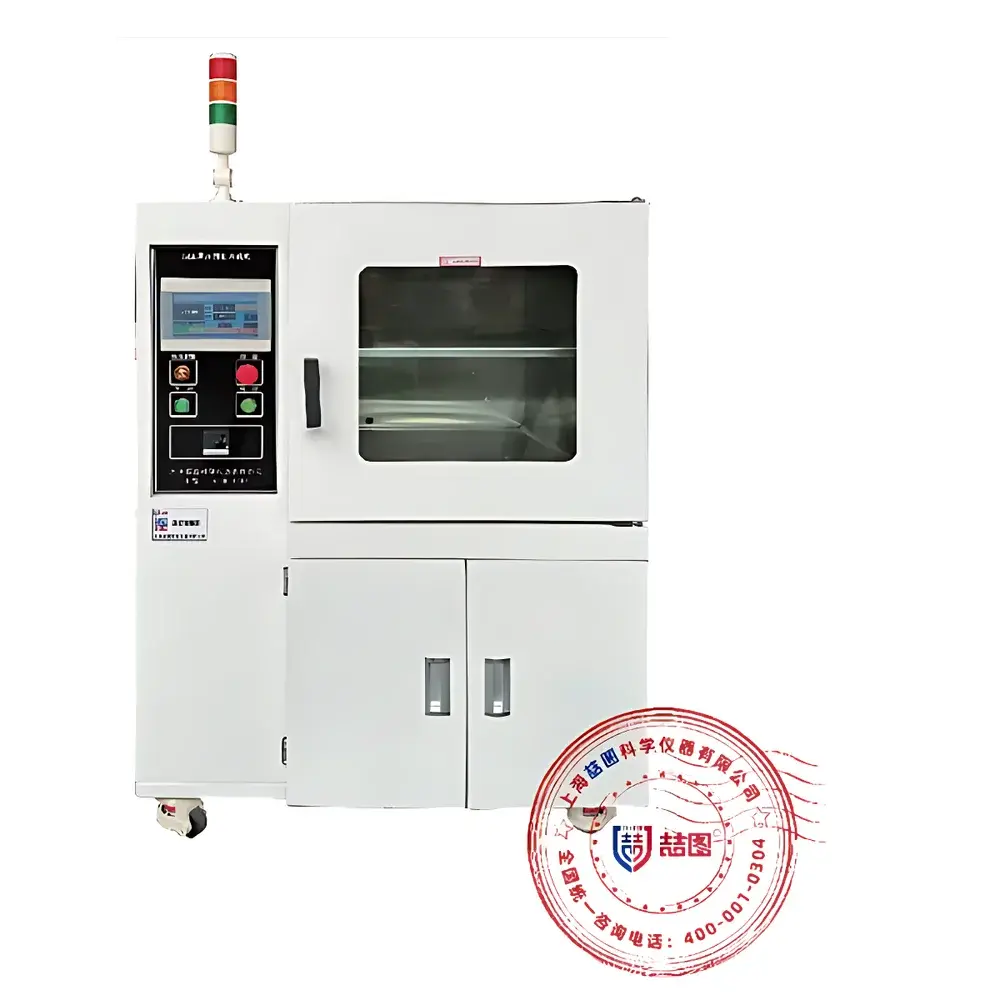
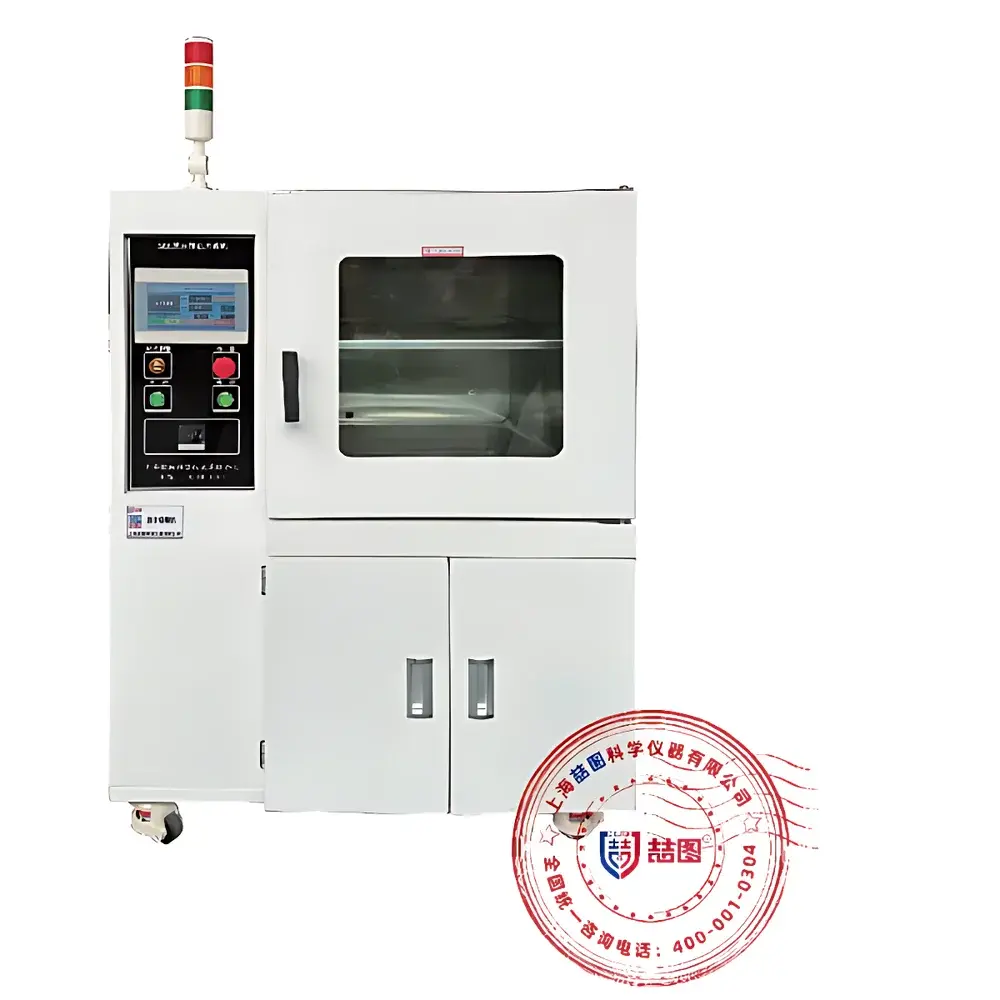
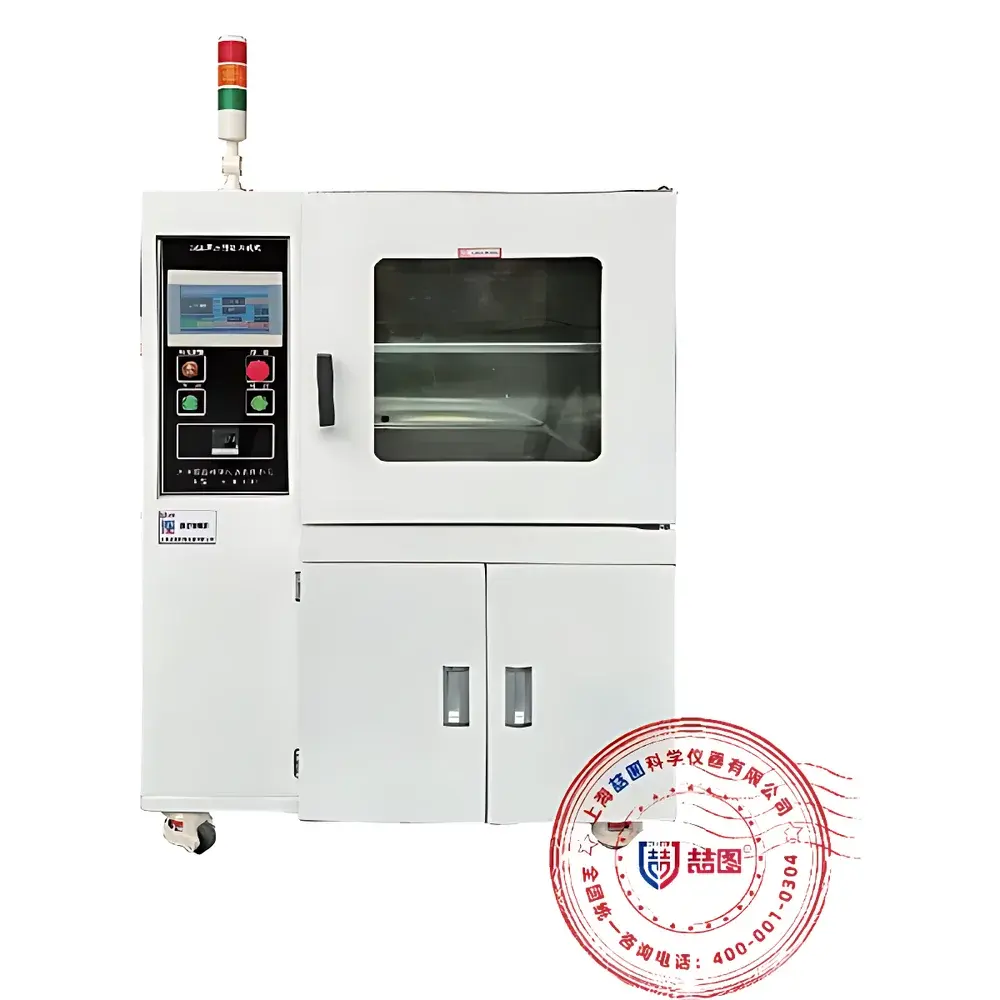
DRETOP VAC-Flux90 HMDS Vapor Priming System
| Brand | DRETOP |
|---|---|
| Origin | Shanghai, China |
| Manufacturer Type | Direct Manufacturer |
| Region Category | Domestic (China) |
| Model | VAC-Flux90 |
| Price Range | USD 1,400 – 8,500 |
| Power Supply | AC 220 V, 50 Hz |
| Control System | PLC-based Intelligent Touchscreen Interface |
| Temperature Range | RT +10 °C to 200 °C |
| Temperature Resolution | 0.1 °C |
| Temperature Uniformity | ±0.1 °C |
| Ultimate Vacuum | ≤133 Pa |
| Chamber Dimensions (W×D×H) | 450 × 450 × 450 mm |
| Internal Volume | 90 L |
| Sample Capacity | Up to 4 standard wafer cassettes (e.g., 25–50 × 100 mm or 4 × 150 mm wafers) |
| Shelf Configuration | 2-tier stainless steel adjustable trays |
| Construction | 304 stainless steel interior and exterior |
| Viewing Window | Tempered glass with silicone gasket seal |
| HMDS Delivery | Closed-loop, nitrogen-carrier vaporized dosing system |
| Exhaust Handling | Integrated vacuum-pump–coupled exhaust line for HMDS-laden vapor to dedicated abatement or scrubber system |
Overview
The DRETOP VAC-Flux90 HMDS Vapor Priming System is a precision-engineered vacuum-based surface modification platform designed for semiconductor R&D labs, MEMS fabrication facilities, and photolithography process development environments. It implements controlled hexamethyldisilazane (HMDS) vapor-phase priming under regulated thermal and vacuum conditions to convert hydrophilic silicon, glass, sapphire, GaAs, LiNbO₃, ceramic, and stainless-steel substrates into hydrophobic surfaces. This molecular-level surface functionalization forms a self-assembled monolayer of siloxane (Si–O–Si) bonds, significantly enhancing photoresist adhesion during spin-coating while reducing resist consumption and defect density. Unlike liquid dip or spray methods, the VAC-Flux90 delivers uniform, residue-free HMDS treatment in a fully enclosed, inert atmosphere—eliminating operator exposure, solvent waste, and ambient contamination. The system operates on a repeatable, programmable vacuum–purge–dose–reaction–vent cycle compliant with cleanroom-grade process control requirements.
Key Features
- PLC-driven automation with industrial-grade 7-inch color touchscreen HMI for intuitive recipe management, real-time parameter monitoring, and event logging.
- Precise thermal control across RT+10 °C to 200 °C with ±0.1 °C stability and 0.1 °C resolution, ensuring consistent HMDS reaction kinetics across batch loads.
- Double-sealed vacuum chamber constructed entirely from electropolished 304 stainless steel; includes tempered borosilicate viewing window with integrated silicone gasket for visual process verification without compromising integrity.
- Nitrogen-carrier HMDS vapor delivery system: HMDS liquid is metered into a heated nitrogen stream, generating stable, controllable vapor concentration—no direct liquid contact with substrates or chamber walls.
- Two-tier adjustable stainless steel sample trays accommodate up to four standard wafer cassettes (compatible with 100 mm, 150 mm, and custom-sized substrates); tray spacing optimized for laminar vapor flow and thermal uniformity.
- Integrated safety architecture: automatic over-temperature cutoff, vacuum interlock on door actuation, HMDS reservoir level sensing, and fail-safe exhaust routing to external abatement infrastructure.
Sample Compatibility & Compliance
The VAC-Flux90 supports a broad spectrum of rigid, thermally stable substrates used in microfabrication—including silicon wafers (bare, oxidized, or patterned), fused silica, quartz, alumina ceramics, stainless-steel masks, lithium niobate optical wafers, and sapphire substrates. All processing occurs within ISO Class 5–7 compatible environments when installed in controlled spaces. The system adheres to fundamental safety and operational principles outlined in IEC 61000-6-2 (EMC immunity), UL 61010-1 (lab equipment safety), and OSHA 29 CFR 1910.1200 (hazard communication). HMDS handling complies with GHS classification (Acute Tox. 4, Skin Irrit. 2, STOT SE 3) and supports traceability required under GLP and pre-production GMP workflows. Optional audit trail modules enable 21 CFR Part 11–compliant electronic records for regulated development labs.
Software & Data Management
The embedded PLC firmware stores up to 50 user-defined process recipes, each configurable with multi-step vacuum cycles (pump-down duration, N₂ purge count, dwell time at target pressure), temperature ramp/soak profiles, HMDS vapor injection timing and duration, and final vent sequence. All runtime data—including chamber pressure (via Pirani gauge), actual vs. setpoint temperature, HMDS delivery status, and door/open-event timestamps—are logged with millisecond resolution to internal non-volatile memory. USB export enables CSV-formatted reports for SPC analysis, CAPA documentation, or integration into MES platforms. Optional Ethernet/IP or Modbus TCP interfaces support remote monitoring and centralized fleet management in multi-tool cleanroom deployments.
Applications
- Pre-spin HMDS priming for positive and negative tone photoresists (e.g., AZ® series, SU-8, PMMA) to improve edge bead uniformity and reduce lift-off failures.
- Surface activation of low-k dielectrics (e.g., SiCOH) prior to metallization or etch mask deposition.
- Enhancing adhesion of polymer-based MEMS release layers and sacrificial films.
- In-situ dehydration and hydrophobic passivation of sensor substrates (e.g., piezoresistive cantilevers, optical waveguides) to minimize humidity-induced drift.
- Research-scale surface grafting studies using HMDS analogs (e.g., chlorosilanes) under analogous vacuum-thermal conditions.
FAQ
What substrates are compatible with the VAC-Flux90?
Silicon, SiO₂, fused quartz, sapphire, GaAs, LiNbO₃, alumina, stainless steel, and borosilicate glass—provided they withstand temperatures up to 200 °C and are vacuum-compatible.
Is HMDS consumed or recovered during operation?
HMDS is fully consumed in the surface reaction; unreacted vapor is removed via vacuum exhaust and must be routed to an appropriate chemical scrubber or abatement system per local environmental regulations.
Can the system be integrated into an automated wafer-handling line?
Yes—via optional SECS/GEM protocol support or discrete I/O signals for start/stop, door lock/unlock, and cycle completion handshake.
What maintenance is required for long-term reliability?
Quarterly inspection of silicone door gaskets, annual calibration of temperature and pressure sensors, and routine cleaning of the HMDS vaporizer nozzle and chamber interior using IPA-rinsed lint-free wipes.
Does the VAC-Flux90 meet semiconductor industry cleanliness standards?
The all-stainless construction, absence of organic seals or lubricants, and particle-free vapor delivery mechanism align with SEMI F21-0201 recommendations for low-particulate surface preparation tools.



