
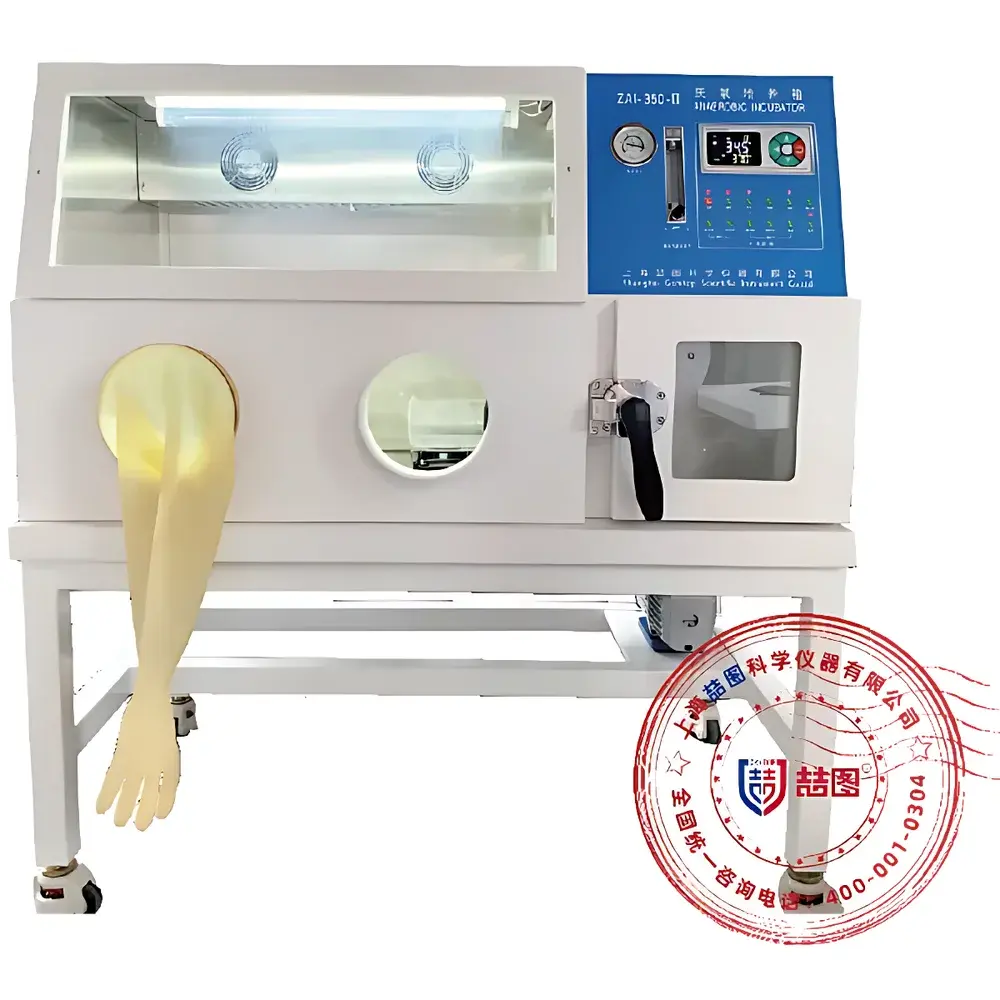
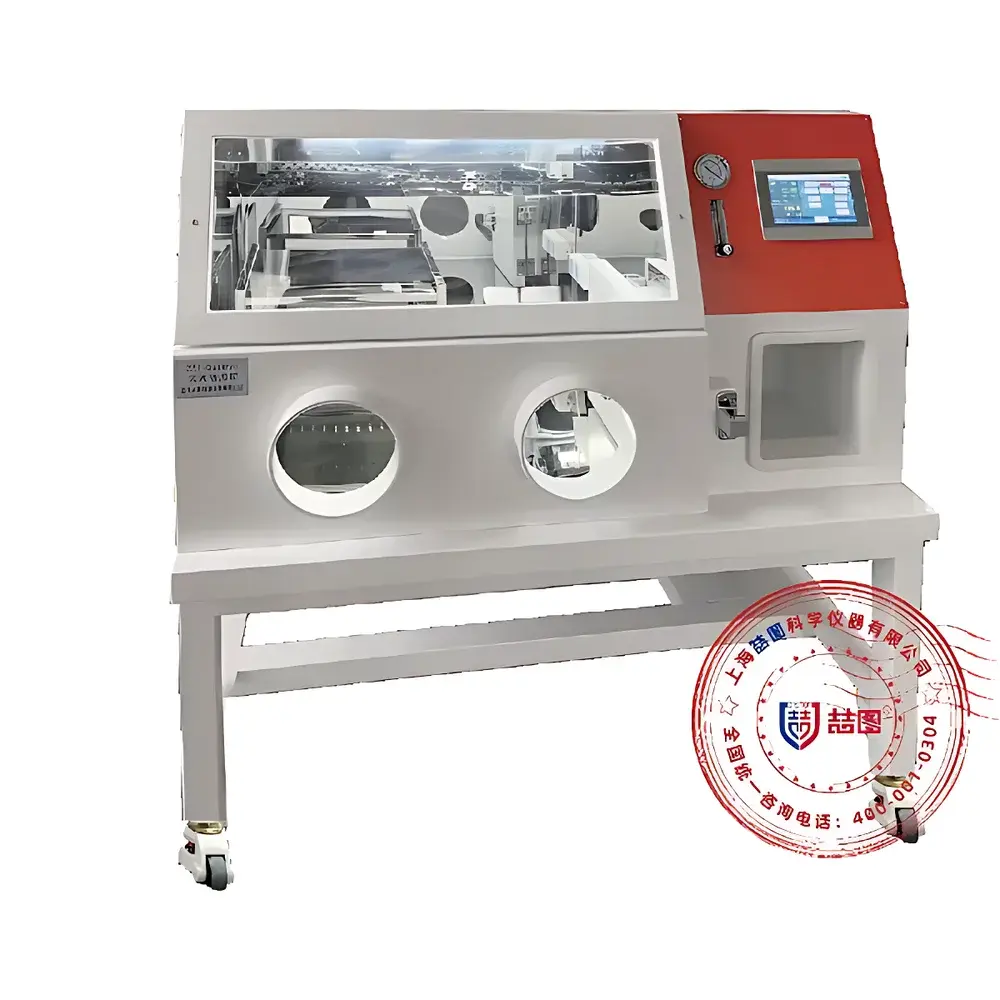
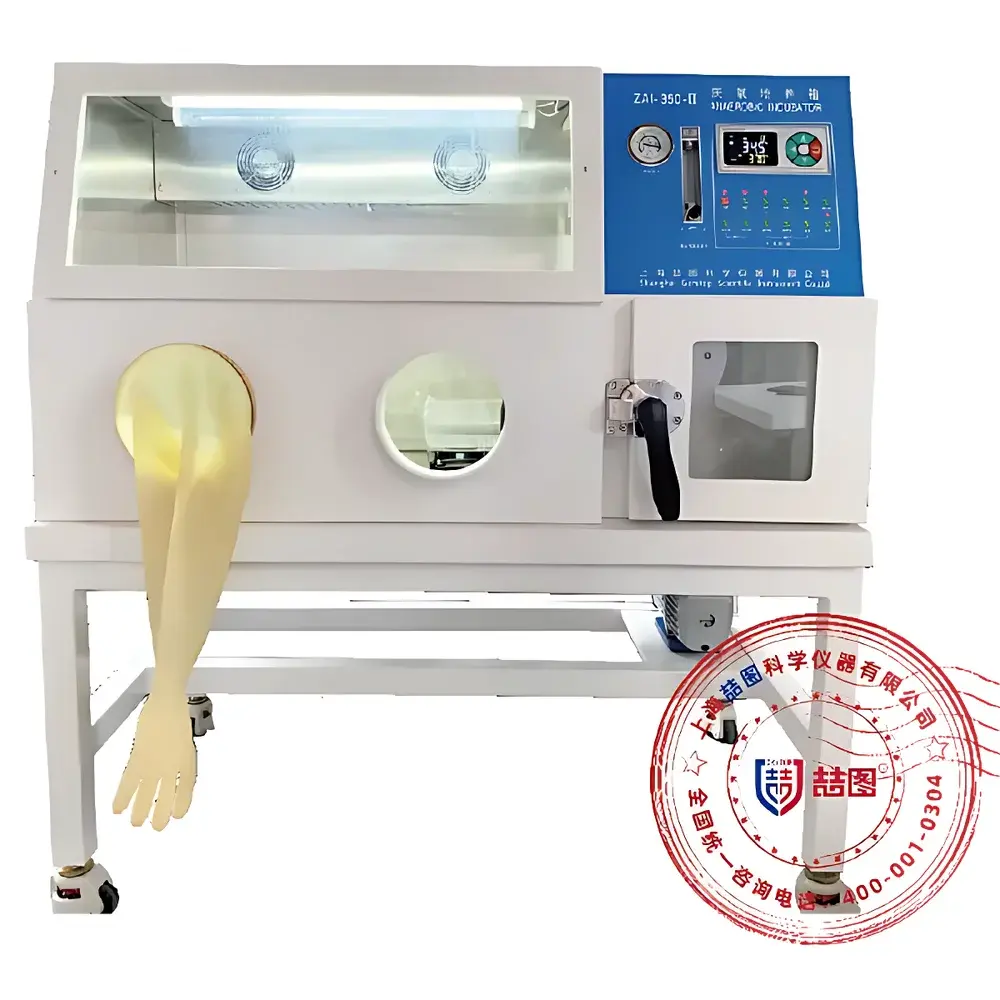
DRETOP ZAI-350-II Manual Anaerobic Incubator
| Brand | DRETOP |
|---|---|
| Origin | Shanghai, China |
| Manufacturer Type | Direct Manufacturer |
| Instrument Type | Manual Anaerobic Incubator |
| Model | ZAI-350-II |
| Temperature Range | RT+3°C to 60°C |
| Temperature Uniformity & Fluctuation | ±1°C |
| Oxygen Concentration Range | 0.1–20% (v/v) |
| Gas Supply Options | Single-gas (premixed anaerobic gas: 5% H₂ + 10% CO₂ + 85% N₂) or dual-gas (separate N₂ and premixed gas cylinders) |
| Chamber Dimensions (W×D×H) | 800 × 690 × 660 mm |
| Anaerobic Maintenance Duration | >12 h after gas supply cessation |
| Vacuum Pump | Oil-free dry diaphragm pump |
| Viewing Window | 12 mm tempered glass |
| Interior Material | 304 stainless steel |
| UV Sterilization | Integrated germicidal lamp |
| Control Interface | LCD display with touch-enabled operation (ZAI-350-II variant includes real-time O₂ % readout and local atmospheric pressure monitoring) |
Overview
The DRETOP ZAI-350-II Manual Anaerobic Incubator is an engineered environmental chamber designed for the cultivation and manipulation of obligate anaerobes, microaerophiles, and oxygen-sensitive cell cultures under precisely controlled low-oxygen or anaerobic conditions. It operates on a gas displacement principle—utilizing sequential vacuum evacuation and inert gas purging—to establish and sustain defined oxygen partial pressures within the working chamber. Unlike automated systems with continuous O₂ feedback loops, the ZAI-350-II employs manual gas flow regulation via tactile electromagnetic valves, enabling reproducible setup of anaerobic (≤1% O₂), microaerophilic (1–10% O₂), or customized gas atmospheres (e.g., 5% H₂ / 10% CO₂ / 85% N₂). Its thermally stable chamber—constructed from electropolished 304 stainless steel with high-density polyurethane insulation—maintains temperature uniformity of ±1°C across the full volume (800 × 690 × 660 mm), supporting applications ranging from clinical microbiology (e.g., Clostridium perfringens, Porphyromonas gingivalis, Campylobacter jejuni) to materials science requiring ultra-low oxygen environments (e.g., Li-ion battery electrode testing, OLED thin-film deposition).
Key Features
- Manual gas control architecture with tactile electromagnetic valves for precise, repeatable adjustment of N₂ and premixed gas flow rates—eliminating reliance on proprietary gas controllers or closed-loop sensors.
- Oil-free dry diaphragm vacuum pump ensures zero hydrocarbon contamination, critical for sterility-sensitive biological work and cleanroom-compatible material synthesis.
- Integrated 254 nm UV-C germicidal lamp (30 W) mounted inside the chamber provides routine decontamination between cycles; all internal surfaces are seamless 304 stainless steel for non-porous, corrosion-resistant cleaning.
- 12 mm thick tempered front viewing window offers optical clarity and mechanical resilience against accidental impact during glove-based manipulation.
- PID temperature controller with linear compensation and self-diagnostic routines delivers thermal stability within ±0.5°C fluctuation and ±1°C spatial uniformity—validated per ISO 13408-2 Annex C for incubator performance verification.
- Real-time O₂ concentration monitoring (0.1–20% range) displayed in percentage format; optional ppm-scale readout available via firmware upgrade for low-O₂ process validation.
Sample Compatibility & Compliance
The ZAI-350-II accommodates standard Petri dishes (up to 150 mm diameter), multi-well plates, culture flasks (T75/T175), and custom sample holders up to 400 × 300 × 280 mm. Its chamber geometry supports simultaneous handling of multiple isolates without cross-contamination risk due to laminar horizontal airflow design. The system complies with core requirements of CLSI M48-A2 (Methods for Antimicrobial Susceptibility Testing of Anaerobic Bacteria), USP (Sterility Tests), and ISO 11133:2014 (Microbiology of food and animal feeding stuffs—Guidelines for performance testing of culture media). While not FDA 21 CFR Part 11–compliant out-of-the-box (lacking electronic audit trail), its analog/digital hybrid interface permits integration with external LIMS via RS485 or USB for GLP/GMP-aligned documentation workflows.
Software & Data Management
The ZAI-350-II features embedded microcontroller firmware with non-volatile memory for parameter retention—including temperature setpoint, O₂ target, gas purge duration, and cycle history—enabling automatic recovery post-power interruption. Data logging is supported via optional USB export (CSV format) of time-stamped temperature and O₂ readings at user-defined intervals (1–60 min). For regulated environments, the unit can be interfaced with third-party SCADA platforms using Modbus RTU over RS485, facilitating centralized monitoring and alarm escalation. No proprietary software installation is required; configuration remains accessible through the front-panel touchscreen interface with intuitive icon-driven navigation.
Applications
- Clinical and research microbiology: isolation and subculture of fastidious anaerobes including Shigella spp., Bifidobacterium, and Actinomyces israelii.
- Hypoxia modeling: mammalian cell culture under physiologically relevant low-O₂ conditions (1–5% O₂) for cancer metabolism or stem cell differentiation studies.
- Industrial biotechnology: fermentation optimization for solventogenic clostridia and acetogenic bacteria requiring strict redox potential control.
- Materials science: inert-atmosphere conditioning of moisture- and oxygen-sensitive nanomaterials (e.g., perovskite precursors, sulfur cathodes) prior to electrochemical characterization.
- Quality control in pharmaceutical manufacturing: anaerobic sterility testing of parenteral products per USP and EP 2.6.1.
FAQ
What gas mixtures are compatible with the ZAI-350-II?
The system accepts either single-cylinder premixed gas (5% H₂ / 10% CO₂ / 85% N₂) or dual-cylinder configurations (pure N₂ + premixed gas), enabling flexible atmosphere tuning for hydrogen-dependent or CO₂-requiring organisms.
How long does it take to achieve anaerobic conditions?
The antechamber reaches ≤1% O₂ in ≤5 minutes; the main chamber achieves equivalent anaerobiosis in ≤50 minutes using three sequential vacuum/gas cycles.
Is the chamber humidity-controlled?
No—this model does not include active humidification; users must employ desiccants or saturated salt solutions within the chamber to manage relative humidity if required for specific protocols.
Can the unit be validated for GMP use?
Yes—its construction, temperature/O₂ repeatability, and documentation-ready interfaces support IQ/OQ/PQ execution per ASTM E2500 and EU Annex 15 guidelines when paired with external calibration hardware and procedural SOPs.
What safety mechanisms prevent overheating or oxygen ingress?
Dual independent thermal cutoffs (mechanical and electronic), audible/visual O₂ breach alarms, and automatic gas valve shutoff upon vacuum failure ensure fail-safe operation per IEC 61010-1.



