
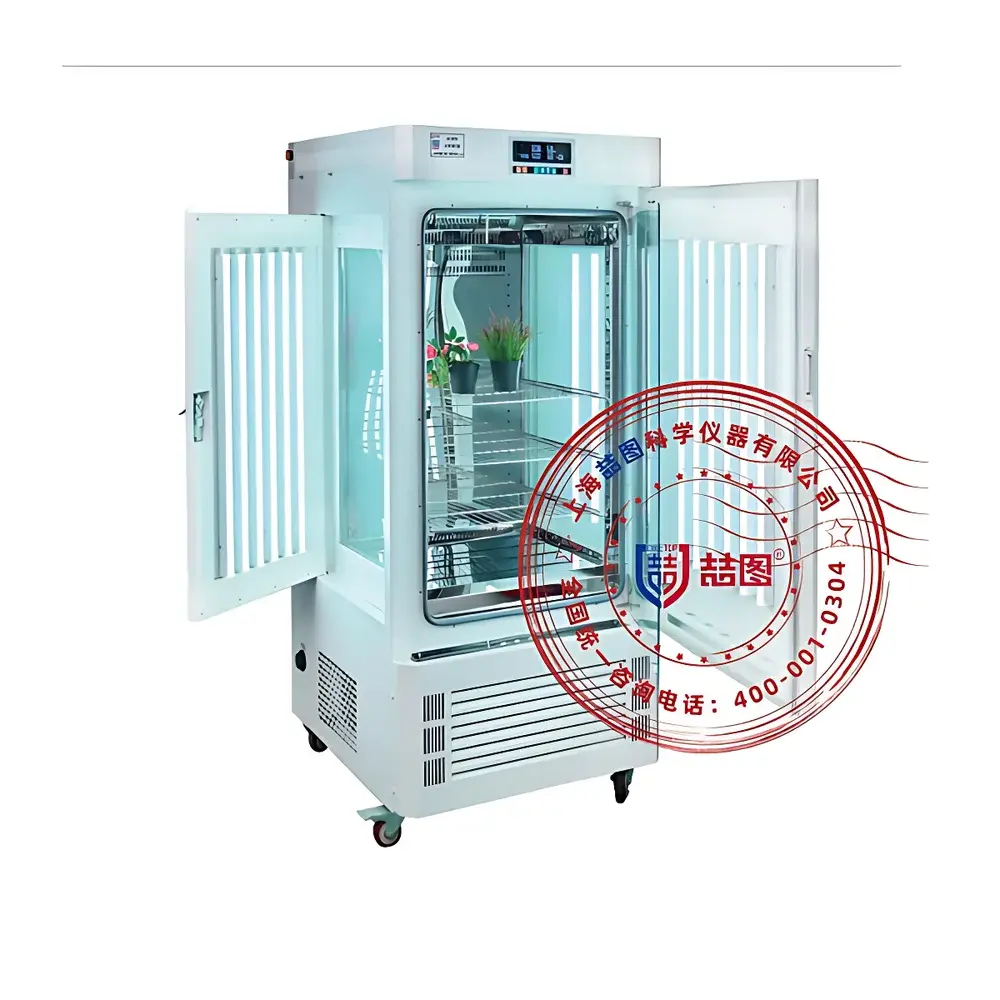
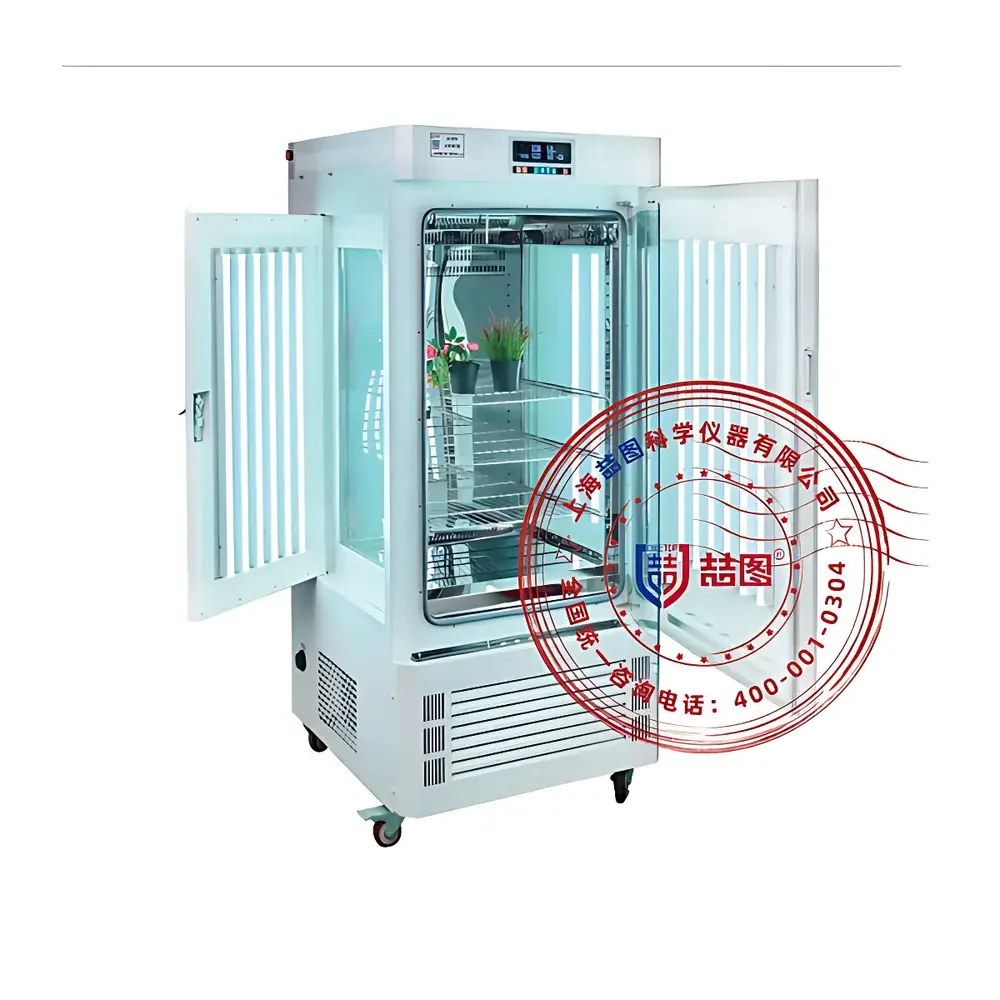
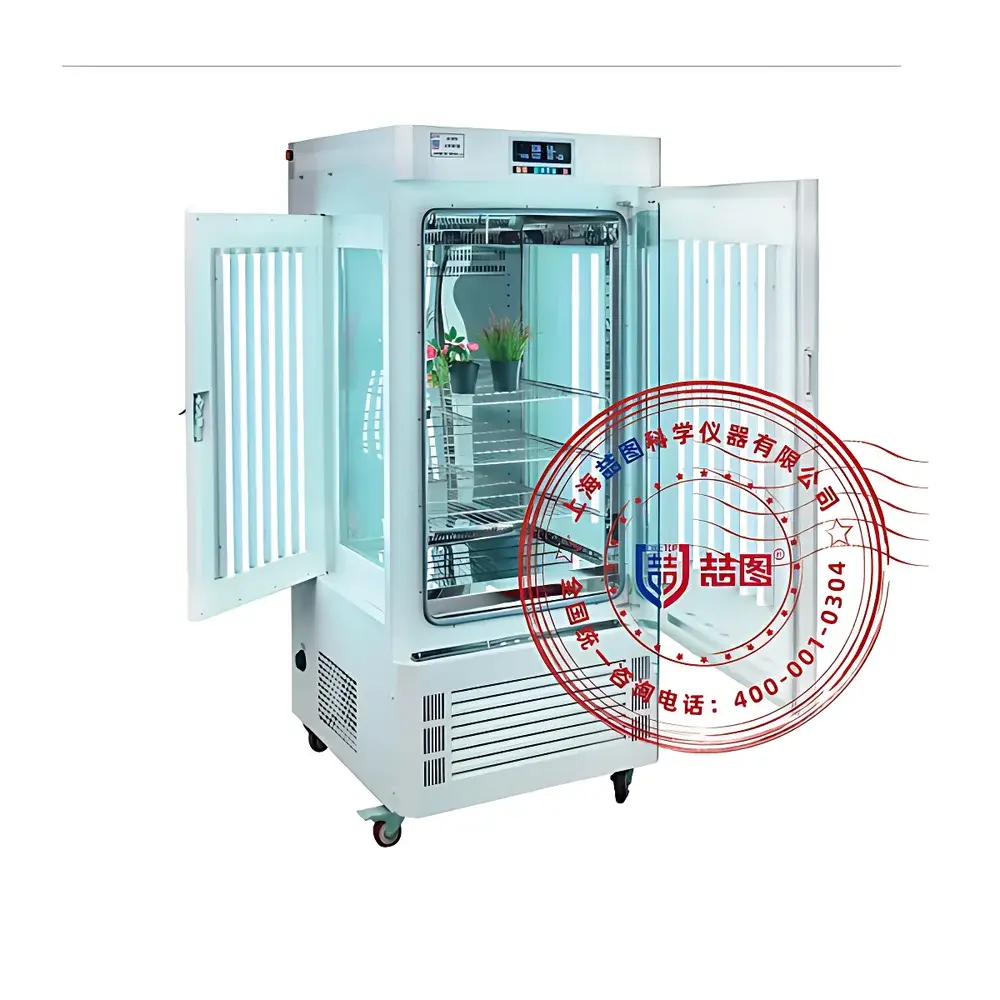
DRETOP ZGC-250-II Plant Growth Chamber
| Brand | DRETOP |
|---|---|
| Origin | Shanghai, China |
| Manufacturer Type | Direct Manufacturer |
| Model | ZGC-250-II |
| Illumination Mode | Dual-Side Illumination |
| Light Source | Fluorescent Lamp |
| Spectral Range | Visible Spectrum (400–700 nm) |
| Temperature Range | 10–65°C (with illumination), 0–65°C (without illumination) |
| Temperature Fluctuation | ±0.5°C |
| Temperature Uniformity | ±1.5°C |
| Illuminance Range | 0–12,000 lx |
| Illuminance Adjustment | 6-Step Stepwise Control |
| Capacity | 250 L |
| External Dimensions | 790 × 790 × 1585 mm |
| Power Supply | AC 220 V, 50 Hz |
| Input Power | 1350 W |
| Internal Dimensions | 580 × 500 × 850 mm |
| Shelf Quantity | 3 adjustable stainless-steel shelves |
| Standard Light | Cool White Fluorescent (Correlated Color Temperature ~6500 K) |
Overview
The DRETOP ZGC-250-II Plant Growth Chamber is a precision-engineered environmental control system designed for reproducible, long-term plant physiology studies, photobiological assays, and microbiological cultivation under controlled light and thermal conditions. It operates on the principle of active thermoelectric and compressor-based temperature regulation combined with programmable dual-side visible-spectrum illumination, enabling simulation of diurnal cycles and photomorphogenic stimuli critical for seed germination, vegetative growth, flowering induction, and stress response analysis. Engineered for laboratory-grade stability, the chamber maintains tight thermal setpoint fidelity (±0.5°C fluctuation) and spatial uniformity (±1.5°C across working volume), meeting baseline requirements for GLP-compliant botanical research and ISO 17025-aligned method validation protocols.
Key Features
- Microprocessor-controlled dual-stage temperature management with independent day/night setpoint programming across up to 30 time-segment cycles;
- Dual-side fluorescent illumination system delivering 0–12,000 lx at sample level, adjustable in six discrete intensity levels to emulate seasonal or canopy-depth light gradients;
- Stainless-steel interior chamber (580 × 500 × 850 mm) with three removable, height-adjustable shelves—optimized for autoclave-compatible cleaning and residue-free disinfection;
- Double-glazed observation window with magnetic door seal and tempered inner glass, minimizing thermal leakage and condensation during humidity-sensitive experiments;
- Energy-efficient R134a-free refrigerant system paired with nickel-chromium heating elements and axial-flow air distribution ducting for laminar internal convection;
- Intelligent safety architecture including power-failure memory retention, over-temperature alarm with relay output, compressor delay protection, and automatic restart after voltage recovery.
Sample Compatibility & Compliance
The ZGC-250-II accommodates standard petri dishes, multi-well plates, hydroponic trays, and potted seedlings up to 30 cm in height. Its visible-light spectrum (400–700 nm) supports photosynthetic photon flux density (PPFD)-correlated applications without UV or far-red emission—making it suitable for ASTM E2912-13 referenced photostability testing and USP plant tissue culture environments. While not certified to IEC 61000-4 electromagnetic compatibility standards out-of-the-box, its grounded chassis and shielded power input meet basic CE-conformant EMC prerequisites for non-medical lab use. Optional RS485 interface enables integration into centralized facility monitoring systems compliant with ISO/IEC 17025 Clause 5.9.2 for equipment interconnectivity traceability.
Software & Data Management
Equipped with a 30-segment programmable controller featuring full-screen parameter visualization, the unit logs real-time temperature and illuminance values internally for up to 30 days (non-volatile memory). Optional color touchscreen upgrade (T-series variant) adds graphical trend display for the preceding 60 minutes, LED lifespan estimation alerts, and configurable illumination deficiency alarms—triggered when cumulative low-light duration exceeds user-defined thresholds. Multi-level password protection supports three-tier access control (operator / supervisor / administrator), aligning with FDA 21 CFR Part 11 Annex 11 principles for audit-trail integrity in regulated botanical research workflows.
Applications
- Controlled-environment phenotyping of Arabidopsis thaliana, rice, maize, and legume mutants under standardized photoperiod regimes;
- BOD5 incubation per APHA Standard Methods 5210B, where stable 20°C ±0.5°C and dark/light cycling are required;
- Mycelial growth kinetics of Aspergillus spp., Penicillium spp., and Trichoderma spp. under defined spectral irradiance;
- Seed viability and germination rate assessment per ISTA Rules Section 6.2, including light-dependent dormancy break studies;
- Pre-acclimation trials for tissue-cultured orchids (e.g., Dendrobium, Phalaenopsis) prior to greenhouse transfer;
- Phototropic response quantification in etiolated coleoptiles using directional white-light gradients.
FAQ
Does the ZGC-250-II support custom spectral configurations beyond cool white fluorescent?
Yes—red (660 nm) and blue (450 nm) LED modules can be retrofitted as factory options to enable narrow-band photobiological stimulation, subject to mechanical compatibility verification with existing ballast and driver architecture.
Is relative humidity control available as a built-in function?
No—humidity regulation is not integrated; however, external humidifiers or desiccant modules may be connected via the optional 30 mm test port (G1/4″ BSP thread) with manual feedback loop implementation.
Can the unit operate continuously for extended durations (e.g., >30 days)?
Yes—the compressor duty cycle, thermal load distribution, and sealed refrigerant circuit are validated for unattended 24/7 operation under nominal ambient conditions (15–30°C room temperature, <70% RH).
What calibration documentation is supplied with delivery?
Each unit ships with a factory-verified temperature uniformity report (per ISO 16745 Annex C) and illuminance mapping certificate (traceable to NIM China primary standards), both valid for 12 months from commissioning date.
Is remote monitoring supported via Ethernet or Wi-Fi?
Native Ethernet/Wi-Fi is not included; however, the RS485 interface (optional) permits Modbus RTU communication with third-party SCADA platforms or building management systems using standard protocol converters.




