
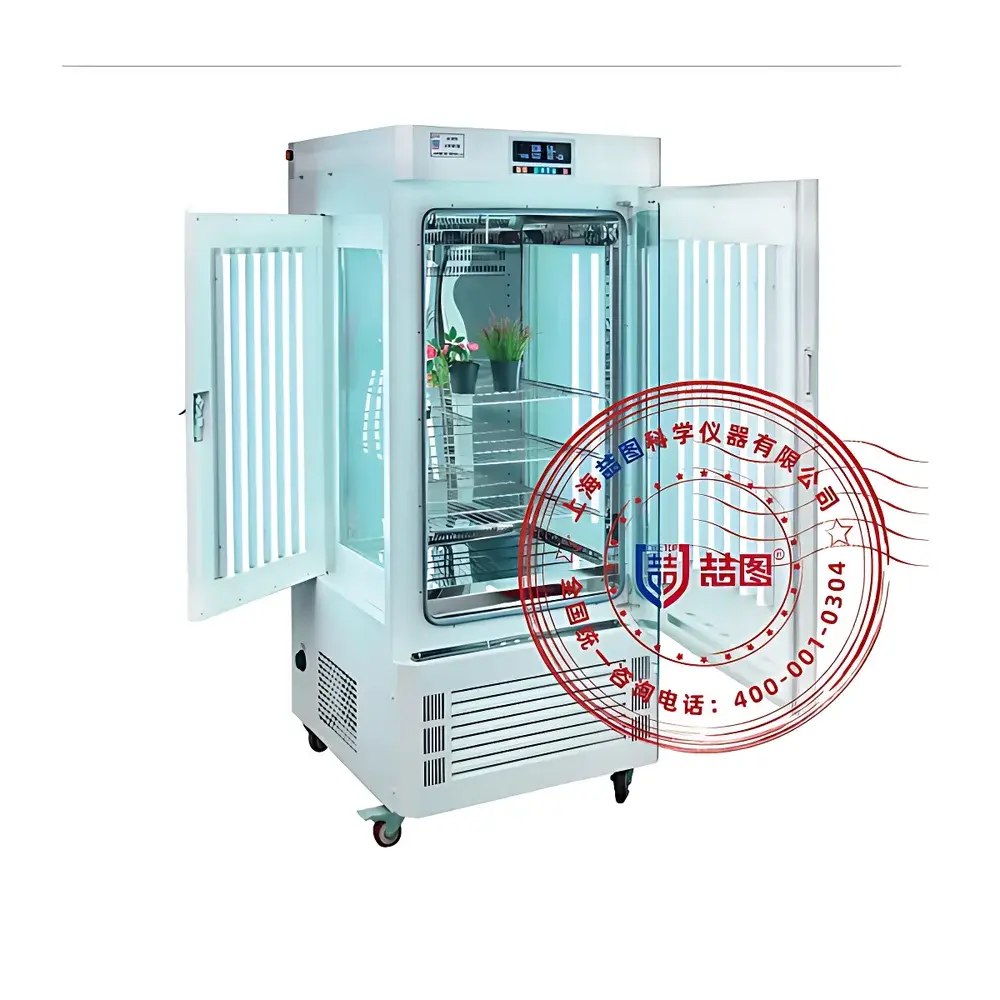
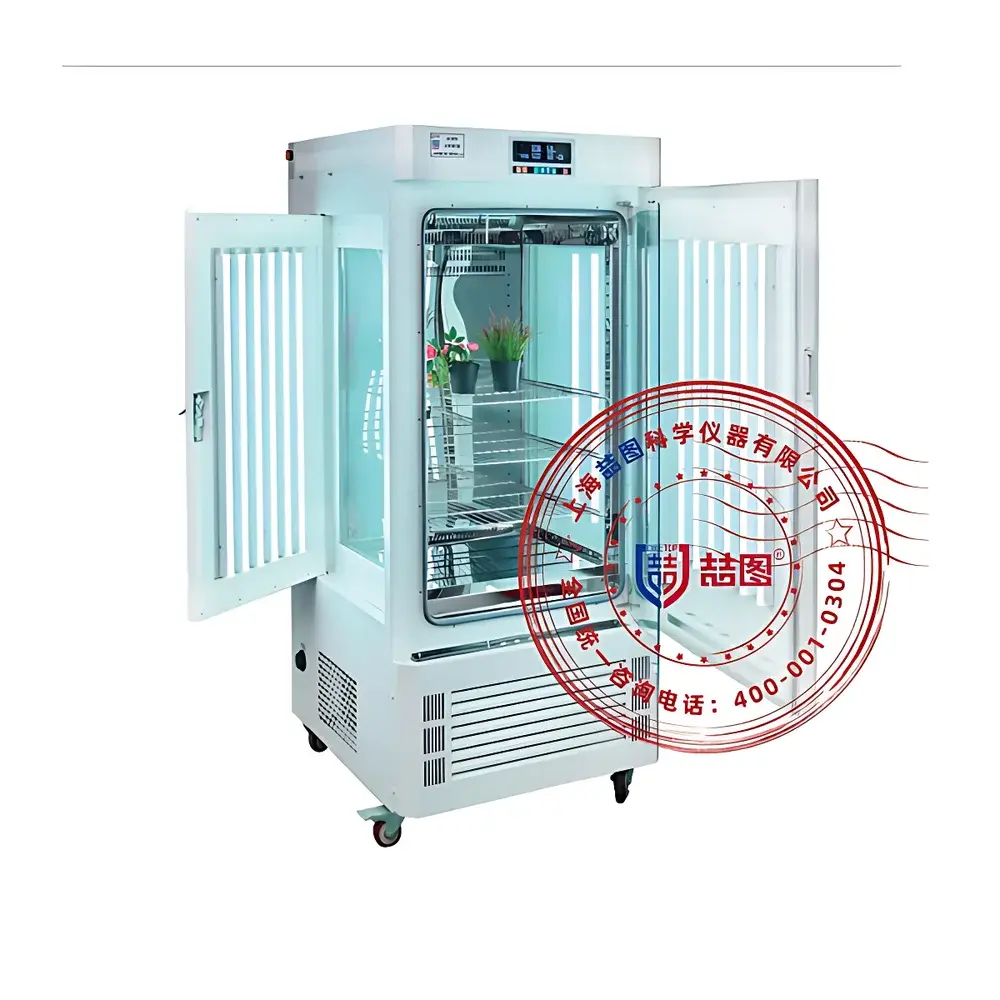
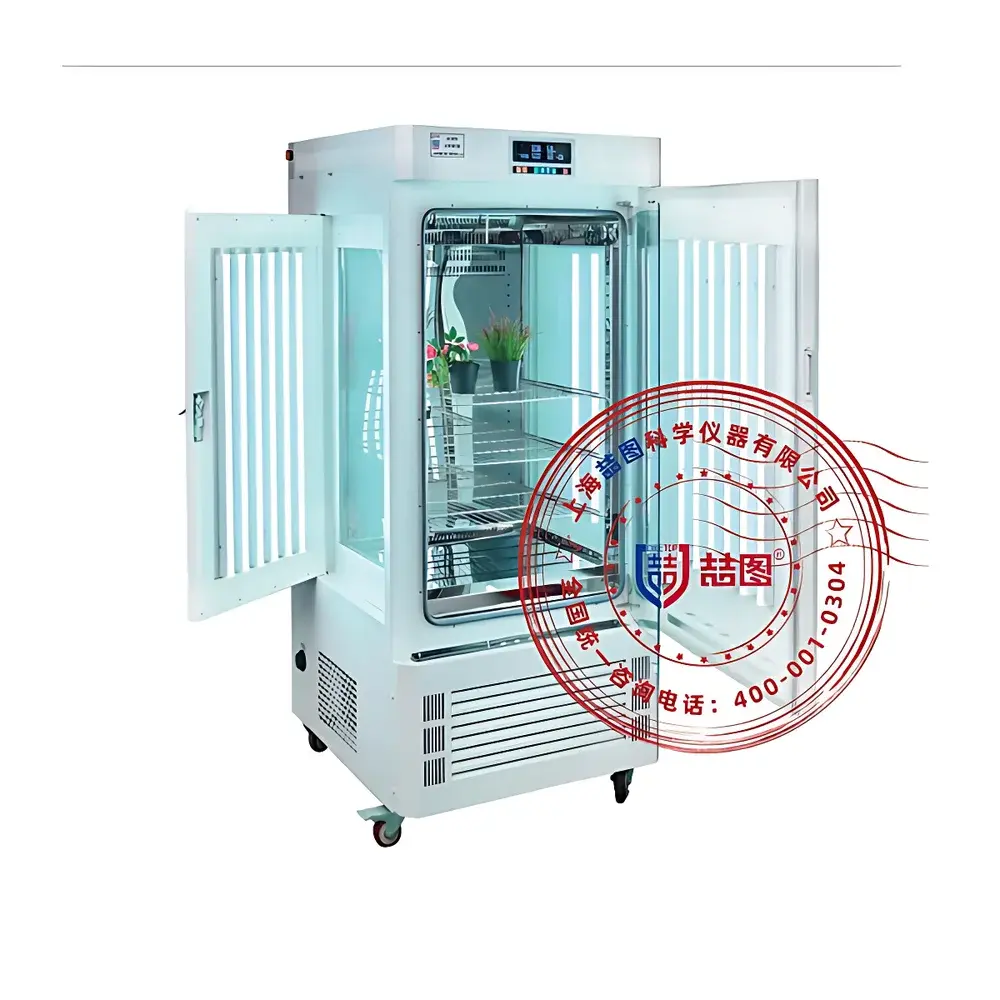
DRETOP ZGC-300T Plant Growth Chamber
| Brand | DRETOP |
|---|---|
| Origin | Shanghai, China |
| Manufacturer Type | Direct Manufacturer |
| Model | ZGC-300T |
| Illumination Method | Shelf-integrated illumination |
| Light Source | Fluorescent lamp |
| Spectral Range | Visible spectrum (400–700 nm) |
| Temperature Range | 10–65°C (with illumination), 0–65°C (without illumination) |
| Temperature Fluctuation | ±0.5°C |
| Temperature Uniformity | ±1.5°C |
| Illuminance Range | 0–20,000 lx |
| Illuminance Control | 6-step adjustable |
| Capacity | 300 L |
| External Dimensions (W×D×H) | 790 × 855 × 1675 mm |
| Power Supply | AC 220 V, 50 Hz |
| Input Power | 2,200 W |
| Interior Dimensions (W×D×H) | 580 × 550 × 950 mm |
| Shelving | 3 removable stainless-steel shelves |
| Standard Light | Cool-white fluorescent (correlated color temperature ~6500 K) |
| Optional Light Configurations | Red (660 nm) / Blue (450 nm) dual-band or full-spectrum LED modules |
Overview
The DRETOP ZGC-300T Plant Growth Chamber is a precision-engineered environmental control system designed for reproducible, long-term plant physiology studies, photobiological assays, and microbiological cultivation under controlled light and thermal conditions. Built upon the principles of radiant energy delivery and convective thermal regulation, it integrates programmable illumination with high-stability air-jacketed temperature control to emulate diurnal cycles and spectral environments essential for controlled-environment agriculture (CEA), seed germination trials, photomorphogenesis research, and BOD incubation. Unlike basic incubators, the ZGC-300T employs shelf-integrated fluorescent illumination—ensuring uniform photon flux distribution across sample planes without shadowing—and couples this with independent day/night temperature setpoint scheduling, enabling simulation of natural climatic rhythms critical for phenotypic consistency in model organisms (e.g., Arabidopsis thaliana, rice, lettuce) and commercial crops.
Key Features
- 30-segment programmable microprocessor controller supporting multi-stage time-temperature-light profiles, with automatic transition between day/night modes and real-time parameter logging.
- Shelf-mounted cool-white fluorescent lighting (standard), delivering 0–20,000 lx at sample level with six discrete intensity levels; optional red/blue LED modules available for wavelength-specific photobiological stimulation (660 nm for flowering/fruiting; 450 nm for vegetative growth and morphogenic control).
- Stainless-steel interior chamber (580 × 550 × 950 mm) with three fully adjustable, autoclavable shelves; reinforced cold-rolled steel exterior with magnetic door seal and double-glazed observation window for thermal integrity and visual monitoring.
- High-efficiency refrigeration system using R134a (CFC-free) refrigerant, paired with a branded hermetic compressor and intelligent start-delay protection to extend service life and ensure stable operation over extended duty cycles.
- Advanced airflow architecture: rear-mounted centrifugal fan with optimized internal ducting ensures laminar, low-turbulence circulation—achieving ±1.5°C temperature uniformity across the 300 L working volume per ISO 15262 and ASTM E1913-22 guidelines.
- Full-color capacitive touchscreen interface (T-series), supporting bilingual (English/Chinese) operation, password-protected multi-level access control, real-time trend visualization (last 60 min), and LED lifespan tracking with configurable alert thresholds.
Sample Compatibility & Compliance
The ZGC-300T accommodates standard petri dishes, multi-well plates, growth pots (up to 15 cm diameter), hydroponic trays, and microbiological culture vessels. Its design supports GLP-compliant workflows: all temperature and illumination setpoints are timestamped and stored in non-volatile memory; power-loss recovery preserves active programs and logged data. While not certified to IEC 61000-4 electromagnetic immunity standards out-of-box, the unit meets CE marking requirements for laboratory equipment (2014/30/EU EMC Directive and 2014/35/EU LVD). For regulated environments, optional RS485 communication enables integration into centralized building management systems (BMS) and third-party LIMS platforms compliant with FDA 21 CFR Part 11 audit-trail requirements when paired with validated software.
Software & Data Management
The embedded controller records temperature, illuminance, and operational status at user-defined intervals (1–60 min). Data export is supported via USB flash drive (CSV format) or optional RS485-to-Ethernet gateway. The touchscreen interface provides on-device graphing, alarm history review, and firmware update capability. No cloud dependency or proprietary desktop application is required—raw logs are human-readable and compatible with MATLAB, Python (pandas), or JMP for statistical analysis. Audit trail functionality includes operator ID tagging (via login), parameter change timestamps, and event-triggered logging (e.g., door-open duration, over-temperature excursions).
Applications
- Plant phenotyping under defined photoperiods and spectral quality (e.g., shade avoidance response, circadian entrainment, phototropism assays).
- Controlled germination testing per ISTA Rules and AOSA Standards for seed viability and vigor assessment.
- BOD5 incubation per APHA Standard Methods 5210B, maintaining 20.0 ± 0.5°C in darkness for biochemical oxygen demand measurement.
- Mycological culture of filamentous fungi (e.g., Aspergillus, Penicillium) and yeast under variable light regimes to study conidiation and secondary metabolism.
- Algal growth optimization in photobioreactor pre-screening, including spectral tuning for chlorophyll-a vs. phycocyanin synthesis.
- Educational use in undergraduate botany and environmental science labs for inquiry-based experiments on light-dependent physiological responses.
FAQ
What is the maximum illuminance achievable at the top shelf?
The rated output is 20,000 lx measured at the center of the uppermost shelf under standard white fluorescent configuration; values decrease by ≤12% at lower shelves due to inverse-square attenuation.
Can the chamber operate in total darkness while maintaining temperature stability?
Yes—the lighting system is electrically isolated from thermal control; darkness mode maintains ±0.5°C fluctuation across the full 0–65°C range.
Is humidity control available as a factory option?
No—humidity is not integrated into the ZGC-300T platform. For hygrothermal studies, users must employ external humidification/dehumidification modules with feedback coupling via the RS485 interface.
What safety certifications does the unit carry?
It complies with GB 4793.1-2019 (China’s safety standard for electrical equipment in laboratories) and bears CE marking for EMC and Low Voltage Directive conformity.
How is calibration traceability established?
Factory calibration uses NIST-traceable dry-block calibrators (±0.1°C) and calibrated lux meters (±3%); users may perform field verification using Class L photometers and PT100 reference probes.




