
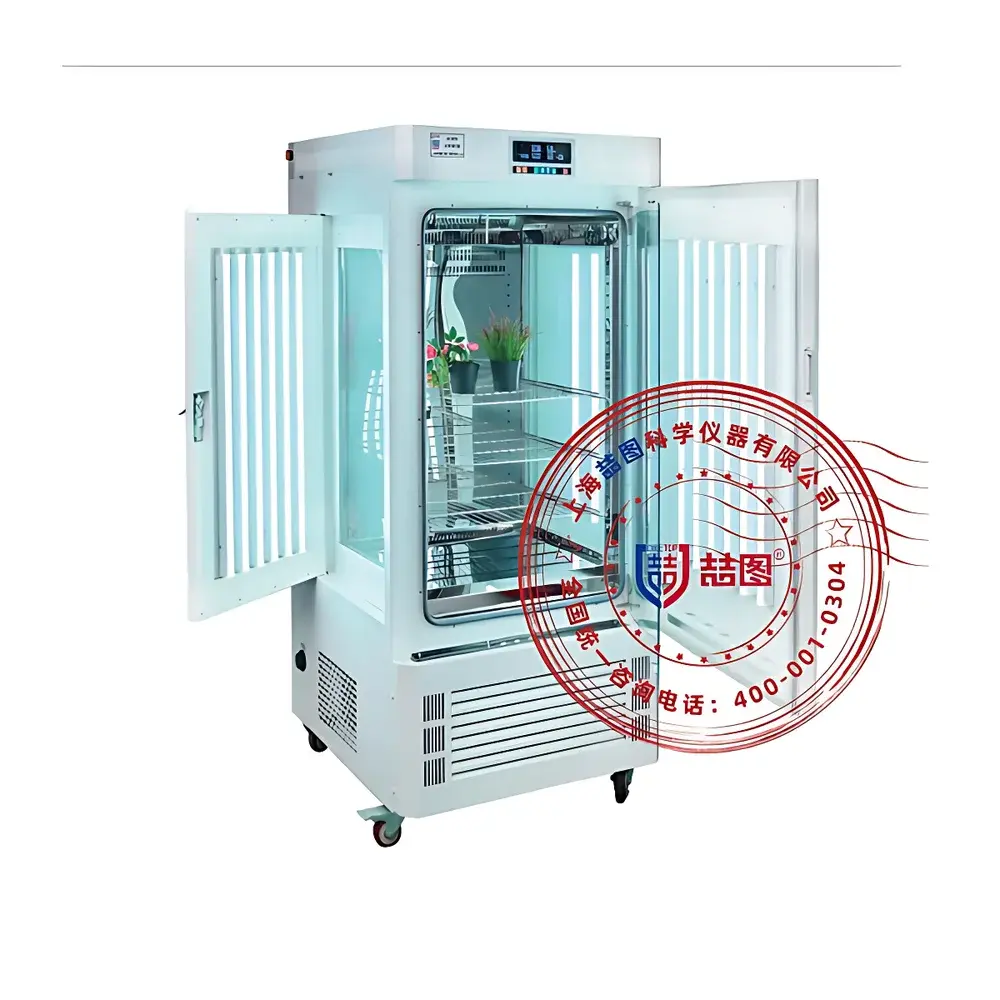
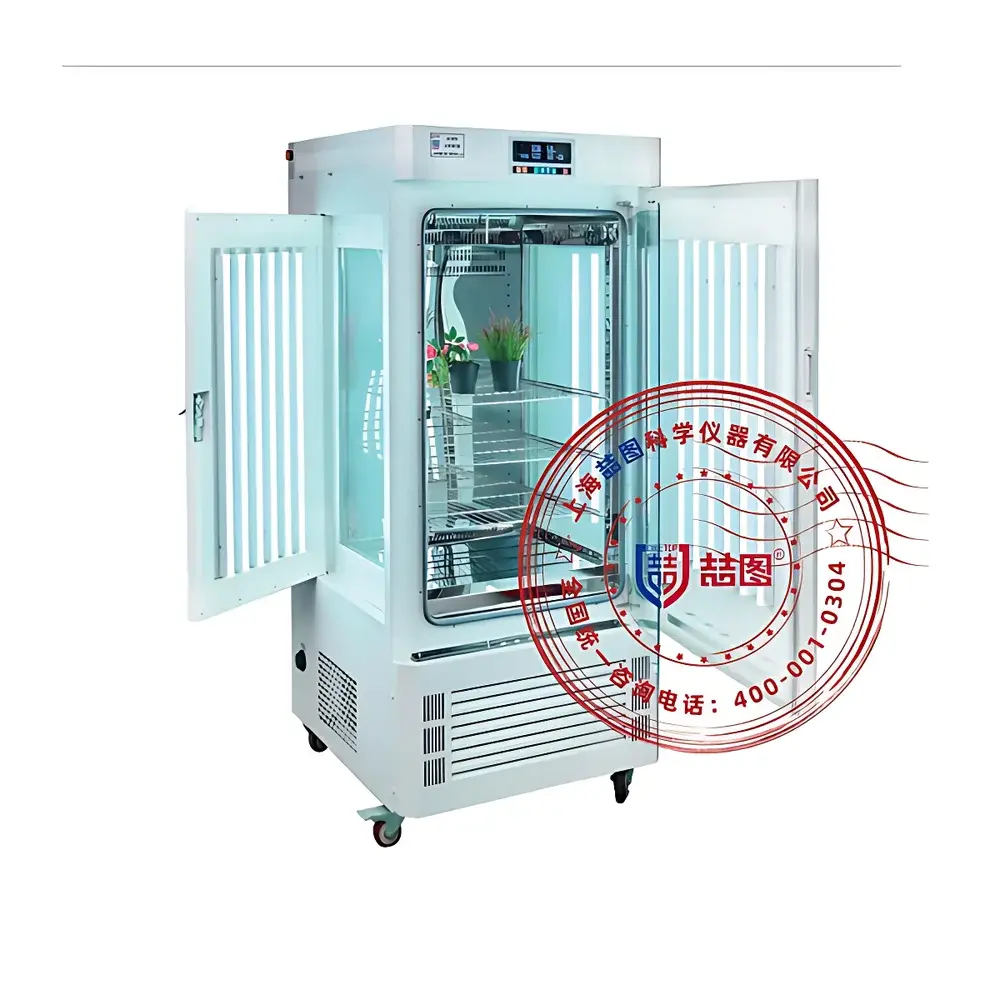
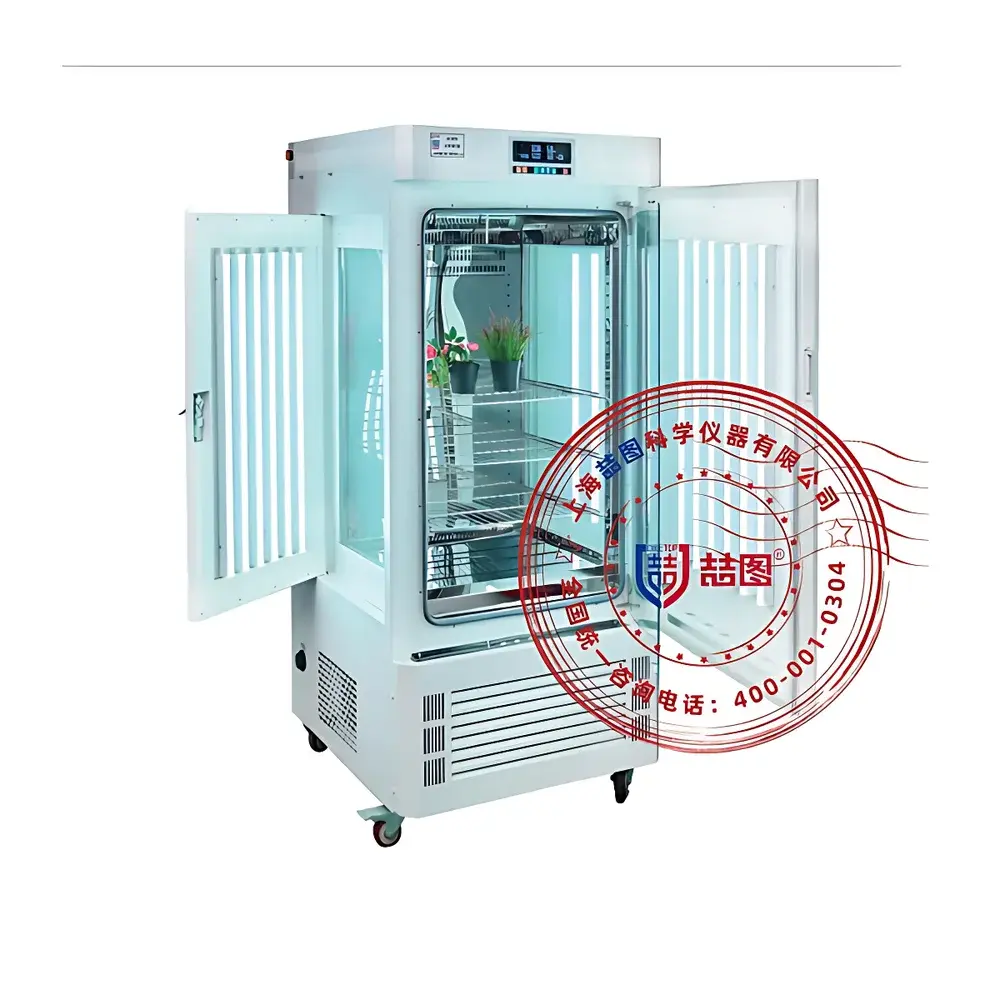
DRETOP ZGC-350-II Plant Growth Chamber
| Brand | DRETOP |
|---|---|
| Origin | Shanghai, China |
| Manufacturer Type | Direct Manufacturer |
| Model | ZGC-350-II |
| Illumination Mode | Dual-Side Illumination |
| Light Source | Fluorescent Lamps |
| Spectral Range | Visible Spectrum (400–700 nm) |
| Temperature Control Range | 10–65°C (with illumination), 0–65°C (without illumination) |
| Temperature Fluctuation | ±0.5°C |
| Temperature Uniformity | ±1.5°C |
| Illuminance Range | 0–15,000 lx |
| Illuminance Adjustment | 6-Step Stepwise Control |
| Capacity | 350 L |
| External Dimensions (W×D×H) | 805 × 775 × 1640 mm |
| Power Supply | AC 220 V, 50 Hz |
| Input Power | 1900 W |
| Internal Dimensions (W×D×H) | 580 × 500 × 850 mm |
| Shelf Capacity | 3 Adjustable Stainless Steel Shelves |
| Standard Light Color | Cool White Fluorescent (Customizable Red/Blue LED Modules Available) |
Overview
The DRETOP ZGC-350-II Plant Growth Chamber is a precision-engineered environmental control system designed for reproducible, long-term plant physiology studies, photobiological assays, seed germination trials, and microbial culture under controlled light and thermal conditions. Built upon the Couette-type air circulation principle with optimized laminar flow distribution, it maintains stable thermal gradients and uniform irradiance across the entire growth volume. Its dual-side illumination architecture—paired with spectrally balanced fluorescent arrays—enables simulation of natural diurnal cycles and supports quantitative photosynthetic response measurements in accordance with ASTM E2937-22 (Standard Guide for Photobiological Testing) and ISO 17025-accredited laboratory practices. The chamber operates within defined climatic envelopes compliant with GLP requirements for environmental monitoring in regulated botanical research.
Key Features
- Microprocessor-based 30-segment programmable controller with real-time display of temperature, illuminance, and operational status—supports autonomous execution of multi-phase growth protocols.
- Dual-side fluorescent illumination system delivering 0–15,000 lx adjustable output across six discrete intensity levels; spectral output centered in the PAR (Photosynthetically Active Radiation) band (400–700 nm).
- High-efficiency refrigeration circuit employing R134a-free eco-friendly refrigerant and a digitally modulated hermetic compressor with built-in start-delay and cycle-interval protection to extend service life.
- Stainless steel interior (304 grade) with removable, height-adjustable shelves; rounded internal corners and seamless welds minimize microbial retention points and simplify sterilization.
- Double-glazed observation window with magnetic door seal and tempered inner glass ensures thermal integrity while enabling non-intrusive visual monitoring without compromising chamber stability.
- Robust cold-rolled steel outer housing with powder-coated finish; integrated omnidirectional casters with locking mechanism for secure repositioning in shared laboratory spaces.
Sample Compatibility & Compliance
The ZGC-350-II accommodates standard plant growth vessels—including Petri dishes, Magenta boxes, hydroponic trays, and multi-tiered rack systems—within its 580 × 500 × 850 mm usable chamber volume. Its temperature and illumination profiles meet the operational specifications required for OECD Test Guidelines 208 (Terrestrial Plant Test) and US EPA OPPTS 850.4400 (Seed Germination/Early Seedling Growth). Optional red/blue LED modules (660 nm ± 5 nm and 450 nm ± 5 nm peak wavelengths) are available for wavelength-specific photomorphogenesis studies, supporting experimental designs aligned with CIE S 026/E:2019 photobiological safety standards. All electrical components comply with IEC 61010-1:2010 for laboratory equipment safety.
Software & Data Management
The chamber’s embedded controller logs timestamped temperature and illuminance data at user-defined intervals (1 min to 24 h), storing up to 30 days of continuous records internally. Optional RS485 interface enables integration with third-party SCADA or LIMS platforms via Modbus RTU protocol. Audit trail functionality—including operator ID tagging, parameter change logging, and power-loss recovery—supports compliance with FDA 21 CFR Part 11 when paired with validated external software. Firmware updates are performed via USB port without requiring disassembly or service technician intervention.
Applications
- Controlled-environment phenotyping of model species (Arabidopsis thaliana, Oryza sativa) under standardized photoperiods and thermoperiods.
- BOD incubation and microbial colony enumeration per APHA Standard Methods 5210B, where consistent ambient lighting eliminates observer bias during plate reading.
- Seed viability testing and dormancy-breaking experiments requiring precise light/dark cycling and sub-ambient chilling phases.
- Pre-clinical evaluation of phytochemical production in medicinal plants (e.g., Phyllanthus amarus, Dendrobium officinale) under spectral tuning conditions.
- Validation of photostability protocols for pharmaceutical excipients per ICH Q1B guidelines using calibrated irradiance exposure routines.
FAQ
What is the maximum allowable ambient room temperature for stable operation?
The unit is rated for continuous operation in environments up to 32°C ambient, provided minimum clearance of 15 cm is maintained on all sides for heat dissipation.
Can humidity be controlled in this model?
Humidity control is not integrated into the ZGC-350-II base configuration; however, optional external humidification/dehumidification modules can be interfaced via analog 0–10 V control signals.
Is calibration certificate included with shipment?
A factory-issued NIST-traceable temperature calibration report is supplied; illuminance sensor calibration requires periodic verification using a handheld PAR meter meeting ISO/IEC 17025 accreditation criteria.
How is light uniformity validated across the chamber volume?
Illuminance mapping is performed at nine standardized grid points (per ASTM E308-22 Annex A3) during final quality assurance; deviation from mean value remains ≤ ±8% at working plane level.
What safety protections prevent condensation damage during low-temperature operation?
An adaptive defrost algorithm activates based on evaporator coil temperature and runtime history, preventing frost accumulation without interrupting chamber stability or requiring manual intervention.




