
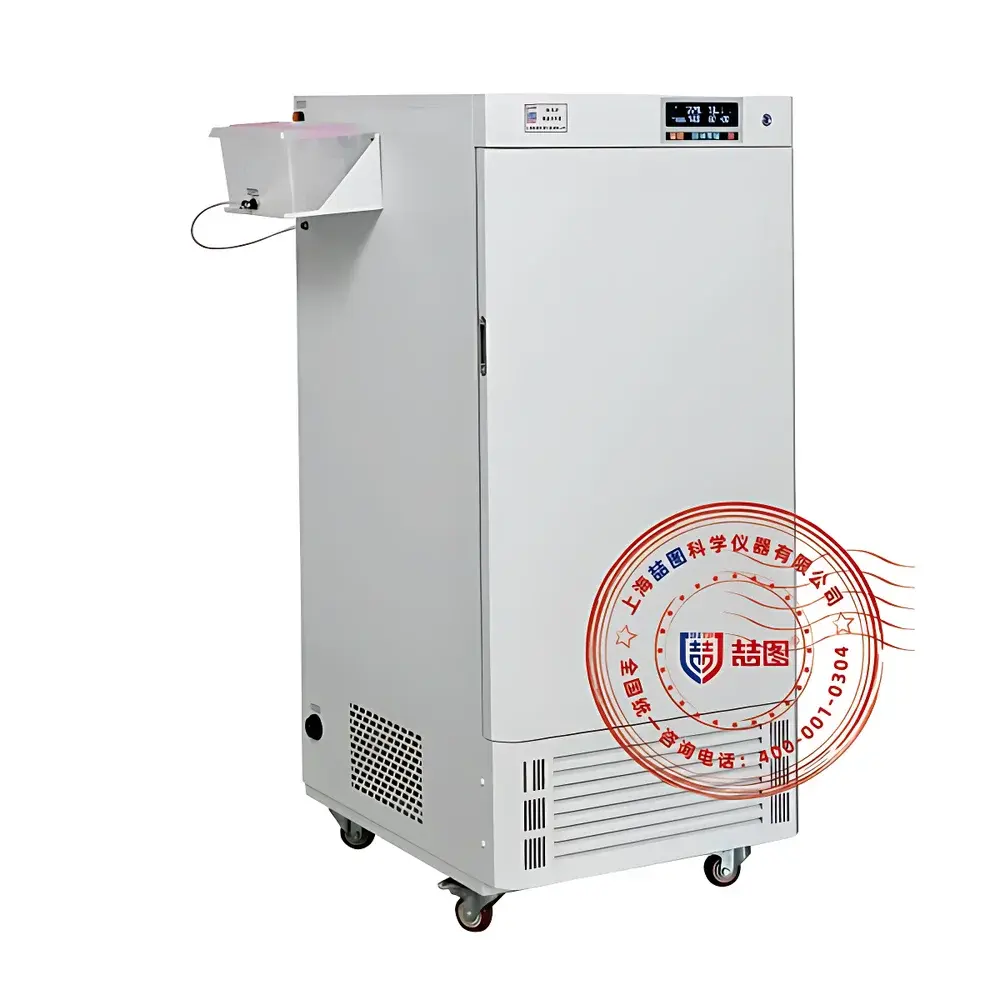
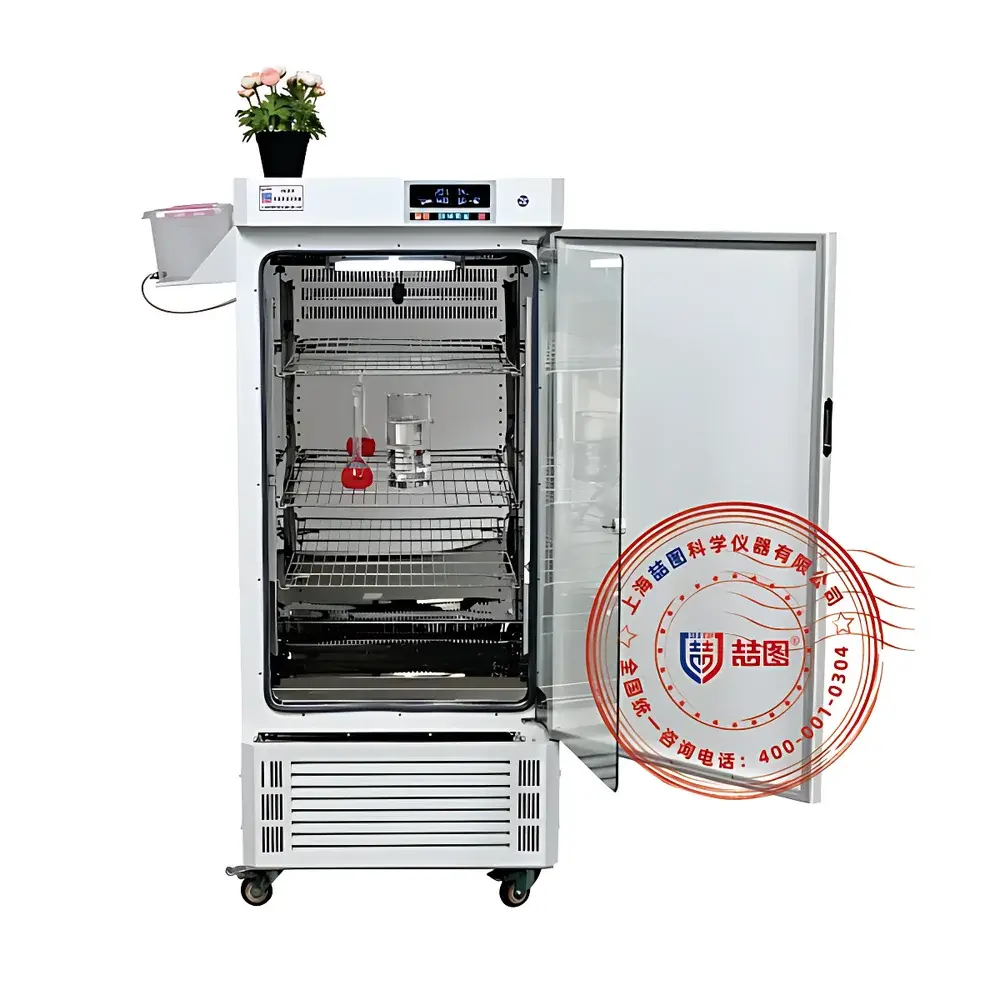
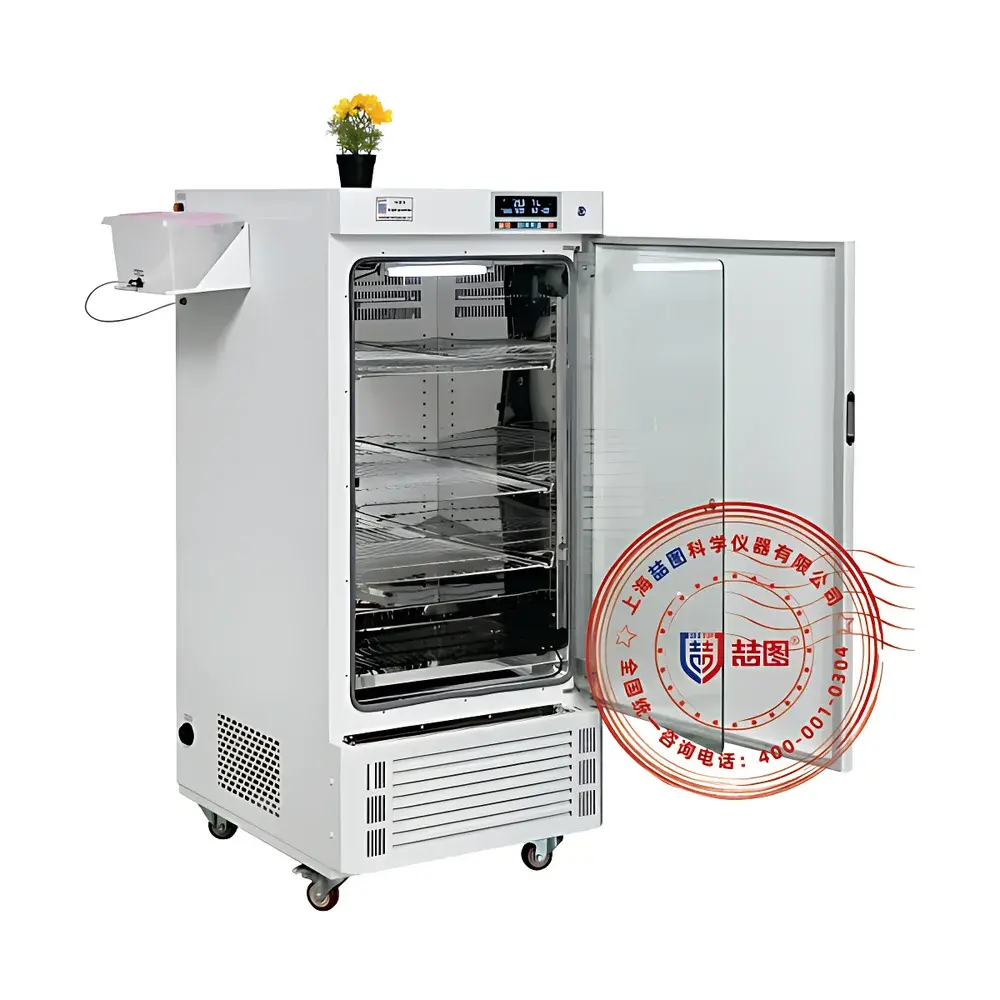
DRETOP ZHS-250SC Temperature and Humidity Controlled Incubator
| Brand | DRETOP |
|---|---|
| Origin | Shanghai, China |
| Manufacturer Type | Direct Manufacturer |
| Product Category | Domestic |
| Model | ZHS-250SC |
| Heating Method | Air-jacketed Heating |
| Cooling Method | Compressor-based Refrigeration |
| Humidification Water Tank | External Reservoir |
| Temperature Range (with Humidification) | 15–45 °C |
| Temperature Range (without Humidification) | 10–45 °C (customizable to 0–65 °C) |
| Temperature Fluctuation | ±0.5 °C at high setpoints |
| Humidity Range | 50–95 %RH |
| Humidity Accuracy | ±3 %RH |
| Capacity | 250 L |
| Internal Dimensions (W×D×H) | 580×500×850 mm |
Overview
The DRETOP ZHS-250SC Temperature and Humidity Controlled Incubator is an engineered environmental simulation system designed for precise, long-term maintenance of biological, pharmaceutical, and material samples under rigorously defined thermal and hygroscopic conditions. Based on dual-loop PID control architecture, the unit integrates independent air-jacketed heating and compressor-driven refrigeration subsystems with a dedicated external humidification reservoir—enabling stable co-regulation of temperature and relative humidity across a wide operational envelope. Its design conforms to core requirements for stability testing per ICH Q1A(R3), accelerated aging per ASTM D3574, and storage condition validation under USP and ISO 14644-1 cleanroom support protocols. The incubator serves as a foundational platform in QC laboratories conducting shelf-life studies, excipient compatibility assessments, textile hygrothermal aging, and microbial growth inhibition assays where reproducible ambient mimicry is critical.
Key Features
- Microprocessor-based dual-channel PID controller with real-time digital display of setpoint, actual temperature, and relative humidity—ensuring closed-loop feedback precision and traceable parameter logging.
- 30-segment programmable cycle scheduler supporting time-dependent ramp/soak profiles, enabling unattended multi-phase experiments such as cyclic humidity stress testing or diurnal temperature variation simulation.
- Air-jacketed heating system with Ni-Cr alloy heating elements and optimized airflow distribution via axial贯流 (axial-flow) fan ensures rapid thermal response and minimizes internal gradients during transient operation.
- Compressor-based cooling circuit utilizes R134a or R600a refrigerant (non-ozone-depleting, GWP-compliant), integrated with start-delay and inter-cycle interval protection logic to extend compressor service life beyond 25,000 hours.
- Stainless steel interior chamber (SUS304) with removable, height-adjustable shelves and radius-corner welding eliminates crevices—facilitating autoclave-compatible cleaning and validated decontamination per ISO 14644-3 particle control standards.
- Dual-door observation window: inner tempered glass pane with anti-fog coating and outer magnetic door seal—reducing heat loss by >35% versus single-glass configurations and maintaining thermal integrity during frequent access.
- Four-position castor base with dual-locking mechanism (swivel + fixed) allows repositioning within ISO Class 7 cleanrooms while ensuring static stability during vibration-sensitive assays.
Sample Compatibility & Compliance
The ZHS-250SC accommodates standard ISO 8573-1 compliant sample containers—including Petri dishes, vials, trays, and sealed stability chambers—within its 250 L working volume. Its uniformity performance (validated per ISO 16730-2 Annex B methodology) meets GLP-compliant spatial homogeneity thresholds for temperature (±1.0 °C at 37 °C, 50 %RH) and humidity (±4.0 %RH at 40 °C, 75 %RH) across the full load configuration. The unit supports audit-ready documentation workflows aligned with FDA 21 CFR Part 11 through optional RS485 Modbus RTU interface integration with LIMS or ELN systems. It complies with CE marking directives (2014/30/EU EMC, 2014/35/EU LVD), RoHS 2011/65/EU, and IEC 61000-4 immunity standards for laboratory-grade electromagnetic resilience.
Software & Data Management
While the base model operates via embedded firmware with local parameter retention (including power-loss recovery and non-volatile memory for up to 10 user-defined programs), optional connectivity modules enable advanced data governance. The RS485 interface permits bidirectional communication with third-party SCADA platforms for centralized monitoring, alarm forwarding via SNMP traps, and automated CSV export of timestamped temperature/humidity logs at configurable intervals (1–60 min). When paired with DRETOP’s optional color touchscreen HMI upgrade, users gain graphical trend visualization, deviation alert history, and electronic signature-capable audit trails satisfying ALCOA+ principles for regulated environments.
Applications
- Pharmaceutical stability testing per ICH Q5C guidelines for biologics and small-molecule APIs under long-term (25 °C/60 %RH) and accelerated (40 °C/75 %RH) conditions.
- Textile moisture regain evaluation per ASTM D2654 and ISO 6741-2, including cyclic wet/dry exposure protocols simulating seasonal climatic shifts.
- Food packaging barrier property validation using water vapor transmission rate (WVTR) test cells maintained at controlled RH gradients.
- Microbial culture preservation and fungal sporulation studies requiring sustained sub-ambient humidity control without condensation risk.
- Electronics component aging tests under high-humidity stress (e.g., 85 °C/85 %RH) per JEDEC JESD22-A101 standard—enabled by optional 0–65 °C extended-range configuration.
FAQ
What is the minimum temperature achievable with humidification active?
The unit maintains stable humidification down to 15 °C; below this point, condensation risk limits RH control fidelity.
Can the incubator operate continuously for 30 days without intervention?
Yes—its compressor duty cycle management, redundant overtemperature cutoff (independent mechanical limiter), and non-volatile program memory support uninterrupted 720-hour runs.
Is calibration certificate included with shipment?
A factory-as-tested calibration report (traceable to NIM China) is provided; UKAS or ISO/IEC 17025 accredited field calibration is available as a value-added service.
Does the external water tank require deionized water?
Use of DI water (resistivity ≥1 MΩ·cm) is strongly recommended to prevent mineral deposition in the ultrasonic or wick-based humidifier assembly.
How is temperature uniformity verified during IQ/OQ qualification?
DRETOP supplies a 9-point sensor mapping template and validation protocol aligned with ASTM E2874-13 for chamber qualification, including acceptance criteria for spatial deviation and temporal drift.




