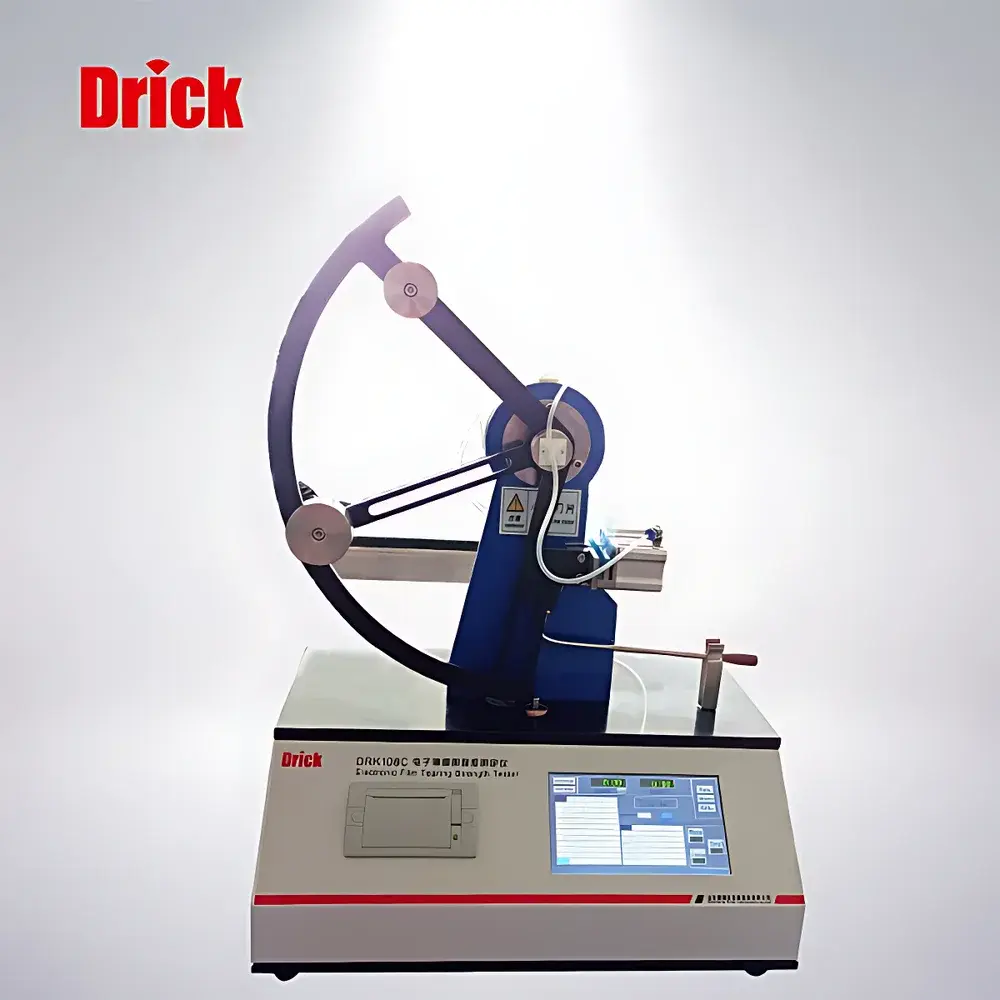
Drick DRK 108 Elmendorf Tear Resistance Tester
| Brand | Drick |
|---|---|
| Origin | Shandong, China |
| Manufacturer Type | OEM Manufacturer |
| Country of Origin | China |
| Model | DRK 108 |
| Measurement Principle | Elmendorf pendulum tear method (ISO 1974, GB/T 455.1) |
| Standard Pendulum Range | (10–13,000) mN |
| Resolution | 10 mN |
| Accuracy | ±1% FS (20–80% of full scale), ±0.5% FS (outside range) |
| Repeatability | <1% FS (20–80% FS), <0.5% FS (outside range) |
| Tear Arm Length | (104 ± 1) mm |
| Initial Tear Angle | 27.5° ± 0.5° |
| Tear Distance | (43 ± 0.5) mm |
| Clamp Face Dimensions | 25 × 15 mm |
| Clamp Spacing | (2.8 ± 0.3) mm |
| Specimen Size | (63 ± 0.5) mm × (50 ± 2) mm |
| Operating Environment | 20 ± 10 °C, RH ≤ 80% |
| Power Supply | AC 220 V ± 5%, 50 Hz |
| Dimensions | 460 × 400 × 400 mm |
| Weight | 30 kg |
| Compliance | ISO 1974, GB/T 455.1, GB/T 450–2002, GB/T 10739–2002 |
| Data Acquisition | 24-bit high-precision ADC (1/10,000,000 resolution), integrated precision load cell |
| Output | Built-in thermal printer (bilingual Chinese/English interface), statistical reporting (mean, SD, CV) |
Overview
The Drick DRK 108 Elmendorf Tear Resistance Tester is a precision-engineered instrument designed for the quantitative determination of tear resistance in flexible sheet materials using the standardized pendulum (Elmendorf) method. Based on the fundamental principle of energy conservation—where the loss of potential energy of a falling pendulum is equated to the work required to propagate a controlled tear—the DRK 108 delivers repeatable, traceable, and internationally comparable results. It complies strictly with ISO 1974:2012 “Paper — Determination of tearing resistance — Elmendorf method”, GB/T 455.1–1989 (and its updated equivalents), as well as supporting standards for sample conditioning (GB/T 10739–2002, equivalent to ISO 187:1990) and sampling (GB/T 450–2002, equivalent to ISO 186:1994). The instrument is calibrated and validated for use across paper, paperboard, thin plastic films, synthetic fibers, metallized foils, and nonwovens—making it a cross-material reference tool in quality control laboratories where mechanical durability under dynamic stress is critical.
Key Features
- Elmendorf-type pendulum mechanism with rigid aluminum alloy frame and precision-machined tear arm (104 ± 1 mm), ensuring minimal mechanical hysteresis and long-term geometric stability.
- High-fidelity force transduction system incorporating a 24-bit analog-to-digital converter (ADC) with effective resolution of 1 part in 10,000,000, coupled with a calibrated load cell optimized for the 10–13,000 mN dynamic range.
- Bilingual (Chinese/English) graphical user interface with real-time parameter display, intuitive navigation, and on-screen calibration prompts—designed for multilingual lab environments without requiring software installation.
- Integrated thermal line printer with modular paper-loading design; supports immediate hardcopy output of individual test records and statistical summaries (mean tear force, standard deviation, coefficient of variation).
- Modular clamp assembly featuring standardized 25 × 15 mm clamping faces and fixed 2.8 ± 0.3 mm inter-clamp spacing—engineered to replicate the gripping geometry specified in ISO 1974 and minimize slippage-induced error.
- Compliance-ready architecture: All measurement events—including zero calibration, sample loading confirmation, tear initiation, and result finalization—are timestamped and stored in non-volatile memory, supporting auditability under GLP and internal QA protocols.
Sample Compatibility & Compliance
The DRK 108 is validated for use with specimens conforming to ISO 1974 and GB/T 455.1 dimensions: (63 ± 0.5) mm × (50 ± 2) mm, pre-conditioned at 23 °C ± 1 °C and 50% RH ± 2% (per GB/T 10739–2002). Its mechanical configuration accommodates not only standard pulp-based papers and corrugated board substrates but also low-basis-weight plastics (e.g., LDPE, PET films ≥12 µm), spunbond polypropylene, aluminum foil laminates, and technical textiles. The instrument’s tear initiation geometry—27.5° ± 0.5° initial angle and 43 ± 0.5 mm propagation distance—is mechanically fixed to eliminate operator-dependent variability. Full compliance documentation—including factory calibration certificates traceable to NIM (National Institute of Metrology, China) and conformance statements against ISO/IEC 17025–2017 requirements for testing equipment—is provided with each unit.
Software & Data Management
While the DRK 108 operates as a standalone embedded system, its firmware supports export of ASCII-formatted test logs via USB port for downstream integration into LIMS or statistical analysis platforms (e.g., Minitab, JMP). Each test record contains specimen ID, date/time stamp, environmental conditions (manually entered), raw mN values, and computed statistics. Audit trails are retained for ≥1,000 tests and include operator ID (if configured), calibration history, and system error flags. Though not FDA 21 CFR Part 11–certified out-of-the-box, the device’s deterministic firmware behavior, write-once memory logging, and absence of editable electronic records make it suitable for regulated environments when deployed with documented SOPs and periodic verification per ASTM E2500.
Applications
- Quality assurance in paper mills: Monitoring consistency of kraft linerboard, newsprint, and tissue grades across production batches.
- Packaging R&D: Evaluating seal integrity and pouch tear propagation in flexible food and pharmaceutical packaging.
- Textile testing labs: Quantifying tear resistance of geotextiles, filtration media, and medical gowns per ASTM D1117 (adapted protocol).
- Academic research: Studying fiber-matrix interactions in composite papers and biodegradable polymer blends.
- Regulatory submission support: Generating tear data compliant with TAPPI T 414, ISO 6383-1, and EU Directive 94/62/EC packaging durability requirements.
FAQ
What standards does the DRK 108 comply with?
It meets ISO 1974, GB/T 455.1, GB/T 450–2002, and GB/T 10739–2002, and is functionally compatible with ASTM D1922 and TAPPI T 414 methodologies.
Can the DRK 108 test materials other than paper?
Yes—when equipped with appropriate specimen holders and validated test protocols, it measures tear resistance of thin plastics, metal foils, nonwovens, and coated fabrics within its 10–13,000 mN range.
Is external PC software required for operation?
No. All functions—including calibration, testing, statistics, and printing—are executed onboard. USB export is optional and read-only.
How is measurement accuracy verified?
Using certified reference weights traceable to national standards; routine verification follows ISO 1974 Annex B procedures with certified tear reference materials.
What maintenance is required?
Biannual inspection of pendulum bearing friction, clamp surface wear, and knife edge sharpness; annual recalibration recommended per ISO/IEC 17025 guidelines.