
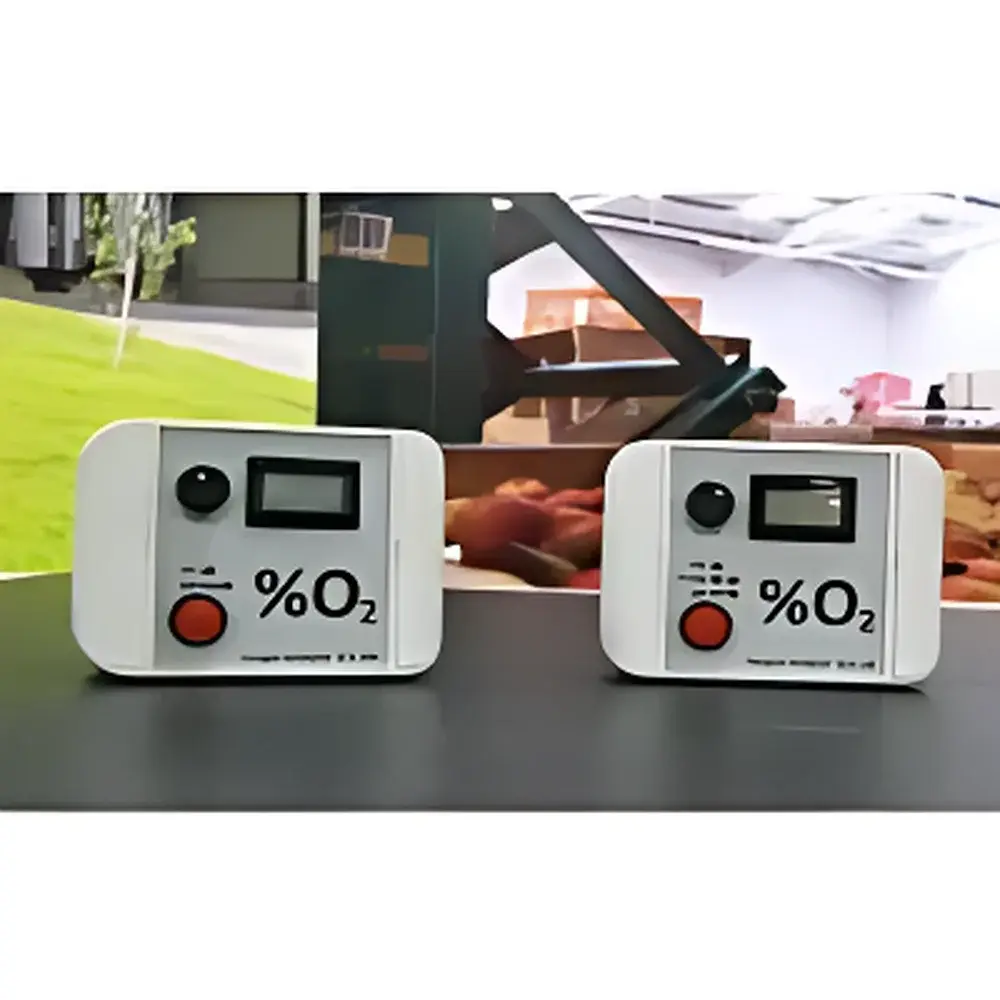
ICA ICA100/110 Oxygen Analyzer
| Brand | ICA |
|---|---|
| Origin | United Kingdom |
| Model | ICA100/110 Oxygen Analyzer |
| Detection Principle | Electrochemical Cell (Galvanic) |
| Measurement Range | 0–25% O₂ (auto-ranging resolution: 0.01% below 10% O₂ |
| Repeatability | < 0.1% O₂ |
| Response Time (t₉₉) | ≤20 s |
| Sample Flow Rate | ICA100 – manual pump |
| Power Supply | ICA100 – 9V lithium-manganese (MN1604, PP3), 4-year service life (8 h/day) |
| Dimensions | 120 × 90 × 60 mm |
| Warranty | 2 years |
| Interference Resistance | Immune to CO₂, CO, H₂, C₂H₄, and other hydrocarbons |
| Calibration | Ambient air calibration (adjustable for barometric pressure drift and sensor aging) |
| Compliance | Designed for GLP-compliant field and lab use |
Overview
The ICA ICA100/110 Oxygen Analyzer is a portable, field-deployable electrochemical gas analyzer engineered for high-accuracy measurement of oxygen concentration in low-oxygen environments—particularly relevant to post-harvest physiology, controlled atmosphere (CA) storage, cold chain monitoring, and plant respiration studies. Based on a temperature-compensated galvanic fuel cell principle, the instrument delivers stable, drift-resistant output without requiring external power during operation (ICA100) or with sustained autonomy via rechargeable architecture (ICA110). Its core design prioritizes operational robustness in variable ambient conditions—such as fluctuating barometric pressure, humidity gradients, and mixed-gas atmospheres common in fruit storage rooms, seed vaults, and growth chambers. Unlike optical or paramagnetic analyzers, the galvanic cell offers inherent immunity to interference from carbon dioxide, carbon monoxide, hydrogen, ethylene, and non-polar hydrocarbons—eliminating cross-sensitivity artifacts critical for longitudinal crop quality assessment.
Key Features
- Auto-ranging resolution: Switches dynamically between 0.01% O₂ (below 10% O₂) and 0.1% O₂ (≥10% O₂) to maintain optimal signal-to-noise ratio across physiological and storage-relevant ranges.
- Dual configuration options: ICA100 employs a manually actuated sampling pump for discrete spot measurements; ICA110 integrates a precision-controlled internal pump delivering consistent 1.0 L/min flow—enabling continuous monitoring and improved reproducibility in dynamic environments.
- Pressure- and aging-compensated calibration: Built-in ambient air calibration routine corrects for local atmospheric pressure variations and gradual electrode sensitivity loss—supporting long-term data integrity without frequent recalibration.
- Rugged handheld form factor: Compact dimensions (120 × 90 × 60 mm) and IP54-rated enclosure ensure reliable operation in humid, dusty, or refrigerated agricultural settings.
- Low-maintenance electrochemical sensor: Replaceable galvanic cell with 4-year nominal service life (based on 8 h/day usage), no warm-up time, and zero consumables beyond the sensor module itself.
Sample Compatibility & Compliance
The ICA100/110 is validated for direct analysis of ambient air, headspace gases from sealed containers, ventilated CA rooms, and modified-atmosphere packaging (MAP) headspaces. It meets functional requirements for ISO 8573-1 (compressed air purity), ASTM D6159 (oxygen permeation testing), and FAO/WHO guidelines for post-harvest gas monitoring. While not certified for hazardous area use (e.g., ATEX), its intrinsic safety profile—no heating elements, spark-free operation, and passive electrochemical detection—makes it suitable for routine deployment in food processing facilities, phytotron labs, and seed conservation centers. All firmware and calibration records adhere to ALCOA+ principles (Attributable, Legible, Contemporaneous, Original, Accurate, Complete, Consistent, Enduring, Available), supporting audit readiness under GLP and GMP frameworks.
Software & Data Management
The analyzer operates as a standalone instrument with real-time LCD display and onboard data logging (ICA110 only). Logged datasets—including timestamped O₂ %, battery voltage, and calibration event markers—are exportable via USB interface to CSV format for integration into LIMS or custom analysis pipelines (e.g., R, Python, or MATLAB). No proprietary software installation is required. For regulated environments, the device supports user-defined calibration intervals and generates immutable log entries compliant with FDA 21 CFR Part 11 Annex 11 expectations—specifically audit trail generation, electronic signature capability (via optional external tablet interface), and secure data export protocols.
Applications
- Controlled atmosphere storage optimization: Real-time O₂ profiling in apple, pear, and kiwifruit cold stores to prevent anaerobic respiration and maintain shelf-life.
- Seed viability monitoring: Non-destructive assessment of O₂ depletion rates in hermetic grain silos and gene bank vaults.
- Plant respiration kinetics: In situ measurement of dark respiration rates in detached leaves, fruits, or root systems under hypoxic stress.
- Modified atmosphere packaging (MAP) validation: Spot-checking residual O₂ levels in retail-ready produce trays prior to distribution.
- Soil gas flux studies: Paired with CO₂ analyzers in chamber-based soil respiration assays where O₂ drawdown correlates with microbial activity.
FAQ
Does the ICA100/110 require periodic factory recalibration?
No—field calibration using ambient air is sufficient for most agricultural and ecological applications. The galvanic cell’s linear response and built-in pressure compensation eliminate the need for trace-gas standards under normal operating conditions.
Can the instrument operate continuously inside a −2°C cold room?
Yes—both models are rated for operation between 0°C and 40°C and 20–90% RH (non-condensing). Battery performance remains stable down to 5°C; extended low-temperature exposure may reduce ICA100’s 9V cell capacity temporarily.
Is the electrochemical sensor compatible with high-CO₂ environments (e.g., 10% CO₂ in CA storage)?
Yes—the galvanic cell exhibits no measurable cross-sensitivity to CO₂, CO, H₂, or ethylene, making it uniquely suited for multi-gas storage environments where optical sensors often require complex compensation algorithms.
How is data traceability ensured for regulatory submissions?
All calibration events, measurement timestamps, and battery status logs are stored in non-volatile memory with write-protected audit trails. Exported CSV files retain embedded metadata required for GLP documentation and peer-reviewed publication.
What is the expected service life of the electrochemical cell?
Typical operational lifespan is 24–36 months under continuous use in 5–15% O₂ environments. Cells are user-replaceable without tools and ship pre-calibrated with NIST-traceable certificate.



