
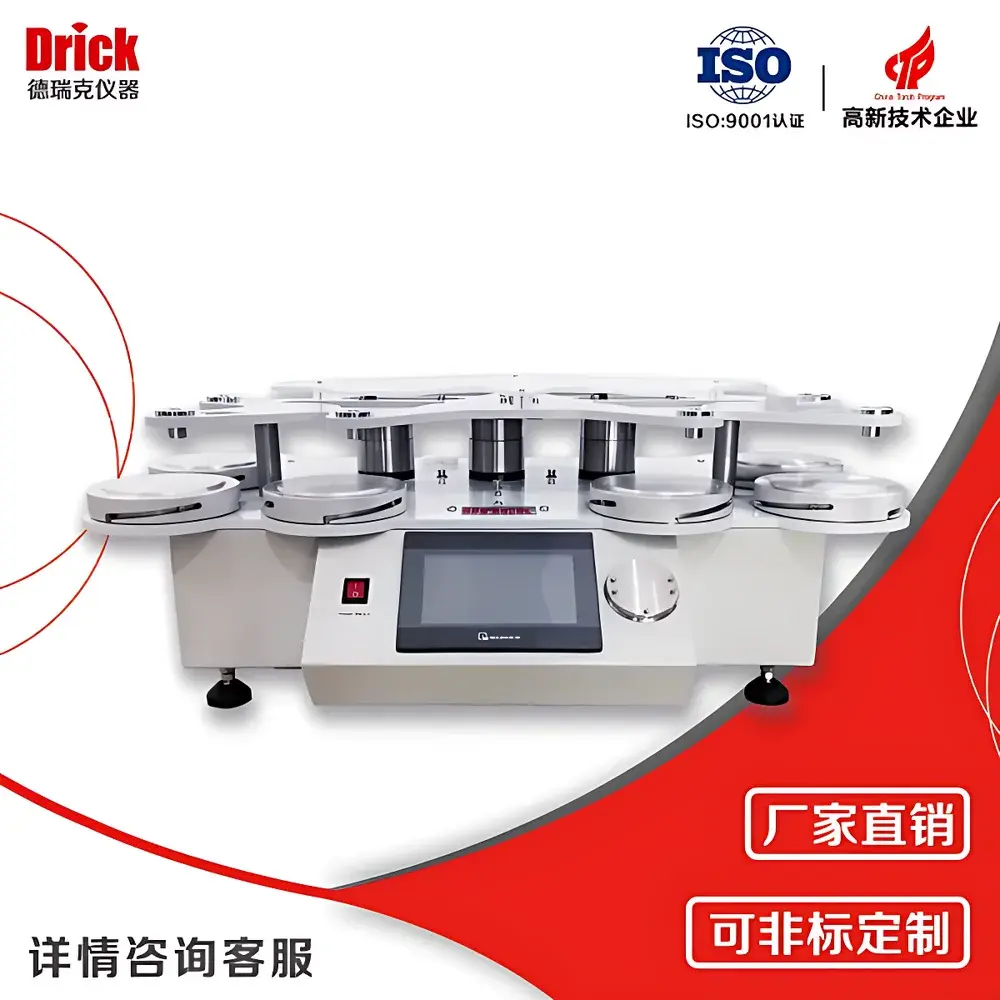
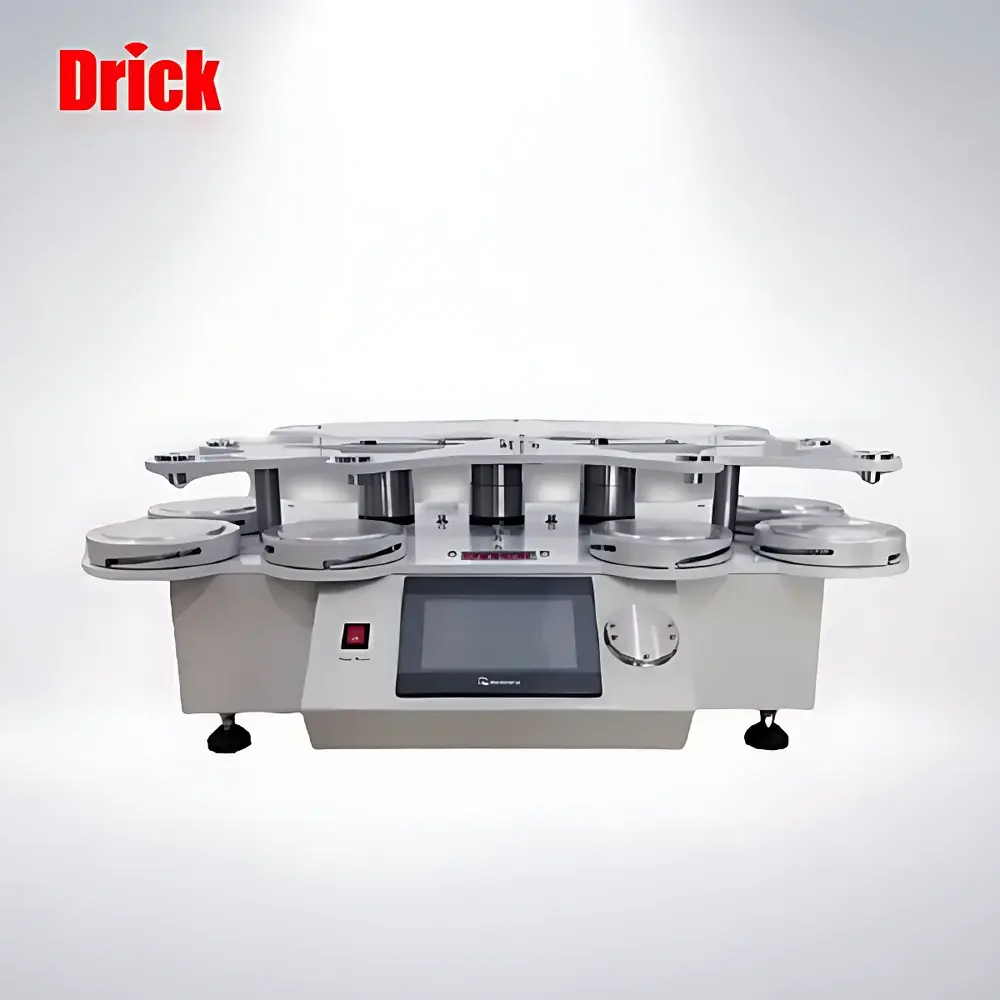
Drick DRK-128C Six-Station Abrasion Resistance Tester for Face Masks
| Brand | Drick |
|---|---|
| Origin | Shandong, China |
| Manufacturer Type | Direct Manufacturer |
| Country of Origin | China |
| Model | DRK-128C |
| Price | USD 7,000 (FOB) |
| Abrasion Stations | 6 |
| Sample Clamp Diameters | Φ38 mm and Φ90 mm |
| Abrasion Table Diameter | Φ120 mm |
| Standard Load Masses | 395 g ±2 g, 594 g ±2 g |
| Nominal Applied Pressures | 9 kPa (595 ±7 g assembly), 12 kPa (795 ±7 g assembly) |
| Counter Range | 1–990,000 cycles |
| Standard Abrasion Speed | 47.5 ±2.5 rpm |
| Optional Speeds | 25 rpm, 75 rpm |
| Power Supply | 220 V ±10%, 50 Hz |
| Motor Power | 120 W |
| Dimensions (L×W×H) | 850 × 600 × 400 mm |
| Net Weight | 120 kg (instrument), 22 kg (accessory case) |
Overview
The Drick DRK-128C Six-Station Abrasion Resistance Tester is a precision-engineered instrument designed to evaluate the surface durability and pilling resistance of face masks, woven fabrics, knitted textiles, and nonwovens under controlled mechanical abrasion. Based on the Martindale principle—where circular oscillatory motion simulates real-world wear mechanisms—the DRK-128C replicates multi-directional frictional contact between standardized abradant surfaces and test specimens. Unlike single-station testers, its six independent testing stations enable parallel evaluation of replicate samples or comparative studies across material batches, significantly improving throughput and statistical robustness in quality control laboratories. The system operates under defined nominal pressures (9 kPa and 12 kPa), conforming to the kinematic and loading parameters specified in ISO 12945-2, ASTM D4966 (Martindale method), and GB/T 4802.2—making it suitable for regulatory-compliant textile performance verification in medical PPE manufacturing, filtration media development, and functional fabric R&D.
Key Features
- Six synchronized, independently driven abrasion stations for high-efficiency batch testing and inter-laboratory reproducibility.
- Modular clamp system supporting dual sample diameters (Φ38 mm and Φ90 mm), enabling flexibility across standard test methods including ISO 12945-2 (pilling), ASTM D4970 (pilling), and GB/T 21196.1–4 (abrasion resistance).
- Precision-machined aluminum alloy frame with vibration-damped base structure ensures long-term dimensional stability and mechanical repeatability over >100,000 cycles.
- Electronically controlled stepper motor drive with integrated gear reduction delivers consistent rotational speed (47.5 ±2.5 rpm standard; optional 25 rpm and 75 rpm configurations available for specialized protocols).
- Intuitive LCD human-machine interface (HMI) with keypad navigation allows direct presetting of cycle counts (1–990,000), automatic stop upon completion, and real-time status monitoring without PC dependency.
- Calibrated mass assemblies—including 395 g and 594 g weights, O-ring-equipped Φ90 mm clamps, and standardized loading blocks—ensure traceable application of nominal contact pressures (9 kPa and 12 kPa) per ISO 12945-2 Annex A.
Sample Compatibility & Compliance
The DRK-128C accommodates flat, dimensionally stable specimens up to 3 mm thickness, excluding high-pile or looped fabrics where fiber entanglement may compromise test validity. It is validated for use with surgical mask layers, melt-blown polypropylene filters, spunbond nonwovens, cotton-polyester blends, and elastane-containing knits. The instrument meets mechanical and procedural requirements of multiple international standards: ISO 12945-2 (determination of fabric pilling resistance), ASTM D4966 (Martindale abrasion tester specification), ASTM D4970 (pilling resistance of fabrics), GB/T 4802.2 (Chinese national standard for fabric pilling), and GB/T 21196.1–4 (abrasion resistance testing series). While not certified to GLP or ISO/IEC 17025 out-of-the-box, its design supports full auditability—traceable mass calibration records, programmable cycle logging, and mechanical symmetry across all six stations facilitate internal validation per ISO/IEC 17025:2017 Clause 7.7 (uncertainty estimation) and FDA 21 CFR Part 11-compliant data archiving when paired with validated third-party software.
Software & Data Management
The DRK-128C operates as a standalone hardware platform with embedded firmware controlling motor sequencing, counter logic, and HMI feedback. Cycle count data is retained in non-volatile memory and can be manually recorded or exported via RS-232 serial interface (optional USB-to-serial adapter) for integration into LIMS or Excel-based QA databases. For laboratories requiring electronic records compliance, Drick provides optional Windows-compatible configuration software that enables remote parameter setting, automated CSV report generation, timestamped cycle logs, and digital signature support—aligning with FDA 21 CFR Part 11 requirements for audit trails, user access controls, and data integrity. All firmware updates are delivered via encrypted USB stick with version-controlled release notes and change logs.
Applications
- Quality assurance of disposable surgical and N95 respirator outer/inner layers for abrasion-induced fiber shedding and barrier integrity loss.
- Comparative assessment of anti-pilling treatments on polyester knits used in reusable cloth masks.
- R&D evaluation of novel biodegradable nonwovens (e.g., PLA, cellulose acetate) against standard PP melt-blown benchmarks.
- Validation of hydrophobic coating durability on moisture-wicking mask linings subjected to repeated donning/doffing simulation.
- Third-party certification testing per CE-marking requirements for EN 14683:2019 Annex A (mechanical performance of medical face masks).
FAQ
What standards does the DRK-128C directly support?
ISO 12945-2, ASTM D4966, ASTM D4970, GB/T 4802.2, GB/T 21196.1–4, and GB 8690.
Can the instrument test materials thicker than 3 mm?
No—specimens exceeding 3 mm thickness are excluded per ISO 12945-2 Clause 5.2 and ASTM D4966 Section 6.1 due to risk of non-uniform pressure distribution and clamp misalignment.
Is calibration documentation provided with shipment?
Yes—each unit ships with a factory calibration certificate for applied load masses (±0.5% tolerance), rotational speed verification (±0.5 rpm), and counter accuracy (±1 cycle), traceable to CNAS-accredited metrology labs.
Does the DRK-128C require compressed air or external cooling?
No—it operates solely on 220 V AC power; no auxiliary utilities are required.
What maintenance intervals are recommended?
Lubrication of eccentric cam shafts every 6 months; inspection of O-rings and clamp seating surfaces before each test series; annual verification of motor encoder alignment and counter sensor response.





