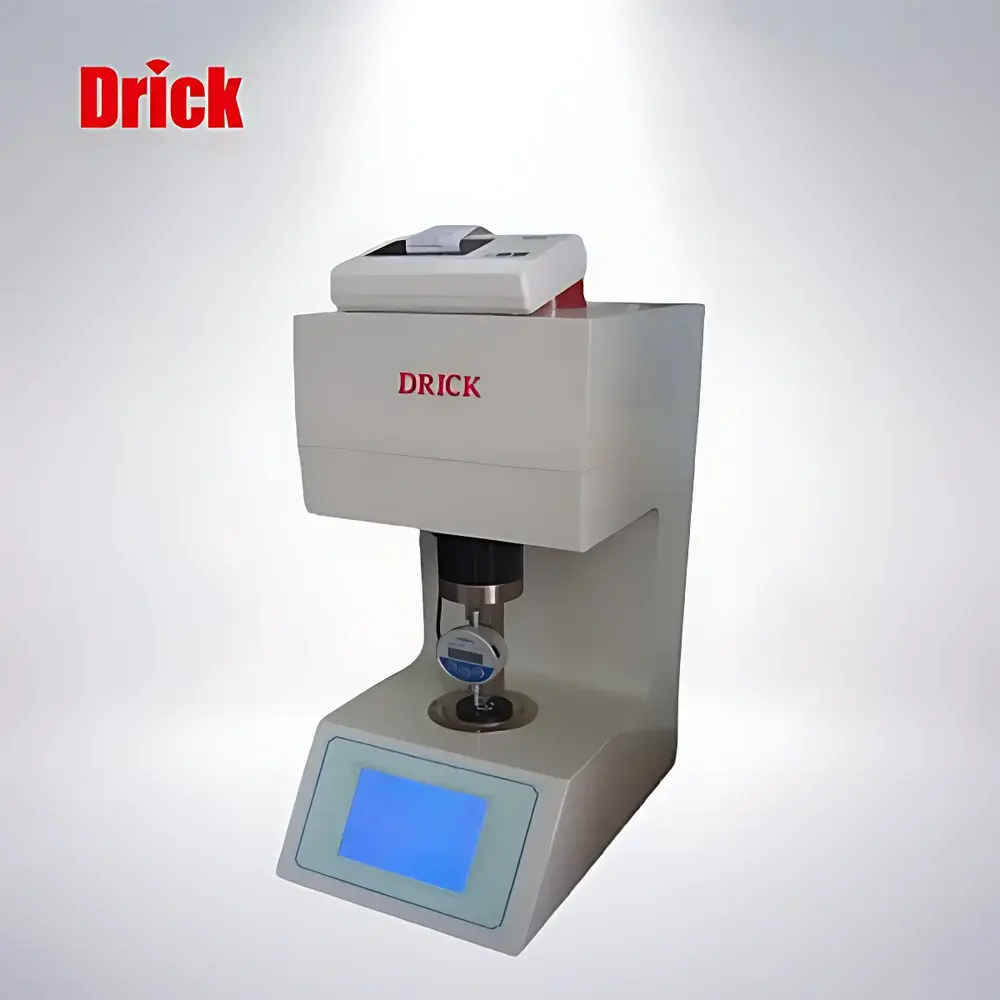
Drick DRK-QY Intelligent Ball Indentation Hardness Tester for Plastics
| Brand | Drick |
|---|---|
| Origin | Shandong, China |
| Manufacturer Type | Direct Manufacturer |
| Country of Origin | China |
| Model | DRK-QY |
| Test Load Stages | 9.8 N (pre-load), 49 N, 132 N, 358 N, 612 N, 961 N |
| Indenter | Steel ball Φ5 mm / Φ10 mm |
| Depth Resolution | 0.001 mm |
| Max Sample Height | 30 mm |
| Indenter-to-Frame Distance | 100 mm |
| Depth Measurement Range | 0.150–0.350 mm |
| Timing Range | 10–90 s (±0.5% accuracy) |
| System Accuracy | ±1% |
| Frame Deformation | ≤0.05 mm |
| Dimensions (L×W×H) | 350 × 400 × 700 mm |
| Weight | 50 kg |
Overview
The Drick DRK-QY Intelligent Ball Indentation Hardness Tester is a microprocessor-controlled instrument engineered for precise, repeatable determination of the ball indentation hardness of thermoplastics, thermosets, and elastomeric materials. It operates on the principle defined in ISO 2039-1, GB/T 3398.1–2008, and DIN 53456:1982—applying a calibrated spherical indenter under controlled load and dwell time to measure the permanent depth of penetration into the material surface. Unlike Shore or Rockwell methods, ball indentation hardness quantifies resistance to localized plastic deformation under sustained load, making it especially relevant for structural polymer components subjected to long-term mechanical stress—such as automotive interior trim, housing enclosures, and industrial ducting. The DRK-QY integrates digital displacement sensing, programmable dwell timing, and automatic loading/unloading sequences to eliminate operator-induced variability and support standardized test execution per international regulatory frameworks.
Key Features
- Microprocessor-based closed-loop control system ensures consistent load application across six discrete test stages (9.8 N pre-load + five main loads: 49 N, 132 N, 358 N, 612 N, and 961 N)
- Dual interchangeable steel ball indenters (Φ5 mm and Φ10 mm) enable compliance with material-specific test protocols and cross-standard comparability
- High-resolution digital displacement transducer with 0.001 mm resolution and linear range of 0.150–0.350 mm, traceable to national metrological standards
- Backlit LCD interface with Chinese-language menu navigation, real-time depth display, elapsed time tracking, and automatic result calculation
- Rigid cast-iron frame design with ≤0.05 mm elastic deformation under maximum load, minimizing measurement drift and ensuring long-term repeatability
- Programmable dwell time from 10 s to 90 s (±0.5% timing accuracy), supporting both short-term compliance checks and extended creep-hardness evaluations
Sample Compatibility & Compliance
The DRK-QY accommodates flat, parallel-surface specimens up to 30 mm in height and 100 mm from the machine’s vertical support column—enabling testing of molded plaques, extruded profiles, and injection-molded parts common in automotive (e.g., ABS, PC/ABS blends), electrical insulation, and packaging applications. All mechanical and procedural specifications conform to ISO 2039-1:2015 (Plastics — Determination of indentation hardness by means of a spherical indenter), GB/T 3398.1–2008 (Chinese national standard equivalent), and DIN 53456 (German standard for thermoplastic materials). While not inherently 21 CFR Part 11 compliant, the instrument’s deterministic operation, non-volatile result storage, and unambiguous test parameter logging support GLP-aligned documentation when integrated into validated laboratory workflows.
Software & Data Management
The DRK-QY operates autonomously via embedded firmware; no external PC or proprietary software is required for basic operation. Test parameters—including selected load stage, dwell duration, indenter diameter, and ambient temperature input (manual entry)—are stored in non-volatile memory alongside each measurement record. Results display as raw indentation depth (mm), calculated hardness value (N/mm²), and pass/fail status relative to user-defined specification limits. Optional RS-232 serial output allows integration with LIMS or custom data acquisition platforms for automated report generation, audit trail capture, and trend analysis across production batches. All timestamped records include instrument ID, operator code (manually entered), and calibration verification flag.
Applications
- Quality control of ABS, PP, PS, PVC, and filled polyolefin compounds used in automotive dashboards, bumpers, and HVAC ducts
- Comparative evaluation of heat-aged or UV-exposed specimens to quantify embrittlement or softening effects
- Material qualification against OEM specifications requiring ISO 2039-1 conformance (e.g., GMW15635, Ford WSS-M99P1111-A)
- Research-grade indentation response mapping for structure–property correlation studies in polymer blend development
- Supplier validation testing where reproducible, load-independent hardness indexing is required prior to machining or assembly
FAQ
What standards does the DRK-QY comply with?
The instrument meets the mechanical, procedural, and reporting requirements of ISO 2039-1:2015, GB/T 3398.1–2008, and DIN 53456.
Can the DRK-QY be used for rubber or elastomers?
It is primarily designed for rigid and semi-rigid thermoplastics and thermosets; elastomers with high compressibility or low modulus may fall outside the valid depth range (0.150–0.350 mm) and require alternative methods such as ISO 48-4 (IRHD) or ASTM D2240.
Is calibration certification included?
The unit ships with factory calibration verification against traceable reference blocks; users must perform periodic verification using certified hardness reference materials per ISO 14644 or internal SOPs.
Does the system support automated data export?
Yes—via RS-232 serial interface, enabling ASCII-formatted output of test ID, load, dwell time, depth, hardness value, and timestamp for downstream analysis.
What maintenance is required?
Routine cleaning of the indenter and specimen stage, annual verification of load cell linearity and displacement sensor zero point, and biannual inspection of mechanical guides and frame integrity are recommended per IEC 61000-4-30 guidelines.