
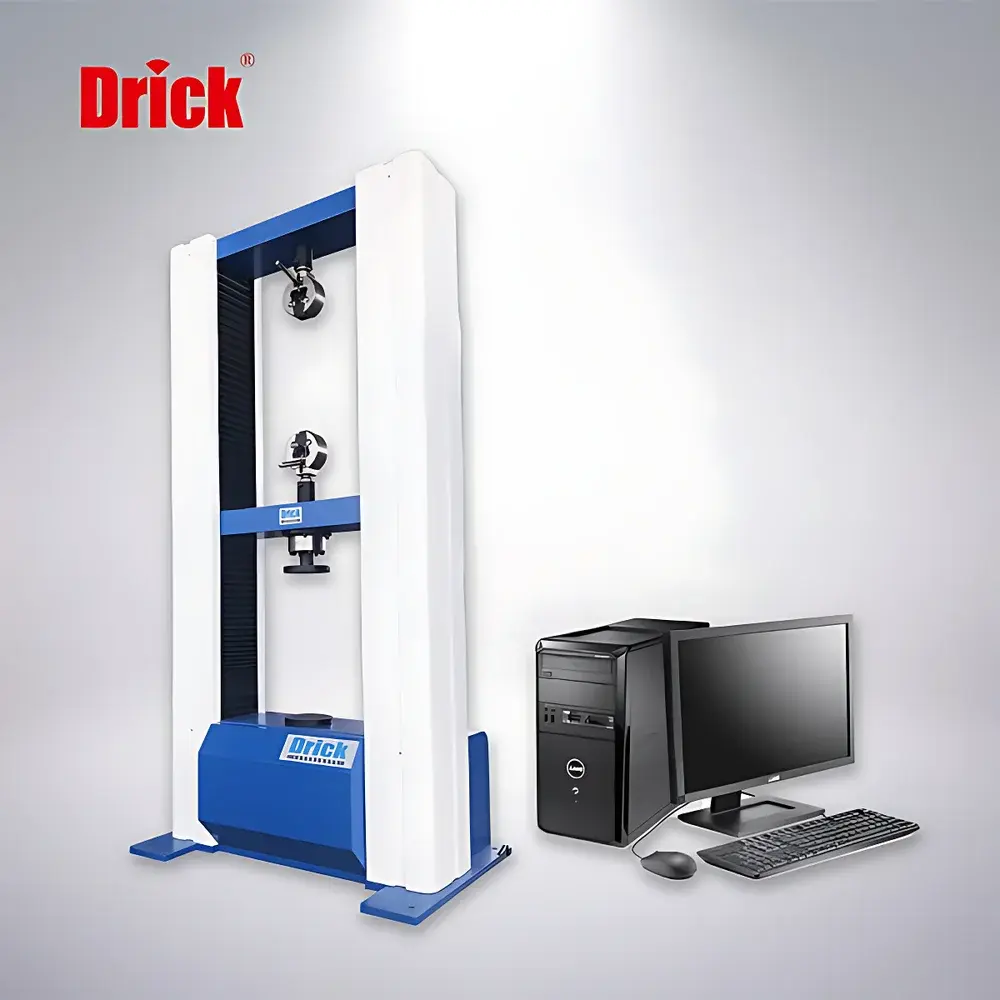
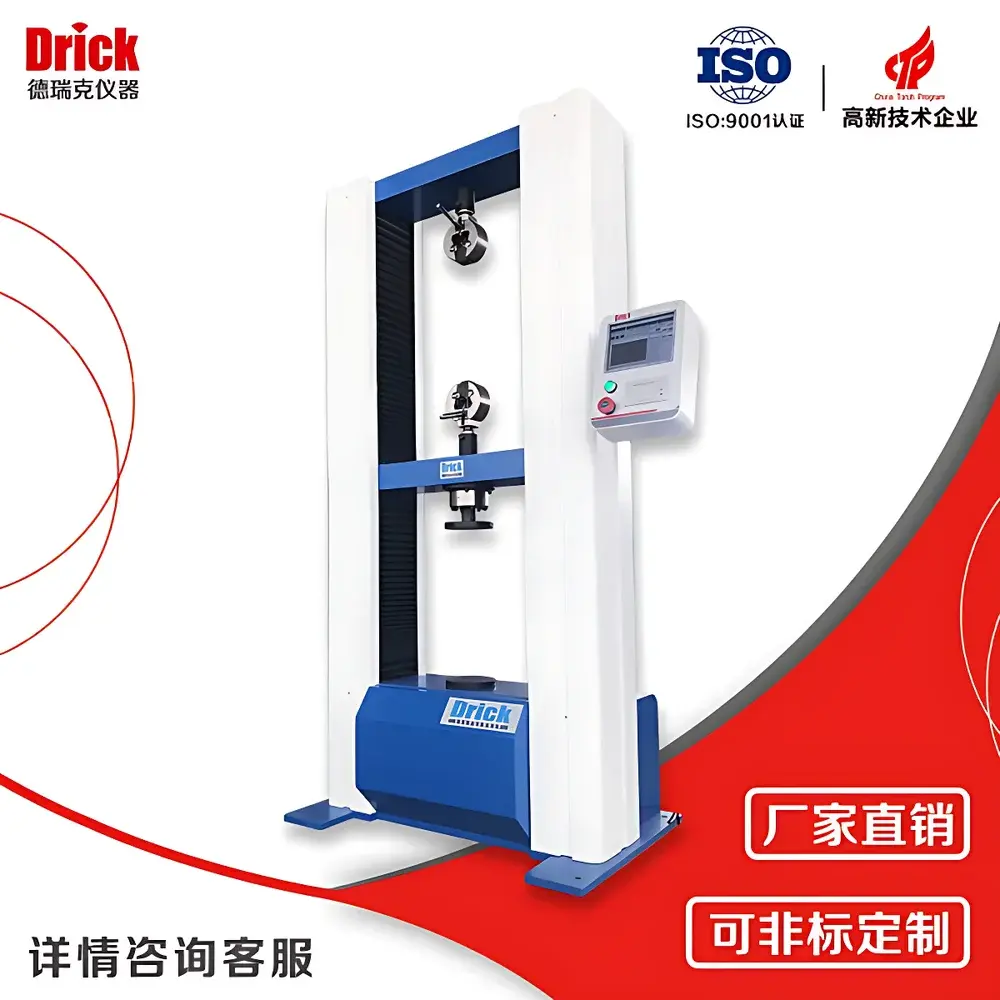
Drick DRK101 Dual-Column Electromechanical Universal Testing Machine (50 kN / 100 kN / 300 kN Configurable)
| Brand | Drick |
|---|---|
| Origin | Shandong, China |
| Manufacturer Type | OEM Manufacturer |
| Country of Origin | China |
| Model | DRK101 |
| Instrument Type | Electromechanical Universal Testing Machine |
| Load Capacity Options | 50 kN, 100 kN, 300 kN |
| Force Accuracy | ±1% or ±0.5% of reading (customer-specified) |
| Crosshead Speed Range | 0.1–500 mm/min |
| Effective Travel Distance | 600–900 mm (configurable) |
| Displacement Accuracy | ±0.5% of reading |
| Data Acquisition Rate | 50 Hz |
| Power Supply | AC 220 V, 50 Hz |
| Dimensions (W×D×H) | 1100 × 785 × 2090 mm |
| Weight | 750 kg |
Overview
The Drick DRK101 Dual-Column Electromechanical Universal Testing Machine is a precision-engineered static mechanical testing system designed for high-reproducibility tensile, compression, flexural, peel, tear, shear, and bending characterization of engineering materials. Based on servo-controlled electromechanical actuation and compliant with ISO 178:2010 (Plastics — Determination of flexural properties), ASTM E4, ASTM D638, ASTM D790, and GB/T 228.1 standards, the DRK101 delivers traceable force and displacement measurements across a configurable load range of 50 kN, 100 kN, or 300 kN. Its dual-column rigid frame architecture minimizes lateral deflection during high-load testing, ensuring axial alignment integrity and reducing measurement uncertainty in both ductile and brittle material regimes. The system employs a preloaded high-precision ground ball screw transmission assembly—superior to trapezoidal or recirculating screws in terms of backlash control, repeatability, and dynamic response—enabling stable low-speed creep testing and high-speed rupture analysis within a single platform.
Key Features
- Rigid dual-column steel frame with zinc-coated + powder-coated finish for long-term corrosion resistance in laboratory and industrial environments
- High-resolution force measurement via imported 24-bit analog-to-digital converter (1/100,000,000 resolution) paired with calibrated load cells meeting ISO 376 Class 0.5 or 1 accuracy requirements
- Servo motor-driven crosshead with closed-loop speed control; programmable rate range from 0.1 mm/min (for slow strain-rate tests) to 500 mm/min (for impact-like loading protocols)
- Real-time multi-channel data visualization: simultaneous display of force–time, force–displacement, and force–strain curves on integrated LCD interface with intuitive Chinese/English bilingual menu navigation
- Integrated thermal line printer supporting direct output of test reports including mean values, standard deviation, coefficient of variation (CV%), and statistical summaries per ISO 5725
- Hardware-level safety protections: adjustable mechanical limit switches, overload cut-off, automatic return-to-initial-position, and emergency stop circuit compliant with IEC 60204-1
- Modular software architecture built on VB.NET framework—supports user-defined test methods, parameter scripting, and customizable report templates without requiring third-party licenses
Sample Compatibility & Compliance
The DRK101 accommodates a broad spectrum of specimen geometries and material classes through interchangeable grip systems—including standard 30 mm parallel-jaw clamps, optional 50 mm and 100 mm configurations, pneumatic grips for thin films, wedge-action fixtures for metallic rods, and three-point/four-point bending fixtures conforming to ISO 178 and ASTM D790. It is routinely deployed in quality control laboratories serving aerospace component suppliers (per AMS 2750E thermal processing validation), wire & cable manufacturers (IEC 60811 compliance), polymer compounders (ASTM D638/D790), textile QA (ISO 13934-1), and construction materials testing (GB/T 5224 for prestressed steel strands). All firmware and data handling routines are structured to support GLP/GMP audit readiness, with optional timestamped electronic signatures, operator ID logging, and raw data immutability features aligned with FDA 21 CFR Part 11 principles.
Software & Data Management
The embedded Windows-based control software (compatible with Windows XP through Windows 10 LTSB editions) provides full test method definition, real-time curve overlay, post-test statistical analysis, and export-ready outputs in CSV, PDF, and XML formats. Raw acquisition operates at 50 Hz minimum sampling rate, preserving transient events such as yield point onset or fracture initiation. Data files include metadata headers specifying operator ID, calibration certificate ID, environmental conditions (if externally interfaced), and instrument serial number—ensuring full traceability. Audit trails record all parameter modifications, test start/stop timestamps, and manual overrides. Optional network-enabled versions support centralized database integration via ODBC drivers for enterprise LIMS environments.
Applications
- Mechanical property validation of structural alloys (e.g., aluminum 6061-T6, stainless steels per ASTM E8/E21)
- Tensile strength and elongation-at-break testing of thermoplastics (PP, PE, PET), elastomers (NR, SBR), and fiber-reinforced composites
- Peel adhesion assessment of laminated packaging films (ASTM D903), pressure-sensitive tapes, and medical device bonding layers
- Compression testing of foams, corrugated board (ISO 3037), and ceramic substrates
- Bending stiffness evaluation of plastic pipes (ISO 1167), printed circuit boards (IPC-TM-650), and biomedical polymers
- Educational use in university materials science labs for ASTM-standardized experiments and student thesis research
FAQ
What load cell accuracy classes are supported?
The DRK101 supports ISO 376 Class 0.5 or Class 1 load cells, with factory calibration certificates traceable to NIM (China National Institute of Metrology) or equivalent national metrology institutes.
Can the system perform cyclic loading or fatigue tests?
No—the DRK101 is configured for static and quasi-static testing only. For dynamic or high-cycle fatigue applications, consider the Drick DF series electrodynamic testers.
Is third-party calibration documentation included?
Yes—each unit ships with a full calibration report covering force, displacement, and speed verification against certified reference standards, valid for 12 months under normal operating conditions.
What environmental conditions are recommended for optimal performance?
Operate within 10–35 °C ambient temperature, ≤80% RH non-condensing, and on a vibration-isolated concrete floor with grounding resistance <4 Ω.
Does the software support automated pass/fail judgment against specification limits?
Yes—user-definable acceptance criteria can be programmed into test methods, triggering visual alerts and auto-flagging of out-of-spec results in generated reports.



