
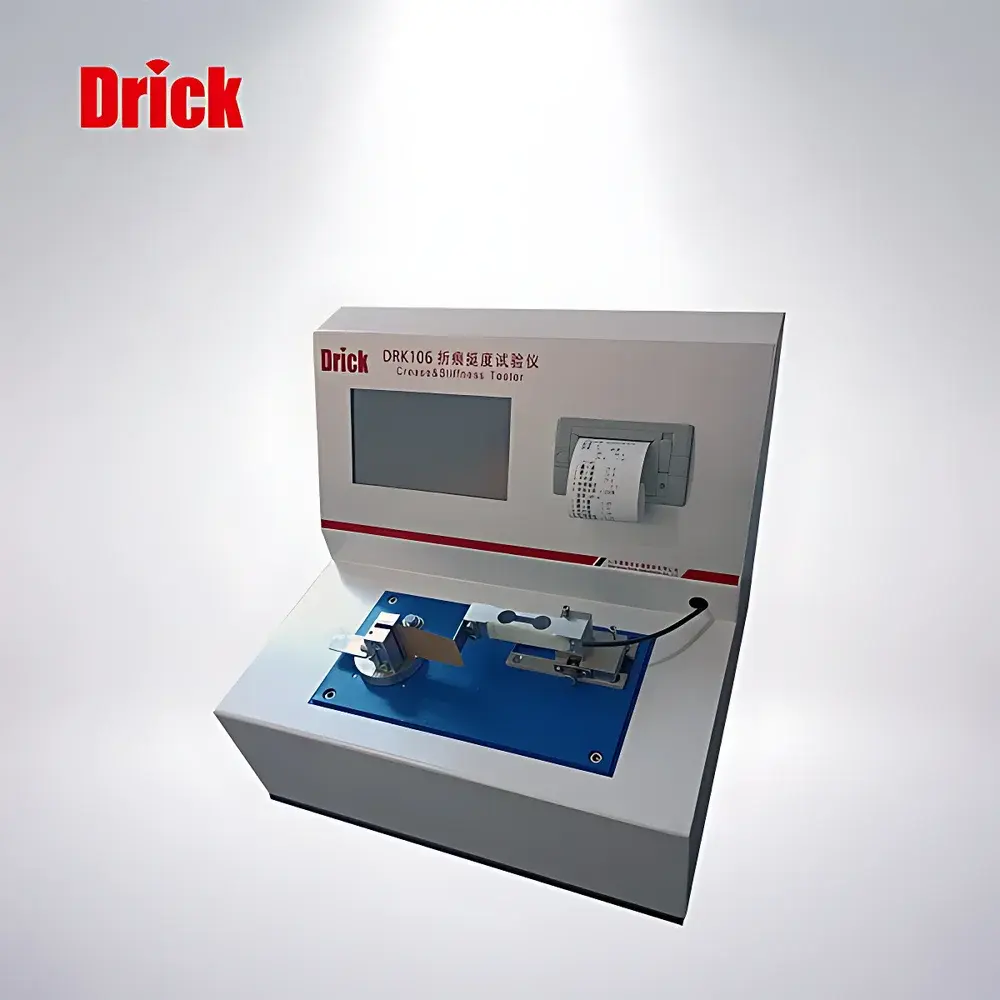
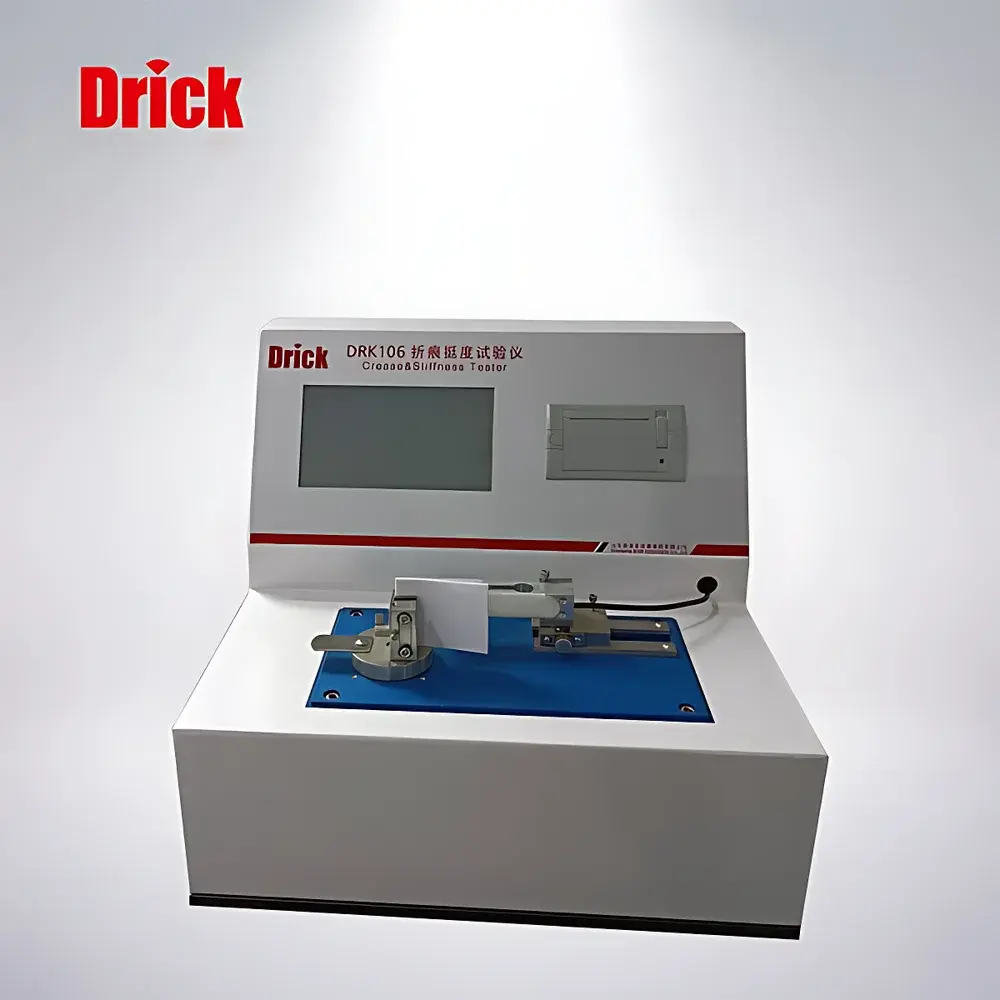
Drick DRK106 Horizontal Touchscreen Paper and Board Stiffness Tester (Crease & Sheet Stiffness)
| Brand | Drick |
|---|---|
| Origin | Shandong, China |
| Manufacturer Type | Direct Manufacturer |
| Regional Category | Domestic (China) |
| Model | DRK106 Horizontal |
| Price Range | USD 7,000 – 14,000 |
| Stiffness Measurement Range (Bending Force) | 15–300 mN |
| Resolution | 0.1 mN |
| Accuracy | ±0.6 mN (≤50 mN), ±1% (>50 mN) |
| Repeatability | ≤1% |
| Bending Length Options | (50±0.1) mm, (25±0.1) mm, (10±0.1) mm |
| Bending Angle | 15°±0.3°, 90°±0.3° |
| Bending Rate | 200°±20°/min (adjustable) |
| Crease Stiffness Specimen Size | 38×36 mm |
| Sheet Stiffness Specimen Size | 70×38 mm |
| Operating Temperature | 20°C±10°C |
| Power Supply | AC 220 V±5%, 50 Hz, Grounded |
Overview
The Drick DRK106 Horizontal Touchscreen Paper and Board Stiffness Tester is a precision instrument engineered for the static bending stiffness measurement of paper, paperboard, corrugated board, and other low-strength sheet-like non-metallic materials. It operates on the principle of controlled angular deflection under defined bending moment, in strict accordance with the fundamental mechanics described in ISO 5628:1995 — *Paper and board — Static bending stiffness — General principles*. The device implements a cantilever-type bending configuration, where a standardized specimen is clamped at one end and subjected to a precisely regulated angular displacement at the free end. The resulting resisting bending force is measured via high-resolution load cell technology, enabling direct quantification of material resistance to flexural deformation. Designed primarily for compliance with GB/T 2679.3–2021 (*Determination of stiffness of paper and board*) and fully compatible with ISO 2493:2016 (*Paper and board — Determination of bending resistance*), the DRK106 supports dual-mode testing: conventional sheet stiffness (e.g., for packaging board rigidity assessment) and crease-line stiffness (critical for evaluating fold durability in carton design and folding box manufacturing).
Key Features
- Horizontal ergonomic layout with integrated 7-inch capacitive touchscreen interface for intuitive test setup, real-time curve visualization, and one-touch report generation
- Dual-bending-length capability: selectable bending spans of 10 mm, 25 mm, and 50 mm—each calibrated to ±0.1 mm tolerance—to accommodate diverse material thicknesses and stiffness ranges per ISO 5628 requirements
- Precisely regulated bending angles: 15°±0.3° (for low-stiffness papers) and 90°±0.3° (for rigid boards), both executed at a nominal rate of 200°/min (±20°/min), adjustable within operational limits
- High-fidelity force transduction system with 0.1 mN resolution and traceable accuracy: ±0.6 mN below 50 mN; ±1% full-scale above 50 mN
- Robust mechanical architecture featuring hardened steel jaws, linear-motion guide rails, and vibration-damped base assembly to ensure ≤1% measurement repeatability across repeated cycles
- Compliant specimen handling: dedicated fixtures for both crease stiffness (38 × 36 mm) and sheet stiffness (70 × 38 mm) configurations, aligned to dimensional tolerances specified in GB/T 2679.3 and ISO 2493
Sample Compatibility & Compliance
The DRK106 accommodates a broad spectrum of fibrous sheet materials, including but not limited to kraft linerboard, solid bleached sulfate (SBS), coated recycled board, corrugated medium, and specialty laminated packaging substrates. Its bending force range (15–300 mN) corresponds to typical static bending moments of 2–1000 mN·m, making it suitable for materials with ISO 5628-defined stiffness values from ~0.1 to ~150 mN·m. All mechanical and metrological aspects conform to national and international standards: GB/T 2679.3–2021, ISO 2493:2016, and the foundational methodology of ISO 5628:1995. While not inherently 21 CFR Part 11 compliant out-of-the-box, the system’s audit-trail-capable software mode (optional firmware upgrade) supports GLP/GMP-aligned documentation workflows—including user login tracking, parameter change logs, and electronic signature-ready PDF reports.
Software & Data Management
The embedded control software provides real-time graphical display of force vs. angle curves, automatic peak detection for maximum bending resistance, and configurable pass/fail thresholds based on user-defined specification limits. Test data are stored in timestamped CSV and XML formats, with metadata including operator ID, environmental conditions (manual entry), specimen ID, bending length, angle, and calibration certificate reference. Export options include direct USB transfer and network-enabled Ethernet output (optional). Raw data files retain full traceability for retrospective analysis or regulatory submission. Optional PC-based software extension enables batch statistical reporting (mean, SD, CV%), SPC charting, and integration with LIMS via ODBC-compliant drivers.
Applications
- Quality assurance of folding cartons: quantifying crease-line stiffness to predict fold cracking and hinge fatigue life
- Board supplier qualification: verifying stiffness consistency across production lots per TAPPI T 543 or ISO 2493 specifications
- R&D of sustainable packaging: comparative evaluation of fiber composition, coating formulations, and moisture conditioning effects on bending resistance
- Corrugated board optimization: correlating flute geometry and liner combinations with static stiffness metrics relevant to box compression strength modeling
- Standards laboratory accreditation: supporting ISO/IEC 17025 method validation for paper physical testing procedures
FAQ
What standards does the DRK106 comply with?
It is designed and verified for full conformance with GB/T 2679.3–2021 and ISO 2493:2016, and its mechanical operation aligns with the general principles of ISO 5628:1995.
Can the DRK106 measure both sheet and crease stiffness on the same platform?
Yes—dual specimen fixtures and programmable bending parameters allow seamless switching between sheet stiffness (70 × 38 mm) and crease stiffness (38 × 36 mm) modes without hardware modification.
Is environmental conditioning required before testing?
Per ISO 187 and GB/T 10739, specimens must be conditioned at 23°C ±1°C and 50% RH ±2% for ≥24 h prior to testing; the DRK106 itself operates reliably within 20°C ±10°C ambient temperature.
Does the system support automated calibration verification?
It includes built-in zero-point and span-check routines using NIST-traceable reference weights; full external calibration requires certified dead-load kits (available separately).
What power supply stability is recommended?
AC 220 V ±5%, 50 Hz, with reliable grounding; voltage fluctuations beyond this range necessitate an industrial-grade line conditioner or servo-stabilizer.






