
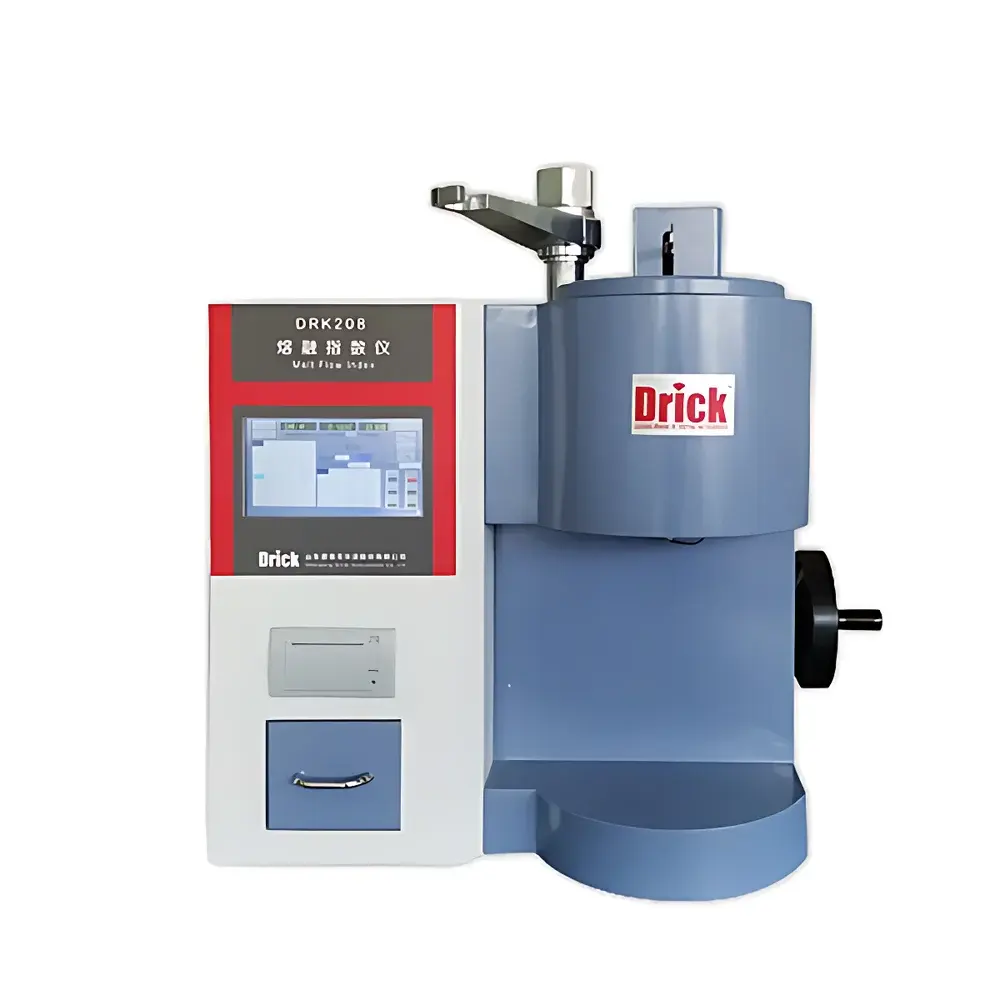
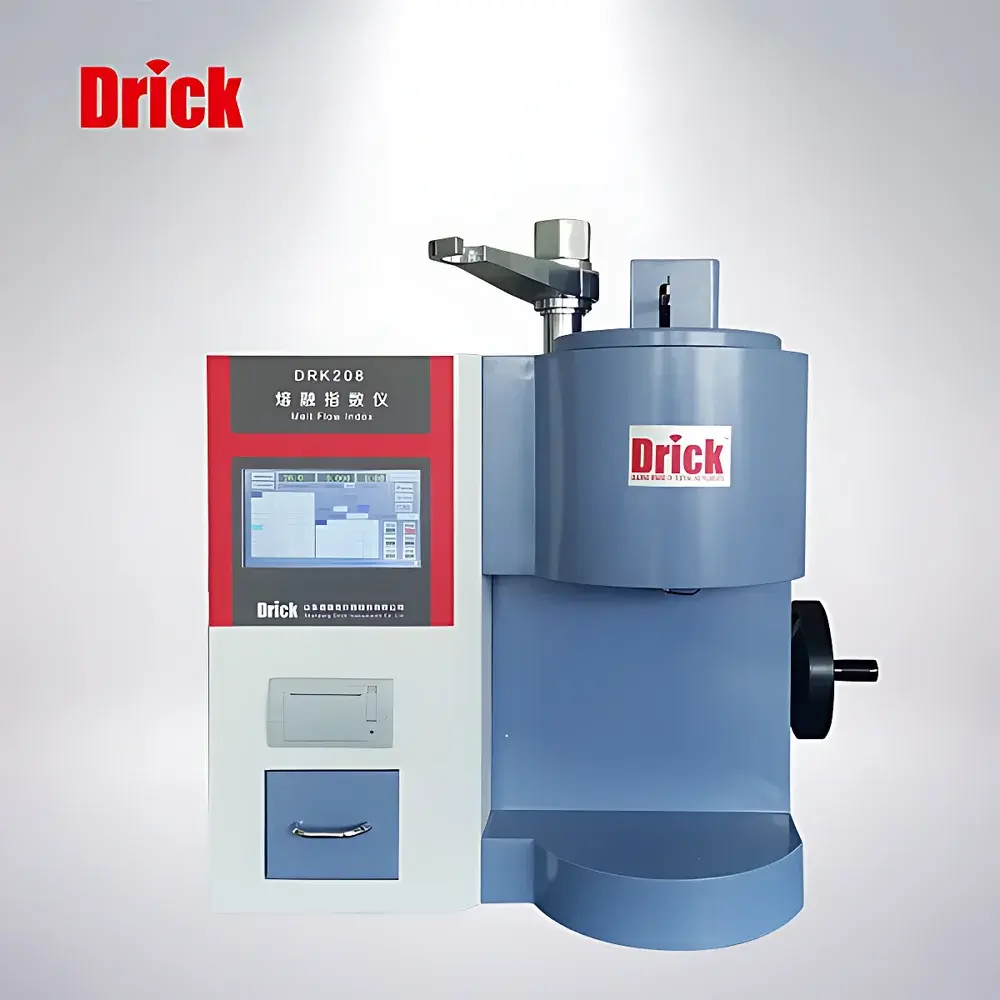
Drick DRK208 Microcontroller-Based High-Range Melt Flow Rate Tester for Meltblown Polypropylene
| Brand | Drick |
|---|---|
| Origin | Shandong, China |
| Manufacturer Type | Direct Manufacturer |
| Country of Origin | China |
| Model | DRK 208 |
| Price | USD 7,000 (FOB Qingdao) |
| Standards Compliance | GB/T 3682, ISO 1133, ASTM D1238, ASTM D3364, DIN 53735, UNI 5640, JJG B78–94, JB/T 5456 |
| Temperature Range | 50–400 °C |
| Temp. Accuracy | ±0.1 °C |
| Display Resolution | 0.01 °C |
| MFR Range | 0.01–1500.00 g/10 min |
| MVR Range | 0.01–1500.00 cm³/10 min |
| Melt Density Range | 0.001–9.999 g/cm³ |
| Barrel ID | 9.55 ± 0.025 mm |
| Barrel Length | 160 mm |
| Piston Head Diameter | 9.475 ± 0.01 mm |
| Piston Mass | 106 g |
| Die ID | 2.095 mm |
| Die Length | 8 ± 0.025 mm |
| Standard Loads | 0.325, 1.2, 2.16, 3.8, 5.0, 10.0, 21.6 kg (±0.5% accuracy) |
| Displacement Range | 0–30 mm |
| Displacement Accuracy | ±0.05 mm |
| Power Supply | 220 V ± 10%, 50 Hz |
| Heating Power | 550 W |
| Dimensions (L×W×H) | 560 × 376 × 530 mm |
| Control Mode | PID microcontroller-based temperature regulation |
| Cutting Mode | Manual or automatic timed/position-triggered cutting |
| Measurement Input | Encoder-based displacement acquisition |
| Output | MFR, MVR, melt density |
| Data Handling | Manual mass entry, thermal stability logging, printable report generation |
Overview
The Drick DRK208 Microcontroller-Based High-Range Melt Flow Rate Tester is a precision instrument engineered for the quantitative characterization of thermoplastic polymers—specifically polypropylene (PP) resins used in meltblown nonwovens for medical face masks, surgical gowns, and protective apparel. It operates on the principle of extrusion plastometry defined in ISO 1133 and ASTM D1238, where molten polymer is forced through a standardized capillary die under controlled temperature and specified load conditions. The resulting mass or volume of extrudate collected over a fixed time interval (typically 10 minutes) yields the Melt Mass Flow Rate (MFR) or Melt Volume Flow Rate (MVR), respectively—key rheological indicators directly correlated with molecular weight distribution, processability, and fiber fineness in meltblown production.
Key Features
- PID-controlled microprocessor system ensures stable thermal regulation across the full operating range (50–400 °C), with temperature accuracy maintained at ±0.1 °C and display resolution of 0.01 °C.
- Dual-mode extrudate cutting: user-selectable timed or position-triggered automatic cutting, synchronized with encoder-based displacement sensing (0–30 mm range, ±0.05 mm accuracy).
- Comprehensive load configuration: seven calibrated standard weights (0.325–21.6 kg), traceable to national metrological standards, each certified to ±0.5% mass tolerance per JB/T 5456.
- Integrated measurement workflow: manual mass input for specimen weighing, real-time calculation of MFR (g/10 min), MVR (cm³/10 min), and derived melt density (g/cm³).
- Robust mechanical architecture: precision-machined barrel (ID 9.55 ± 0.025 mm, length 160 mm), hardened piston (head diameter 9.475 ± 0.01 mm, mass 106 g), and interchangeable dies (standard 2.095 mm ID, length 8 ± 0.025 mm).
- Thermal and mechanical validation support: built-in calibration routines for temperature uniformity verification and load verification per ISO 1133 Annex B and ASTM D1238 Annex A.
Sample Compatibility & Compliance
The DRK208 is validated for homopolymer and copolymer polypropylenes meeting the high-flow specifications required in medical-grade meltblown production—particularly those with MFR values up to 1500 g/10 min. It accommodates both virgin and stabilized PP grades, including those formulated with peroxide degradation additives. The instrument fully complies with international standard test methods including ISO 1133-1 (Method A), ASTM D1238 (Condition L, M, N, O), GB/T 3682–2018, and DIN 53735. Its design and verification protocols align with GLP documentation requirements, supporting audit-ready test records when paired with laboratory information management systems (LIMS). While not inherently 21 CFR Part 11 compliant, the instrument’s deterministic output and manual data entry workflow are compatible with validated electronic record procedures under FDA-regulated environments.
Software & Data Management
The DRK208 operates via an embedded microcontroller interface with no proprietary software dependency. All operational parameters—including setpoint temperature, selected load, cut timing, and displacement trigger thresholds—are configured directly on the front-panel keypad. Test results (MFR, MVR, melt density) are displayed in real time and may be manually recorded or printed via integrated thermal printer (optional). For laboratories requiring digital traceability, raw time-stamped temperature logs and displacement profiles can be exported via RS232 serial interface to external PCs running custom or third-party data acquisition software. The system supports manual entry of operator ID, sample ID, and batch number—enabling alignment with internal QA documentation templates aligned with ISO/IEC 17025 Clause 7.7 (Results Reporting).
Applications
- Quality control of meltblown PP feedstock for N95 and surgical mask manufacturing lines.
- R&D screening of peroxide-modified PP formulations targeting ultra-high MFR (>1000 g/10 min) without gel formation.
- Verification of resin lot-to-lot consistency prior to extrusion die installation.
- Supporting technical documentation for regulatory submissions (e.g., CE marking Annex II, FDA 510(k) biocompatibility dossiers).
- Validation of thermal degradation behavior under extended dwell times at elevated temperatures (e.g., 230–270 °C).
- Correlation studies between MFR and downstream fiber diameter distribution measured by SEM or laser diffraction.
FAQ
What is the maximum measurable MFR value supported by the DRK208?
The instrument is calibrated and verified for MFR measurements up to 1500.00 g/10 min, consistent with current industry requirements for medical-grade meltblown polypropylene.
Does the DRK208 support automatic MVR calculation without manual density input?
No—MVR is calculated from measured extrudate volume; melt density must be entered manually or determined separately via pycnometry or dilatometry.
Can the DRK208 be used for materials other than polypropylene?
Yes, provided the material melts within the 50–400 °C range and flows through the 2.095 mm die under standard loads—e.g., certain grades of polyethylene, polystyrene, and ABS—but method validation per ISO 1133 is required for each matrix.
Is the barrel assembly compliant with ISO 1133 dimensional tolerances?
Yes—the barrel inner diameter (9.55 ± 0.025 mm) and die geometry (2.095 mm ID, 8 ± 0.025 mm length) meet ISO 1133–1 Table 1 specifications for Method A testing.
How is temperature uniformity verified during routine operation?
Users perform periodic checks using a calibrated immersion thermometer or platinum resistance thermometer (PRT) inserted into the barrel bore at three axial positions (top, middle, bottom), per ISO 1133 Annex C.





