
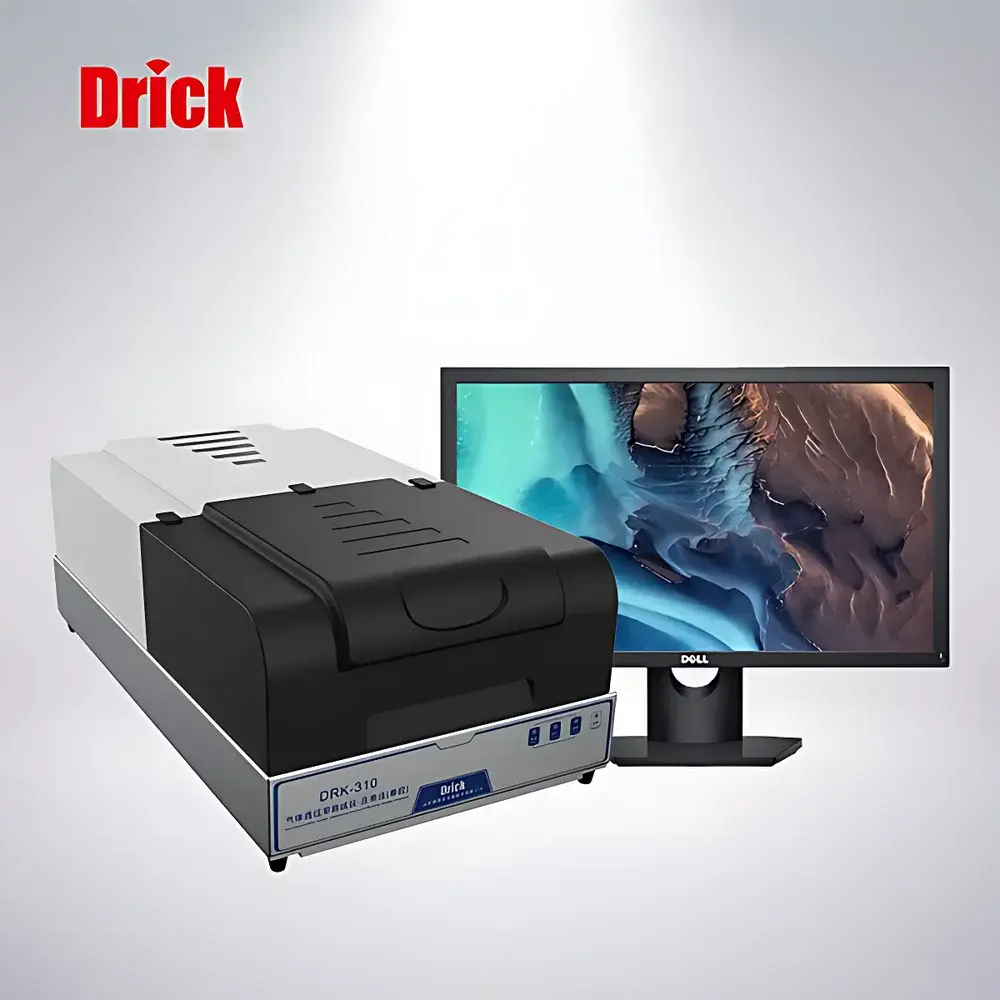
Drick DRK310 Triple-Chamber Independent Pressure-Difference Gas Permeation Analyzer
| Brand | Drick |
|---|---|
| Origin | Shandong, China |
| Manufacturer Type | Direct Manufacturer |
| Model | DRK310 |
| Measurement Range | 0.01–55,000 cm³/m²·24h·0.1 MPa |
| Sample Capacity | 3 independent test chambers |
| Vacuum Resolution | 0.1 Pa |
| Vacuum Range | 0–1333 Pa |
| Ultimate Vacuum | <10 Pa |
| Test Gas | O₂, N₂, CO₂ |
| Test Pressure Differential | 0–0.15 MPa |
| Temperature Range | 15–50 °C |
| Temperature Control Accuracy | ±0.05 °C |
| Power Supply | AC 220 V, 50 Hz, <1500 W |
| Net Weight | 65 kg |
| Dimensions (L×W×H) | 680 × 380 × 280 mm |
Overview
The Drick DRK310 Triple-Chamber Independent Pressure-Difference Gas Permeation Analyzer is a precision-engineered instrument designed for quantitative determination of gas transmission rates (GTR) through polymeric films, laminates, and rigid sheet materials under controlled temperature and pressure differential conditions. It operates on the principle of constant-pressure-difference (i.e., upstream/downstream pressure gradient) measurement using high-vacuum detection — a method standardized in GB/T 1038, ASTM D1434, ISO 2556, ISO 15105-1, JIS K7126-A, and YBB 00082003. Unlike single-chamber systems, the DRK310 integrates three physically isolated test cells, each equipped with independent vacuum control, pressure regulation, and real-time sensor feedback—enabling concurrent evaluation of heterogeneous samples without cross-contamination or shared environmental drift. This architecture ensures metrological integrity across comparative studies, regulatory submissions, and accelerated aging protocols where inter-sample variability must be minimized.
Key Features
- Triple independent test chambers with fully segregated vacuum lines, pressure manifolds, and thermal zones—eliminating cross-talk and enabling simultaneous multi-material or multi-condition testing.
- High-stability vacuum sensing system utilizing imported piezoresistive vacuum transducers (0.1 Pa resolution), calibrated traceably to national standards, ensuring reproducibility ≤±1.5% RSD over extended operational cycles.
- Advanced pneumatic architecture featuring precision solenoid valves and stainless-steel micro-bore tubing, engineered for rapid evacuation (<120 s to <10 Pa) and complete desorption of surface-adsorbed gases—critical for low-permeability barrier film characterization.
- Dual-mode test logic: configurable proportional control for stable differential pressure maintenance and fuzzy-logic-based endpoint detection for adaptive termination when permeation equilibrium is statistically confirmed.
- Integrated temperature-controlled chamber with PID-driven Peltier modules and dual-point RTD monitoring, delivering ±0.05 °C uniformity across all three test zones at setpoints from 15 °C to 50 °C.
- Full computer automation via embedded industrial controller; all calibration, test initiation, data logging, and report generation executed without manual intervention.
Sample Compatibility & Compliance
The DRK310 accommodates flat, non-porous specimens up to 100 mm in diameter—including monolayer plastics (e.g., PET, PP, PE), metallized films, AlOx/SiOx-coated substrates, pharmaceutical blister foils, and multilayer food packaging laminates. Each chamber accepts standard ASTM/ISO-compliant sample holders with fluoropolymer-sealed clamping mechanisms to prevent edge leakage. The system conforms to ISO/IEC 17025 documentation requirements for test method validation and supports full audit trails compliant with FDA 21 CFR Part 11, EU Annex 11, and GLP/GMP quality systems. All firmware and software modules undergo annual verification against reference gas standards (NIST-traceable O₂/N₂ mixtures) per internal SOP-QA-027.
Software & Data Management
The proprietary PermeaSoft™ v4.2 platform provides role-based access control aligned with GMP Annex 11 principles: administrator, analyst, and reviewer accounts with granular permissions for method editing, result approval, and electronic signature. Every test session logs timestamped metadata—including chamber-specific vacuum decay curves, real-time differential pressure profiles, temperature variance maps, and raw sensor voltage outputs—stored in encrypted SQLite databases with SHA-256 hashing. Export options include CSV, PDF (with digital signature watermark), and XML formats compatible with LIMS integration. Audit trail functionality records all user actions, parameter changes, and calibration events with immutable timestamps and operator IDs.
Applications
- Barrier performance qualification of flexible packaging for sterile medical devices (ISO 11607-1 compliance).
- Accelerated shelf-life modeling via Arrhenius-based permeability extrapolation across 15–50 °C.
- Development and QC of high-barrier OLED encapsulation films requiring sub-0.1 cm³/m²·24h·0.1 MPa O₂TR.
- Regulatory dossier preparation for FDA 510(k) submissions involving drug packaging integrity (YBB 00082003).
- Diffusion coefficient (D), solubility coefficient (S), and permeability coefficient (P = D × S) derivation via time-lag analysis per ISO 15105-1 Annex B.
FAQ
Does the DRK310 support mixed-gas permeation testing?
No—the system is configured for single-purity gas challenges (O₂, N₂, CO₂) under controlled partial pressure; mixed-gas diffusion requires supplementary gas blending modules not included in base configuration.
Can test data be exported directly to Excel or LIMS?
Yes—CSV and XML exports are natively supported; optional OPC UA gateway module enables real-time data streaming to enterprise LIMS platforms.
Is third-party calibration certification available?
Yes—Drick offers UKAS-accredited calibration services (certificate #DRK-CAL-2024-XXX) covering vacuum sensors, temperature probes, and pressure transducers, valid for 12 months.
What maintenance intervals are recommended for long-term accuracy?
Vacuum pump oil replacement every 1,000 operating hours; O-ring inspection and replacement every 6 months; annual full-system verification including leak rate validation (<5 × 10⁻⁹ mbar·L/s).





