
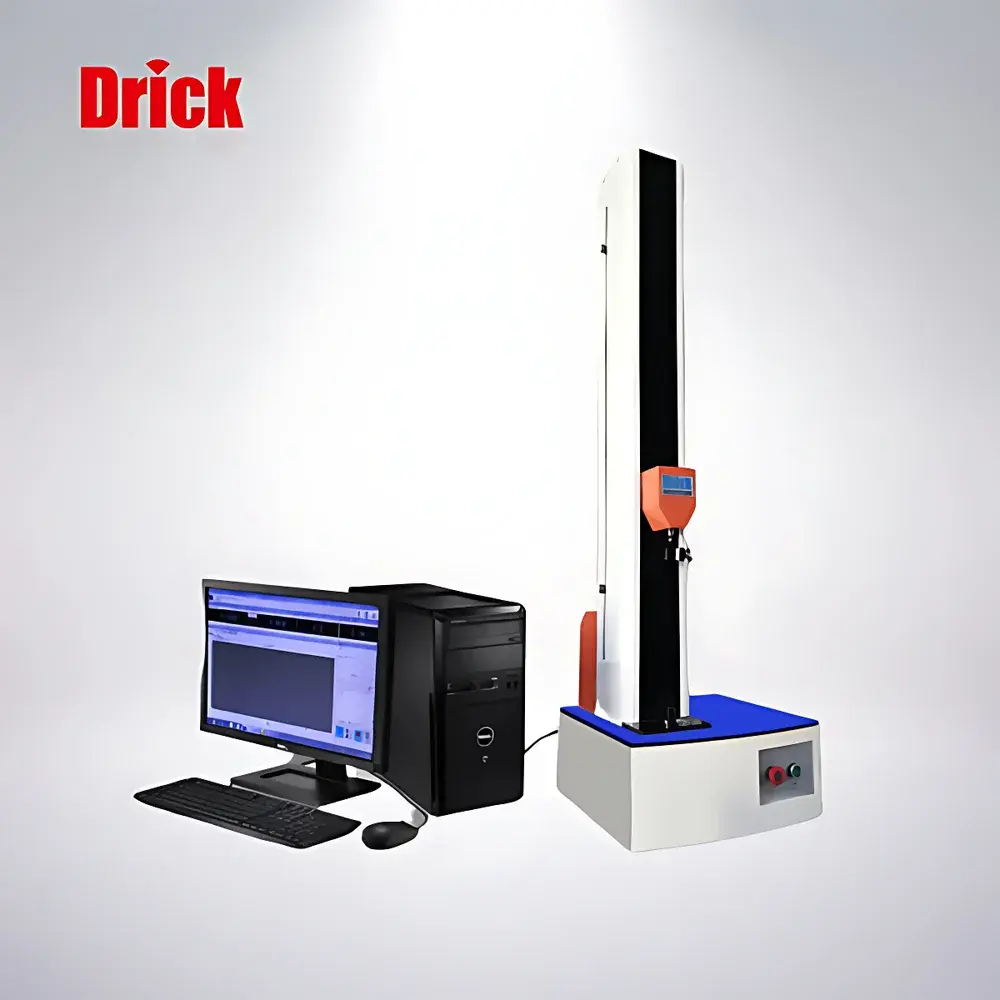
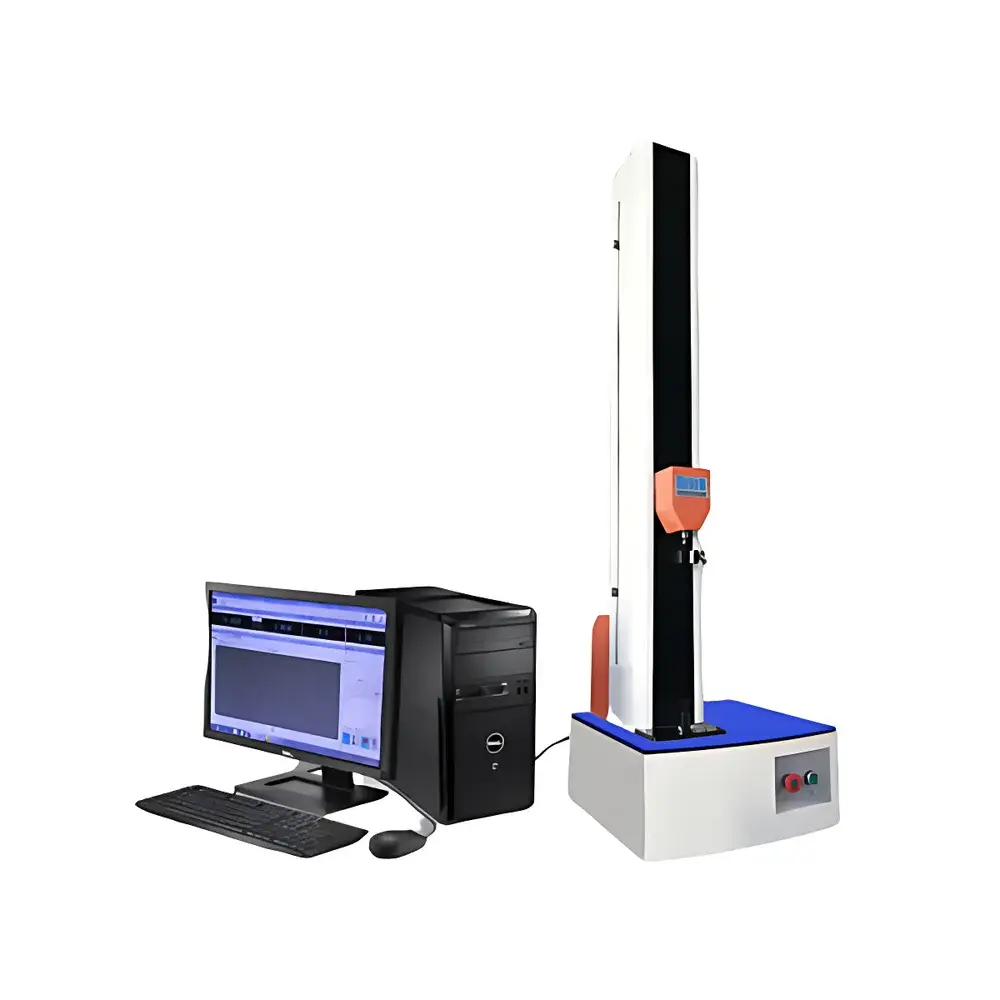
Drick DRK501 Pharmaceutical Aluminum Foil Packaging Performance Tester
| Brand | Drick |
|---|---|
| Origin | Shandong, China |
| Manufacturer Type | Manufacturer |
| Country of Origin | China |
| Model | DRK 501 |
| Load Capacity | 500 N (standard), optional 50 N / 100 N / 5000 N |
| Force Accuracy | Better than Class 0.5 |
| Force Resolution | 0.1 N |
| Displacement Resolution | 0.001 mm |
| Test Speed | 1–500 mm/min (infinitely variable) |
| Standard Sample Width | 30 mm (50 mm optional) |
| Standard Travel | 1000 mm (400 mm / 700 mm / 800 mm optional) |
| Dimensions | 500 mm (L) × 300 mm (W) × 1700 mm (H) |
| Drive System | Precision Ball Screw + Imported Servo Motor |
| Control Architecture | Embedded Real-Time System with Multi-Level Software Permissions |
| Sensor Support | Up to 4 interchangeable bidirectional load cells (auto-recognized) |
| Compliance Standards | YBB00152002-2015, YBB00212005-2015, YBB00232005-2015, YBB00222005-2015, YBB00182004-2015, YBB00202005-2015, YBB00242002-2015, YBB00212004-2015, YBB00132005-2015, YBB00142005-2015 |
Overview
The Drick DRK501 Pharmaceutical Aluminum Foil Packaging Performance Tester is a fully integrated, microprocessor-controlled universal testing system engineered for precise mechanical evaluation of primary and secondary pharmaceutical packaging materials and components. Designed in strict accordance with Chinese Pharmacopoeia supplementary standards—including YBB00152002-2015 (Aluminum Foil for Pharmaceutical Use), YBB00212005-2015 (Plastic-Capped Rubber Stopper), and YBB00232005-2015 (Aluminum-Plastic Composite Lid)—the instrument applies fundamental principles of uniaxial tensile mechanics, peel adhesion theory, and quasi-static force-displacement analysis to quantify critical functional parameters. Its modular architecture supports standardized test protocols across rigid, semi-rigid, and flexible packaging formats, enabling laboratories to perform regulatory-compliant mechanical characterization without cross-platform instrumentation.
Key Features
- Precision ball-screw actuation system coupled with imported servo motor ensures smooth, low-noise motion control and high positional repeatability over full stroke (up to 1000 mm standard)
- Embedded real-time control platform with multi-tier software permissions (Level 1–3) supporting audit-ready user access control, electronic signature, and 21 CFR Part 11–compatible data integrity workflows
- Auto-recognizing dual-range bidirectional load cell interface: accommodates up to four interchangeable sensors (50 N, 100 N, 500 N, 5000 N) with automatic calibration coefficient loading and unit scaling
- Real-time dynamic plotting of force–time, force–displacement, and force–strain curves with adjustable sampling frequency and exportable raw ASCII/CSV datasets
- Programmable test sequences including ramp-hold, cyclic loading, break-point detection, and conditional termination—enabling full compliance with ASTM F88, ISO 11607-2, and USP <1207> mechanical test requirements
- Integrated safety logic: automatic overload cutoff, mechanical end-stop protection, software-based travel limit enforcement, and self-diagnostic fault logging with error code reporting
Sample Compatibility & Compliance
The DRK501 is validated for mechanical testing of aluminum foil laminates, PVC/PVDC hard sheets, cold-forming blister films, alu-alu and alu-PVC blisters, rubber-stoppered vials, crimp-sealed ampoules, flip-off caps, and pre-filled syringe components (e.g., plunger glide, needle shield retention). It directly supports all mechanical test clauses specified in the YBB series of Chinese pharmaceutical packaging standards—including peel strength (YBB00152002-2015 §4.3), seal strength (YBB00222005-2015 §5.2), opening force of aluminum-plastic lids (YBB00142005-2015 §4.4), puncture resistance of stoppers (YBB00202005-2015 §5.5), and ampoule breaking force (YBB00132005-2015 §4.2). Optional fixtures extend applicability to ISO 8536-4 (glass containers), ISO 15747 (pre-filled syringes), and ASTM D3330 (adhesive tape peel).
Software & Data Management
The embedded DRK-TestSuite v4.x software provides GLP/GMP-aligned data governance: all test sessions generate immutable metadata (operator ID, timestamp, environmental conditions, calibration status), enforce electronic signatures, and maintain full audit trails per FDA 21 CFR Part 11 Annex 11 requirements. Raw force/displacement data is stored in vendor-neutral .csv format with millisecond-level time stamps. Statistical post-processing includes mean, SD, CV%, min/max, trend analysis, and pass/fail flagging against configurable specification limits. Reports comply with ISO/IEC 17025 documentation templates and support PDF export with embedded digital signatures and watermarking.
Applications
- Quantification of heat seal strength for aluminum foil–polymer laminates used in blister packaging
- Measurement of peel adhesion between aluminum foil and PVC hard sheet under controlled peel angle (90° or 180°)
- Determination of ampoule neck breaking force per YBB00132005-2015 and Ph. Eur. 3.2.1
- Evaluation of aluminum-plastic combination cap opening torque and puncture force for vial closures
- Assessment of piston glide force and barrel friction in pre-filled glass/polymer syringes
- Leak integrity verification via pressure-decay simulation using custom fixture integration
- Characterization of tensile modulus, yield point, and elongation at break for multilayer barrier films
FAQ
Does the DRK501 comply with international pharmacopeial standards beyond YBB?
Yes—the system’s test methodology, resolution, and traceability framework align with ISO 11607-2, ASTM F1140/F1886, USP <1207>, and Ph. Eur. 3.2.1 when configured with appropriate fixtures and calibration certificates.
Can the instrument perform both tension and compression tests on the same sample setup?
Yes—its bidirectional load cells and symmetrical crosshead design enable true push-pull mechanical testing without hardware reconfiguration.
Is third-party calibration certification available?
Drick provides NIST-traceable calibration certificates issued by CNAS-accredited laboratories, with optional on-site validation per IQ/OQ protocols.
How is data security enforced during multi-user operation?
Role-based access control (RBAC), encrypted local database storage, session timeout, and mandatory electronic signatures prevent unauthorized data modification or deletion.
What maintenance intervals are recommended for long-term accuracy?
Annual verification of force transducer linearity and displacement encoder accuracy is advised; ball-screw lubrication and motor performance checks are scheduled every 12 months or 2000 operational hours.





