
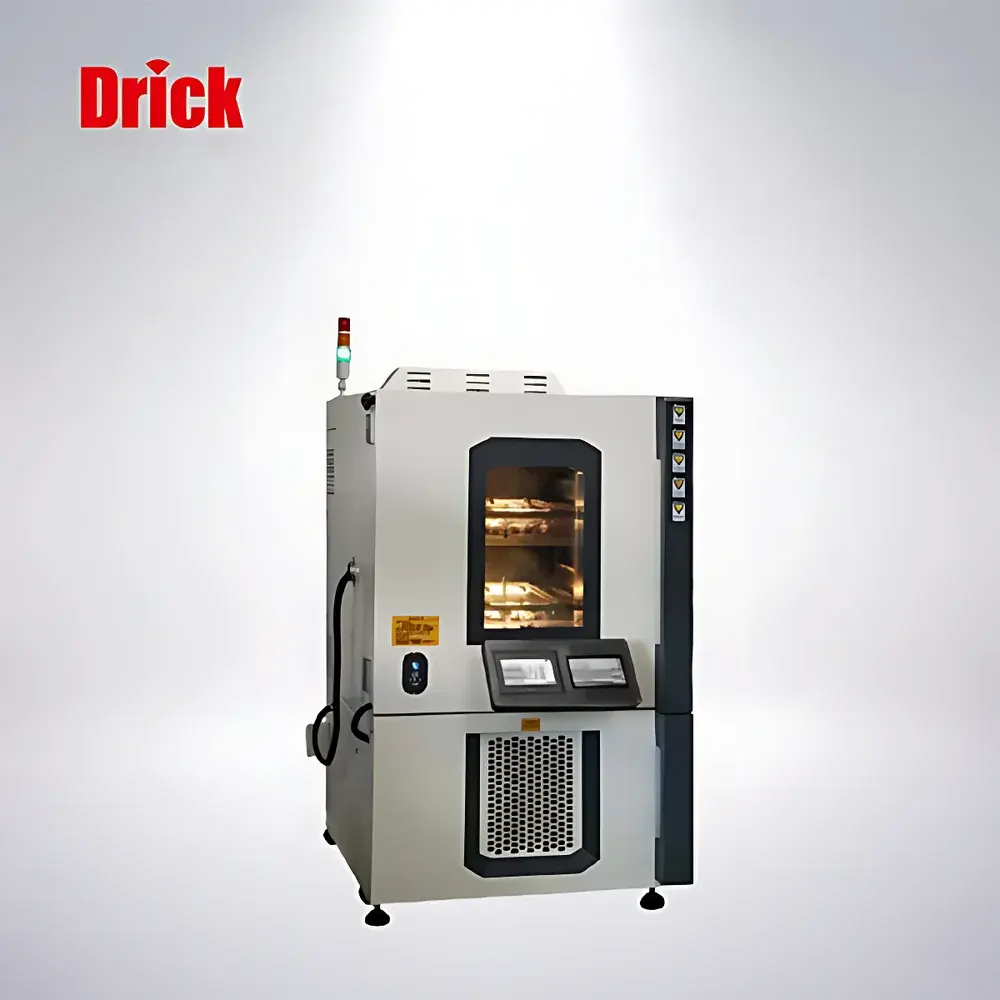
Drick DRK501F Gravimetric Cup Method Water Vapor Transmission Rate (WVTR) Tester with Integrated Environmental Chamber
| Brand | Drick |
|---|---|
| Origin | Shandong, China |
| Manufacturer Type | OEM/ODM Manufacturer |
| Region of Manufacture | Domestic (China) |
| Model | DRK501F |
| Price | USD 7,000 (FOB Qingdao) |
| Temperature Range | 0–130 °C ±1 °C |
| Humidity Range | 20–98 %RH ±2 %RH |
| Airflow Velocity | 0.5–2.5 m/s (variable-frequency, stepless adjustment) |
| Test Cup Capacity | 18 independent cups |
| Weighing Mode | Intermittent gravimetric measurement with auto-zeroing load cell |
| Test Methods | Gain-weight (desiccant inside cup, humid environment outside) and loss-weight (water inside cup, controlled humidity outside) |
| Chamber Dimensions (W×D×H) | 630 × 660 × 800 mm |
| Heating Power | 1500 W stainless-steel finned heater |
| Cooling System | 750 W Tecumseh (France) hermetic compressor |
| Humidification | Saturated steam generator |
| Power Supply | AC 220 V, 50 Hz, 2000 W |
| Overall Dimensions (W×H×D) | 850 × 1800 × 1550 mm |
| Weight | 350 kg |
| Timer Range | 0.01–99.99 hours |
| Compliance | GB 1037, GB/T 16928, ASTM E96, ASTM D1653, TAPPI T464, ISO 2528, DIN 53122-1, JIS Z0208, YBB 00092003 |
Overview
The Drick DRK501F Gravimetric Cup Method Water Vapor Transmission Rate (WVTR) Tester is a fully integrated, precision-engineered system for determining the moisture barrier performance of flexible packaging materials—including plastic films, laminates, aluminum foils, coated papers, and corrugated board—under rigorously controlled environmental conditions. It operates on the gravimetric cup principle defined in ISO 2528 and ASTM E96: a test specimen is sealed over a permeation cup containing either desiccant (for gain-weight mode) or distilled water (for loss-weight mode), then placed within a thermally and hygroscopically stabilized chamber. The change in cup mass over time is measured at predefined intervals using a high-stability, auto-zeroing electromagnetic force compensation balance. This method delivers traceable, reproducible WVTR values expressed in g·m⁻²·day⁻¹, serving as the reference standard for regulatory submissions, quality control release testing, and R&D material screening.
Key Features
- Integrated dual-zone environmental chamber with independent PID-controlled heating (1500 W stainless-steel finned heater), refrigeration (750 W Tecumseh hermetic compressor), and saturated steam humidification—enabling stable operation across the full range of 0–130 °C and 20–98 %RH (±1 °C / ±2 %RH).
- 18 independently monitored test positions with dedicated cup holders, each equipped with mechanical isolation to prevent cross-interference during intermittent weighing cycles.
- Programmable airflow system (0.5–2.5 m/s, variable-frequency drive) ensures uniform boundary-layer conditions per ASTM E96 Annex A4, minimizing edge effects and enhancing inter-laboratory reproducibility.
- Automated intermittent weighing mechanism with real-time load-cell auto-zeroing before each acquisition—eliminating drift-related error and supporting GLP-compliant audit trails.
- Front-access calibration port and external温湿度 verification interface allow in-situ validation of chamber conditions using NIST-traceable portable sensors without interrupting ongoing tests.
- 7-inch industrial-grade capacitive touchscreen HMI with intuitive navigation, multilingual UI (English/Chinese), and local data storage (≥10,000 test records) with USB export capability.
Sample Compatibility & Compliance
The DRK501F accommodates specimens up to Ø100 mm (standard cup diameter) and thicknesses up to 3 mm, making it suitable for monolayer films, coextrusions, metallized substrates, wax-coated papers, and pharmaceutical blister lidding materials. All mechanical, thermal, and metrological subsystems conform to the physical requirements stipulated in ISO 2528:2017, ASTM E96/E96M-23, and YBB 00092003 (Chinese Pharmacopoeia packaging standards). The system supports both gain-weight and loss-weight configurations per ASTM E96 Procedure A and B, respectively, and meets the chamber uniformity criteria outlined in ASTM D1653 Annex A1. Optional IQ/OQ documentation packages are available to support 21 CFR Part 11 readiness and GMP facility qualification.
Software & Data Management
Embedded firmware provides full test lifecycle management: method setup (temperature/humidity setpoints, airflow velocity, weighing interval, duration), real-time mass trend visualization, automatic calculation of WVTR and permeance per ISO 2528 Annex B, and linear regression-based slope analysis with R² reporting. Raw mass vs. time datasets are stored with timestamp, operator ID, environmental log (T/RH every 30 s), and metadata (cup ID, specimen lot, seal integrity flag). Export formats include CSV and PDF reports compliant with internal QA templates. For enterprise integration, optional Ethernet-enabled remote monitoring and data forwarding to LIMS via Modbus TCP or RESTful API is supported.
Applications
This instrument is routinely deployed in QC laboratories of packaging converters, food & beverage manufacturers, pharmaceutical packaging suppliers, and adhesive formulators. Typical use cases include: validating shelf-life predictions for moisture-sensitive products (e.g., dried dairy, nutraceutical tablets, roasted coffee); benchmarking barrier coatings (SiOx, AlOx, PVDC) against baseline PET or PP; assessing delamination risk in multi-layer structures under accelerated aging; and generating comparative WVTR datasets for supplier qualification under IATF 16949 or ISO 13485 frameworks. Its compliance with YBB 00092003 also enables direct use in Chinese NMPA-regulated pharmaceutical packaging dossiers.
FAQ
What standards does the DRK501F explicitly support?
ASTM E96 (Procedures A & B), ASTM D1653, ISO 2528, GB/T 1037, GB/T 16928, TAPPI T464, DIN 53122-1, JIS Z0208, and YBB 00092003.
Can the system perform simultaneous gain-weight and loss-weight tests?
Yes—18 independent cups allow mixed-mode operation; users may assign subsets to desiccant-filled or water-filled configurations within the same test run.
Is the weighing mechanism compliant with GLP audit requirements?
Yes—the auto-zeroing load cell, timestamped mass logs, operator authentication, and electronic signature-capable report generation meet core GLP data integrity expectations.
Does the chamber support temperature ramping or only static setpoints?
Static setpoint control only; the system is optimized for steady-state diffusion measurement per gravimetric standards—not dynamic thermal profiling.
What maintenance is required for long-term accuracy?
Quarterly verification of chamber uniformity (per ASTM D1653), biannual load-cell calibration with certified weights, and annual replacement of steam generator scale-inhibitor cartridges.




