
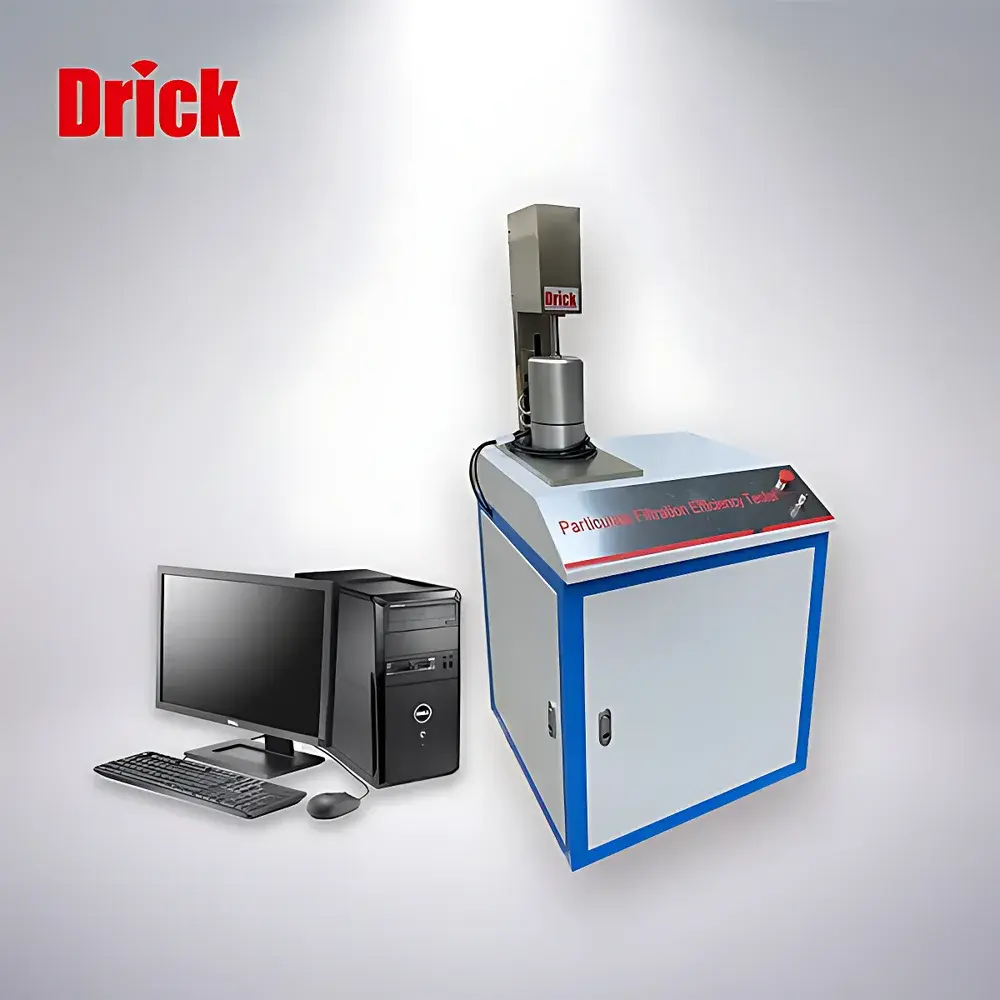
Drick DRK506 Particle Filtration Efficiency Tester for Meltblown Fabric and Respiratory Protective Devices
| Brand | Drick |
|---|---|
| Origin | Shandong, China |
| Manufacturer Type | Direct Manufacturer |
| Country of Origin | China |
| Model | DRK506 |
| Test Flow Rate | 5–100 L/min (±1% accuracy) |
| Pressure Range | 0–2500 Pa (±1% accuracy) |
| Aerosol Concentration Range | 0.001–100 μg/L (0.001 μg/L resolution) |
| Salt Aerosol CMD | (0.075 ± 0.02) μm |
| Optional Oil Aerosol CMD | (0.185 ± 0.02) μm |
| Temperature Control | 20 ± 5 °C |
| Noise Level | <60 dB(A) |
| Power Supply | AC 220 V ±10%, 50 Hz |
| Dimensions (L×W×H) | 700 × 720 × 1450 mm |
Overview
The Drick DRK506 Particle Filtration Efficiency Tester is a precision-engineered instrument designed specifically for quantitative assessment of filtration performance in meltblown nonwovens, surgical masks, N95 respirators, and other airborne particulate filtering media. It operates on the principle of real-time aerosol photometry—measuring upstream and downstream particle mass concentrations using calibrated light-scattering photometers—to determine filtration efficiency (%) as defined by differential concentration decay across the test sample under controlled airflow conditions. The system conforms to the core physical measurement paradigm required by international respiratory protection standards, including ISO 16900-1 (Respiratory protective devices — Methods of test — Part 1: Determination of filtration efficiency), ASTM F2299 (Standard Test Method for Determining the Initial Efficiency of Materials Used in Medical Face Masks to Penetration by Particulates Using Latex Spheres), and EN 14683:2019 (Medical face masks — Requirements and test methods). Its primary operational mode employs sodium chloride (NaCl) aerosol as a standardized non-oily challenge agent, with optional dioctyl phthalate (DOP) or polyalphaolefin (PAO) capability for oil-based evaluation per GB 2626–2019 and EN 143:2000.
Key Features
- Integrated NaCl aerosol generator with precise control over particle number median diameter (CMD = 0.075 ± 0.02 µm) and gravimetric concentration (0.001–100 µg/L), ensuring repeatability across regulatory test cycles.
- Dual-channel high-stability photometric detection system with automatic optical path cleaning alerts based on cumulative sampling time—minimizing drift and maintaining long-term signal fidelity.
- Programmable flow control architecture featuring a high-accuracy digital mass flow meter (resolution: 0.01 L/min; uncertainty: ±1% FS) and low-pulsation vacuum pump, enabling stable delivery across the full 5–100 L/min range.
- Modular fixture system accommodating flat filter media, cup-shaped surgical masks, folded respirators, and 3D-molded facepieces—compatible with all common medical and industrial PPE geometries.
- Automated calculation engine that computes both filtration efficiency (%) and pressure drop (ΔP, Pa) in real time, generating traceable reports compliant with GLP documentation requirements.
- Onboard environmental monitoring for ambient temperature (20 ± 5 °C operational envelope) and acoustic noise (<60 dB[A]), supporting ISO/IEC 17025-compliant laboratory validation protocols.
Sample Compatibility & Compliance
The DRK506 supports testing of flat fabric specimens (e.g., meltblown polypropylene layers), finished medical masks (YY 0469–2011, YY/T 0969–2013), reusable elastomeric respirators (GB 2626–2019), and industrial filter media (GB/T 32610–2016). All test configurations adhere strictly to the sampling geometry, face velocity, and challenge aerosol specifications outlined in referenced standards. The instrument’s mechanical design—including sealed aerosol chamber integrity, laminar flow conditioning, and electrostatic discharge mitigation—ensures compliance with ISO 16900-1 Annex B verification procedures. Calibration traceability is maintained via NIST-traceable photometer reference standards and certified flow calibration adapters.
Software & Data Management
The embedded firmware supports automated test sequencing, real-time data logging at 1 Hz resolution, and export of CSV-formatted datasets containing timestamped flow rate, upstream/downstream concentration, ΔP, efficiency, and system diagnostics. Audit trails record operator ID, test parameters, calibration events, and firmware version history—fully aligned with FDA 21 CFR Part 11 requirements for electronic records and signatures when deployed in regulated quality assurance environments. Optional PC-based software provides advanced statistical analysis (e.g., mean efficiency ± standard deviation across replicate samples), graphical overlay of efficiency vs. particle size distribution (when paired with SMPS integration), and customizable report templates for internal QA or third-party certification submission.
Applications
- Quality control of meltblown web production lines—monitoring batch-to-batch consistency in filtration grade PP nonwovens.
- Regulatory pre-submission testing for Class I/II medical device registration (NMPA, FDA 510(k), CE-MDR).
- Material R&D for next-generation electret-charged filters, nanofiber composites, and antimicrobial-coated media.
- Validation of decontamination efficacy following multiple sterilization cycles (e.g., vaporized hydrogen peroxide, UV-C).
- Comparative benchmarking of filter media against WHO-recommended PPE performance thresholds for healthcare settings.
- Training and proficiency testing in national CDC laboratories and accredited medical device testing centers.
FAQ
What aerosol generation method does the DRK506 use for non-oily particle challenge?
It employs a thermally generated sodium chloride (NaCl) aerosol with controlled CMD of 0.075 ± 0.02 µm, meeting the monodisperse requirement specified in YY 0469–2011 and ISO 16900-1.
Can the system be used for oil-based aerosol testing?
Yes—optional DOP or PAO aerosol generation modules are available, enabling compliance with GB 2626–2019 oil aerosol classification and EN 143:2000 oil mist resistance testing.
Is the instrument suitable for GLP or GMP-regulated laboratories?
Yes—the firmware includes audit trail logging, user access levels, electronic signature support, and calibration management tools fully compatible with ISO/IEC 17025 and FDA 21 CFR Part 11 requirements.
How is flow rate stability ensured during extended testing?
Through closed-loop feedback control between the digital mass flow meter and variable-speed vacuum pump, maintaining ±1% deviation across 5–100 L/min even under variable backpressure conditions.
Does the DRK506 require external compressed air or vacuum sources?
No—it integrates a self-contained, oil-free vacuum pump and internal aerosol generator; only standard AC 220 V power supply is required for operation.





