
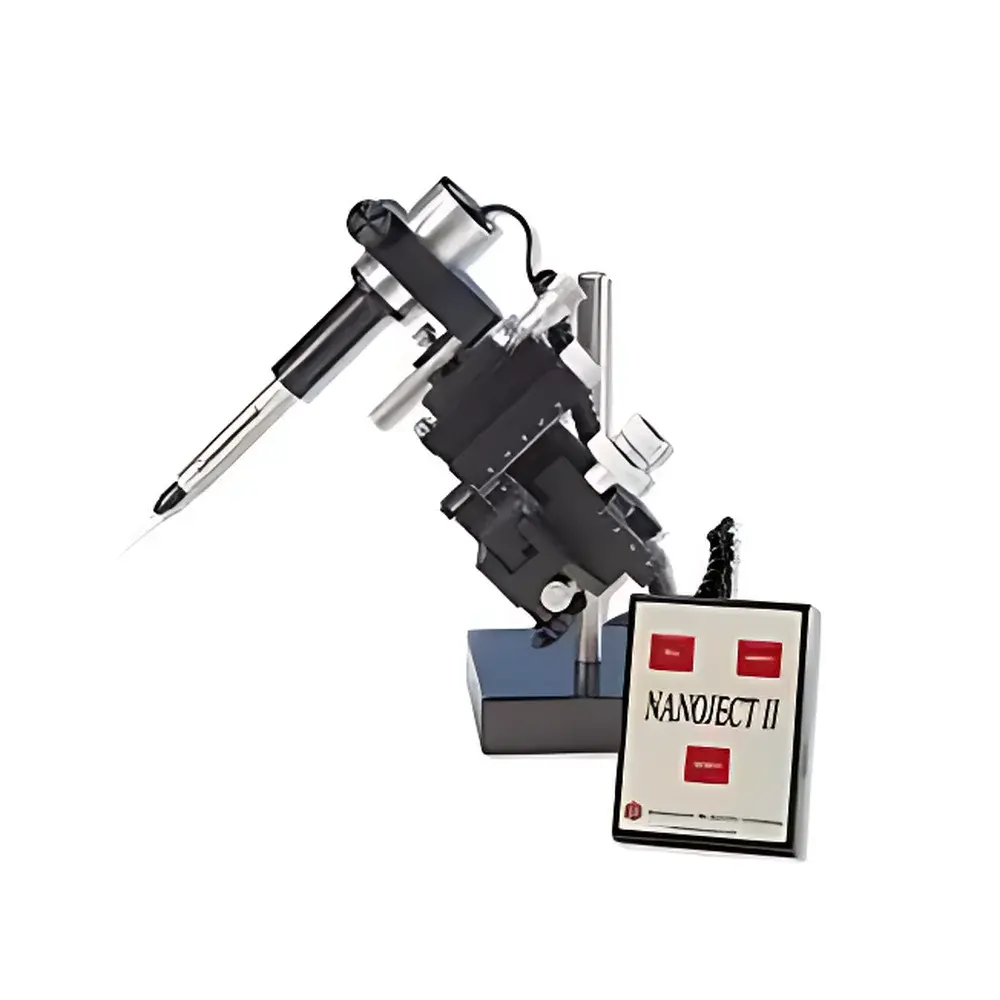
Drummond Nanoject II Auto-Nanoliter Injector
| Brand | Drummond |
|---|---|
| Origin | USA |
| Model | Nanoject II Auto-Nanoliter Injector |
| Injection Volume Range | 2.3–69.0 nL |
| Filling Rate | 46 nL/s (fast), 23 nL/s (slow) |
| Injection Rate | 46 nL/s (fast), 23 nL/s (slow) |
| Emptying Rate | 230 nL/s (fast), 92 nL/s (slow) |
| Capillary Material | Borosilicate Glass, Softening Point: 780 °C |
| Included Accessories | 200 borosilicate glass capillaries, maintenance kit, foot switch, universal adapter (3-000-024-A) |
Overview
The Drummond Nanoject II Auto-Nanoliter Injector is a precision-engineered microprocessor-controlled instrument designed for reproducible, non-rotating piston-based nanoliter-scale liquid delivery in live-cell and developmental biology applications. Operating on a positive-displacement principle with a linear actuation mechanism, the Nanoject II eliminates rotational torque during injection—critical for minimizing mechanical stress on fragile biological specimens such as oocytes, zygotes, blastocysts, and early-stage embryos. Its closed-loop control architecture ensures consistent volumetric accuracy across repeated injections, supporting high-fidelity intracellular, cytoplasmic, and pronuclear microinjection protocols essential in transgenic model generation, CRISPR-Cas9 genome editing, mRNA/cDNA delivery, and embryonic stem cell manipulation.
Key Features
- Non-rotating linear piston drive: Prevents torsional strain on capillaries and cellular membranes, significantly reducing cell lysis during ultra-low-volume delivery.
- Microprocessor-regulated dual-speed operation: Independent programmable control of fill, inject, and empty phases at two discrete rates—enabling fine-tuned optimization for viscous or volatile samples (e.g., oil-suspended nucleic acids or dye-labeled proteins).
- Integrated foot switch interface: Enables hands-free initiation of injection cycles without disrupting microscope focus or micromanipulator positioning—ideal for extended procedural workflows.
- Borosilicate glass capillary compatibility: Accepts standard Drummond 3-000-205-A tapered capillaries (softening point 780 °C), ensuring thermal stability during pull-and-fire protocols and resistance to chemical degradation from common biological solvents.
- Modular mounting system: Ships with Universal Adapter 3-000-024-A for seamless integration with major micromanipulator platforms including MM33 (left/right configurations), Narishige, Sutter, and Scientifica systems.
- Pre-calibrated volume range: Factory-set delivery from 2.3 nL to 69.0 nL per pulse, traceable to NIST-traceable gravimetric standards; no user recalibration required under normal operating conditions.
Sample Compatibility & Compliance
The Nanoject II is routinely deployed in GLP-compliant transgenic core facilities and academic embryology labs where regulatory adherence and inter-operator reproducibility are mandatory. Its design supports injection of aqueous buffers, glycerol-diluted nucleic acids, lipid nanoparticles, fluorescent tracers (e.g., FITC-dextran), and low-concentration protein solutions into mammalian, avian, amphibian, and invertebrate ova and embryos. The device meets electromagnetic compatibility (EMC) requirements per IEC 61326-1 and operates within Class II safety guidelines for laboratory electrical equipment. While not FDA-cleared as a medical device, its operational parameters align with ISO 13485-aligned quality management practices used by contract research organizations performing preclinical embryo manipulation services.
Software & Data Management
The Nanoject II operates via embedded firmware with no external software dependency—ensuring deterministic timing and eliminating OS-level latency or driver conflicts. All injection parameters (volume, speed mode, cycle count) are stored in non-volatile memory and recalled instantly upon power-up. For auditability, each unit logs internal operational timestamps (power-on, last injection event, error flags) accessible via serial diagnostic port (RS-232). When integrated into validated laboratory information management systems (LIMS), the foot switch trigger signal can be wired to external PLCs or data acquisition modules to generate time-stamped metadata compliant with 21 CFR Part 11 electronic record requirements—provided supplementary validation documentation is maintained by the end user.
Applications
- Microinjection of CRISPR ribonucleoprotein (RNP) complexes into mouse zygotes for founder line generation.
- Cytoplasmic delivery of antisense morpholinos into Xenopus laevis embryos for loss-of-function phenotyping.
- Pronuclear injection of linearized transgene constructs in rat and rabbit IVF-derived embryos.
- Intracytoplasmic sperm injection (ICSI) support in assisted reproductive technology (ART) research models.
- Targeted delivery of quantum dots or gold nanorods for subcellular photothermal ablation studies.
- High-throughput oocyte enucleation and nuclear transfer in somatic cell cloning protocols.
FAQ
What capillary types are compatible with the Nanoject II?
The instrument is optimized for Drummond borosilicate glass capillaries (part #3-000-205-A), but accepts any 1.0 mm OD, 0.78 mm ID pulled or beveled capillary with standard taper geometry.
Can injection volume be adjusted between pulses during a single experiment?
Yes—volume is digitally selectable in 0.1 nL increments via front-panel encoder; changes take effect immediately without interrupting ongoing sequences.
Is sterilization of the Nanoject II body permitted?
No—the main unit is not autoclavable or chemically sterilizable; only capillaries and disposable adapters should undergo sterilization per institutional biosafety protocols.
How often does the piston seal require replacement?
Under typical usage (≤500 injections/week), the fluoropolymer piston seal maintains performance for ≥12 months; a maintenance kit (included) contains replacement seals and cleaning tools.
Does the Nanoject II support pressure-compensated injection for deep-tissue work?
No—it is a displacement-based system; for hydrostatic pressure modulation (e.g., in brain slice or organoid injection), users must integrate an external pressure controller upstream of the capillary holder.





