
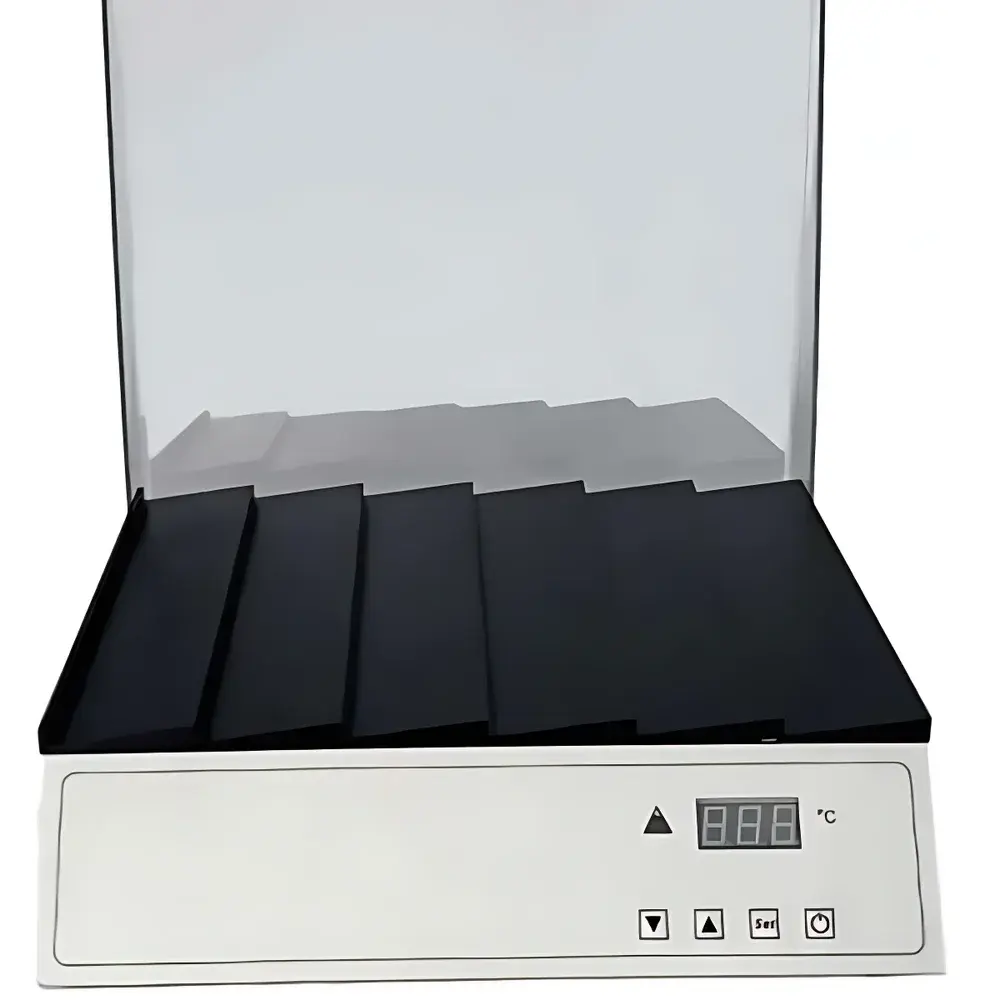
DS DK-100B Tissue Flattening and Baking Station
| Brand | DS |
|---|---|
| Model | DK-100B |
| Temperature Range | 0–99°C (continuously adjustable) |
| Temperature Accuracy | ±0.5°C |
| Power Supply | AC 220 V, 50 Hz or AC 110 V, 60 Hz |
| Rated Power | 300 W |
| Operating Ambient Temperature | 0–40°C |
| External Dimensions | 330 × 330 × 90 mm |
| Working Surface Dimensions | 330 × 280 mm |
| Sample Capacity | 66 standard microscope slides (75 × 25 mm) |
| Heating Method | Imported surface-mount polymer heating film |
| Control System | Self-developed PID algorithm with zero-error calibration capability |
| Dust Protection | Integrated removable dust cover |
| Compliance | Designed for routine histopathology lab workflows per ISO 15189-aligned pre-analytical handling practices |
Overview
The DS DK-100B Tissue Flattening and Baking Station is a precision-engineered thermal platform designed specifically for the standardized drying, flattening, and adhesion enhancement of tissue sections mounted on glass microscope slides—critical pre-analytical steps in histopathology laboratories. Unlike generic hot plates or benchtop ovens, the DK-100B implements a gradient-stage work surface geometry to accommodate uniform heat distribution across multiple slide rows while minimizing thermal stratification. Its core function relies on controlled conductive heating via a high-reliability polymer-based surface-mount heating film, enabling rapid thermal response (<60 s to reach setpoint from ambient) and stable maintenance of temperature setpoints within ±0.5°C under continuous operation. The device operates without forced convection, eliminating airflow-induced section displacement or dehydration artifacts—essential for preserving morphological integrity prior to H&E or immunohistochemical staining.
Key Features
- Gradient-tiered working surface (330 × 280 mm) optimized for sequential placement of up to 66 standard 75 × 25 mm glass slides—no stacking or overlapping required.
- Self-developed PID temperature control algorithm with real-time feedback compensation, ensuring minimal overshoot and sustained stability at any setpoint between 0°C and 99°C.
- Imported surface-mount heating film provides uniform thermal conductivity across the entire platform, eliminating hot spots and extending service life beyond 10,000 operational hours.
- Integrated removable dust cover—mechanically sealed to prevent particulate ingress during idle periods, reducing contamination risk and mitigating long-term oxidation of heated surfaces.
- Dual-voltage compatibility (AC 220 V / 50 Hz or AC 110 V / 60 Hz) with universal input design, supporting deployment in both North American and EU/Asian laboratory environments without adapter requirements.
- Zero-error calibration mode allows users to perform on-site offset correction against certified reference thermometers—supporting internal quality assurance protocols.
Sample Compatibility & Compliance
The DK-100B accommodates all standard histological glass slides (including charged, APES-coated, and poly-L-lysine treated variants), as well as common embedding media residues (e.g., paraffin, low-melting-point wax). It is compatible with downstream automated stainers (Leica ST5010, Sakura Tissue-Tek Prisma) and digital pathology scanners requiring consistent slide flatness and adhesive integrity. While not a medical device per FDA 21 CFR Part 820, the unit conforms to IEC 61010-1:2010 safety standards for laboratory electrical equipment and supports GLP-compliant documentation through external logging interfaces. Its thermal performance aligns with CAP and UK NEQAS pre-analytical guidelines for slide baking duration and temperature validation.
Software & Data Management
The DK-100B operates as a standalone analog-digital hybrid instrument with no embedded firmware or network interface. All parameter settings—including temperature setpoint, timer duration (0–99 min), and calibration offset—are configured via front-panel rotary encoder and LED display. For traceability, laboratories may integrate the unit into environmental monitoring systems using optional PT100 probe outputs (available upon request). No proprietary software is required; however, time-stamped temperature logs can be recorded manually or via third-party data acquisition modules compliant with ISO/IEC 17025 documentation standards.
Applications
- Pre-staining drying of paraffin-embedded tissue sections to ensure optimal antibody binding in IHC workflows.
- Flattening of frozen-section slides prior to fixation, preventing curling-induced edge loss during microtomy.
- Controlled dehydration of cytology smears (e.g., Pap tests) to minimize cell distortion and improve nuclear detail retention.
- Baking of antigen-retrieval-treated slides prior to primary antibody incubation in multiplex IHC panels.
- Standardized slide conditioning in reference labs participating in EQA schemes requiring inter-laboratory reproducibility of pre-analytical variables.
FAQ
What is the recommended baking time and temperature for routine H&E staining?
For most formalin-fixed paraffin-embedded (FFPE) tissues, 60°C for 30–60 minutes is empirically validated. The DK-100B maintains this range with ≤±0.5°C deviation over full load.
Can the DK-100B be used for RNA/DNA preservation workflows?
Yes—when operated below 45°C, it supports RNase-free slide preparation protocols without compromising nucleic acid integrity, provided ambient humidity remains <60% RH.
Is the dust cover autoclavable?
No—the cover is constructed from heat-resistant polycarbonate (max service temp: 120°C) and is cleaned with 70% ethanol; autoclaving will deform its sealing geometry.
Does the unit support external temperature logging?
Yes—via optional 2-wire PT100 output (0–100°C range, Class B tolerance), compatible with standard data loggers meeting NIST-traceable calibration requirements.
How often should zero-error calibration be performed?
Per CAP checklist ANP.41100, calibration verification is recommended before each shift when used in accredited diagnostic labs; daily verification suffices for research-only applications.




