
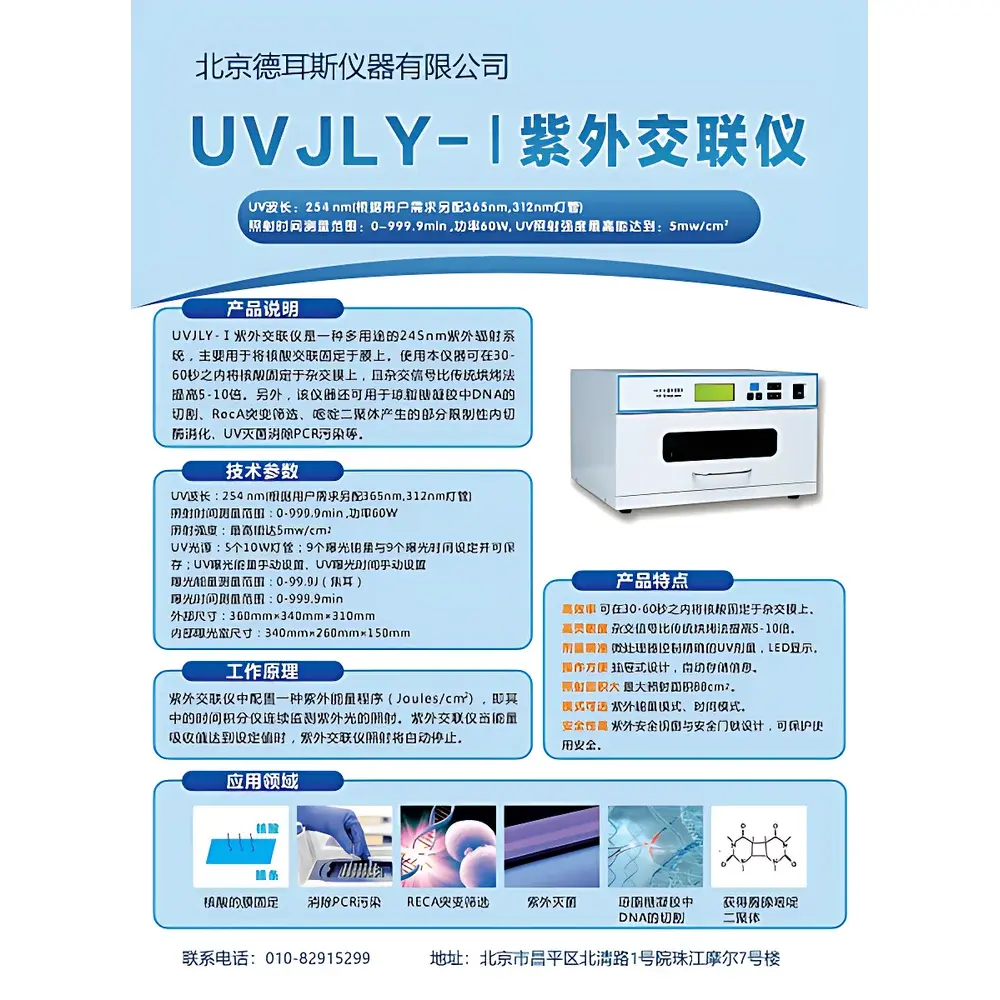
DS UVJLY-1 UV Crosslinker
| Brand | DS |
|---|---|
| Origin | Beijing, China |
| Model | UVJLY-1 |
| UV Wavelength | 254 nm (optional 312 nm / 365 nm lamps) |
| Exposure Time Range | 0–999.9 min |
| Exposure Energy Range | 0–99.99 J |
| Chamber Dimensions | 340 × 260 × 150 mm |
| Lamp Configuration | Five 10 W UV-C lamps (254 nm) |
| Power Input | 60 W |
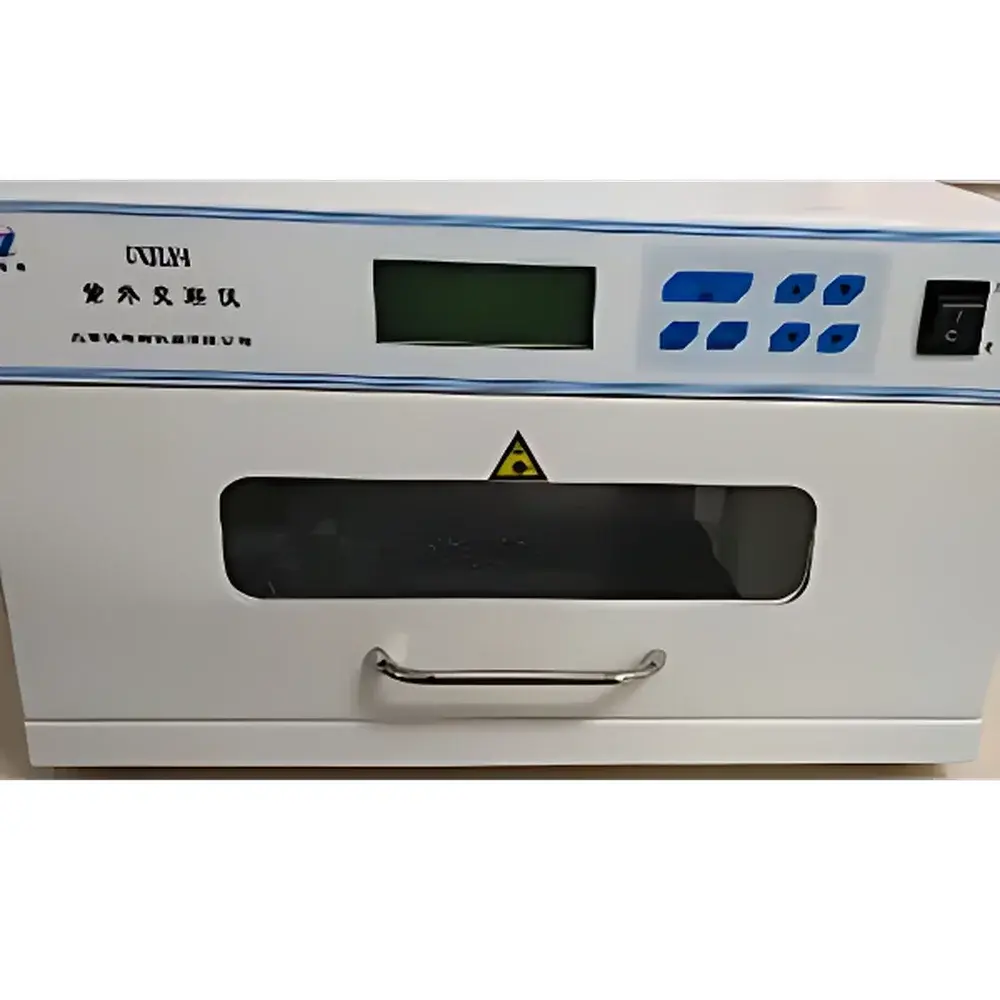
| Display | Backlit LCD with Chinese interface |
| Control Interface | Touch-sensitive keypad |
| Chamber Material | Stainless steel |
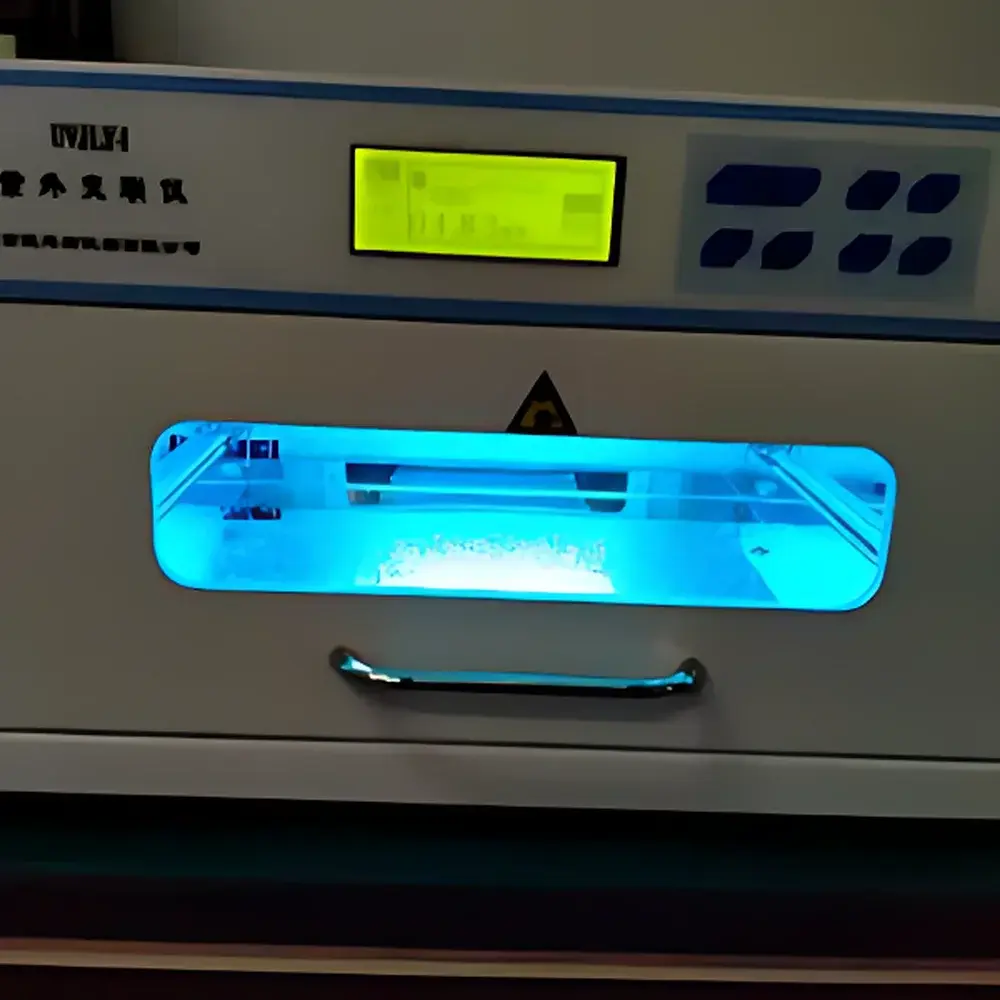
| UV Shielding Window | Integrated safety viewport |
| Data Retention | Non-volatile memory for settings on power-off |
Overview
The DS UVJLY-1 UV Crosslinker is a laboratory-grade, microprocessor-controlled ultraviolet irradiation system engineered for reproducible covalent immobilization of nucleic acids onto nylon or nitrocellulose membranes following electrophoretic transfer. Operating at a primary emission wavelength of 254 nm—optimal for thymine dimer formation and crosslinking of DNA/RNA to solid supports—the instrument leverages germicidal UV-C radiation to generate stable, high-fidelity hybridization substrates. Unlike thermal fixation methods (e.g., 80 °C vacuum baking), which yield inconsistent binding and potential RNA degradation, the UVJLY-1 delivers rapid, energy-quantified exposure with sub-second precision. Its integrated joule-based dosimetry system continuously monitors real-time irradiance (µW/cm²) and calculates cumulative fluence (J/cm²), enabling endpoint-triggered termination that ensures inter-run consistency regardless of lamp aging, ambient temperature, or positional variation within the chamber.
Key Features
- Five independently mounted 10 W low-pressure mercury vapor lamps emitting at 254 nm (IEC 62471 compliant), with optional dual-wavelength configurations (312 nm or 365 nm) available for specialized photochemical applications.
- Energy-integrated exposure control: User-defined fluence (0–99.99 J/cm²) or time-based protocols (0–999.9 min) with automatic shut-off upon target achievement.
- Stainless steel exposure chamber (340 × 260 × 150 mm internal volume) featuring seamless welds, UV-reflective interior surfaces, and an interlocked safety viewport with >99.9% UV-C attenuation (OD ≥ 4.0).
- Non-volatile memory retains up to nine user-programmed protocols—including exposure parameters, lamp selection, and calibration offsets—across power cycles.
- Backlit monochrome LCD display with Chinese-language UI and tactile membrane keypad for gloved-hand operation in biosafety cabinets or cleanroom environments.
- Compliance-ready design: Meets IEC 61010-1 (Safety Requirements for Electrical Equipment for Measurement, Control, and Laboratory Use) and incorporates fail-safe door interlock circuitry.
Sample Compatibility & Compliance
The UVJLY-1 accommodates standard Western/Northern/Southern blotting membranes (up to 20 × 20 cm), multi-well PCR plates (96-/384-well), microcentrifuge tubes (0.2–2.0 mL), and glass slides. It supports downstream compatibility with chemiluminescent, fluorescent, and colorimetric detection systems. For regulatory environments, the instrument’s repeatable energy delivery enables documentation traceability aligned with GLP and ISO/IEC 17025 requirements. While not FDA 21 CFR Part 11–certified out-of-the-box, its deterministic exposure logic and non-volatile parameter storage facilitate audit-ready SOP implementation in QC laboratories performing nucleic acid assay validation per CLSI MM19-A or USP <1058>.
Software & Data Management
The UVJLY-1 operates via embedded firmware without external PC dependency. All exposure logs—including date/time stamp, selected protocol ID, actual delivered fluence (J/cm²), lamp-on duration, and error codes—are stored in internal flash memory (retained for ≥10,000 cycles). Export is performed manually via visual readout; optional RS-232 serial interface (available upon request) permits integration with LIMS platforms for automated log ingestion. Firmware updates are delivered via USB-to-serial adapter and validated using SHA-256 checksum verification to ensure integrity.
Applications
- Nucleic acid immobilization on positively charged nylon or nitrocellulose membranes prior to hybridization (Southern/Northern blotting).
- UV-induced cleavage of DNA in agarose gels for fragment recovery and cloning.
- RecA-mediated recombination assays requiring controlled UV damage induction.
- Generation of cyclobutane pyrimidine dimers (CPDs) to modulate restriction enzyme accessibility in footprinting studies.
- Decontamination of PCR workstations, pipette tips, and reusable plasticware via 254 nm germicidal irradiation (validated against ISO 15714 for UV disinfection efficacy).
- Photo-crosslinking of photoreactive polymers and hydrogels in biomaterials R&D.
FAQ
What UV wavelength is standard on the UVJLY-1, and can it be customized?
The default configuration uses five 10 W lamps emitting at 254 nm. Optional lamp sets operating at 312 nm (UVA-II) or 365 nm (UVA-I) are available for applications requiring reduced DNA damage or enhanced photopolymer activation.
Does the UVJLY-1 provide calibrated energy output data for audit purposes?
Yes—the integrated photodiode sensor measures irradiance in real time and computes cumulative fluence (J/cm²) with ±5% accuracy (NIST-traceable calibration certificate optional). All values are displayed pre- and post-exposure.
Is the exposure chamber compatible with standard blotting membranes and multiwell plates?
The 340 × 260 × 150 mm chamber accommodates full-size 20 × 20 cm membranes and stacked 96-well PCR plates (maximum height: 14 mm). Chamber floor features alignment grooves for consistent sample positioning.
How does the UVJLY-1 ensure repeatability across lamp aging or voltage fluctuations?
By measuring irradiance continuously—not just timing—the system dynamically adjusts exposure duration to deliver the exact programmed fluence, compensating for lamp output decay over service life (typical 1,000 h rated lifetime).
Can exposure protocols be exported or backed up externally?
Protocol parameters are retained internally. For full electronic record retention, RS-232 logging (ASCII format) is supported via optional interface module, enabling direct capture into laboratory information management systems (LIMS).





