
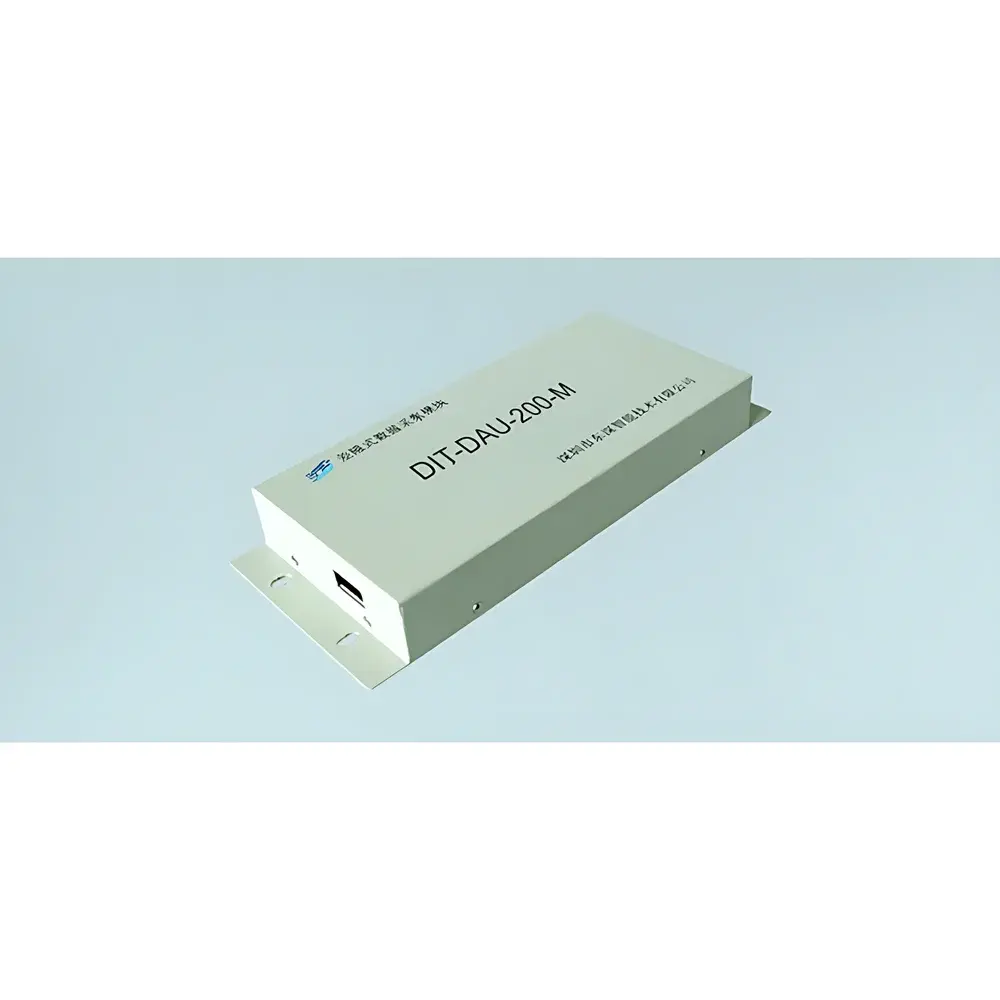
DSE DIT-DAU-200 Resistive Bridge Data Acquisition Unit
| Brand | DSE |
|---|---|
| Origin | Shenzhen, China |
| Manufacturer Type | Authorized Distributor |
| Region | Domestic (China) |
| Model | DIT-DAU-200 |
| Pricing | Upon Request |
Overview
The DSE DIT-DAU-200 Resistive Bridge Data Acquisition Unit is an industrial-grade, low-power embedded measurement system engineered for long-term structural health monitoring in geotechnical and civil infrastructure applications. It operates on the four-wire or five-wire resistive bridge (differential resistance) principle—measuring minute resistance changes (ΔR) in precision strain-sensitive elements—and converts them into calibrated physical quantities (e.g., load, pressure, displacement, temperature-compensated stress) with high repeatability and thermal stability. Designed for deployment in remote, unattended, and harsh environments—including dam abutments, tunnel portals, high-cut slopes, bridge piers, and embankment foundations—the unit complies with IEC 61000-4 electromagnetic immunity standards and features IP67-rated enclosure options for outdoor mounting. Its architecture prioritizes data integrity over extended periods, supporting continuous operation under wide ambient temperature ranges (−25 °C to +70 °C) and high humidity conditions typical of hydrological monitoring sites.
Key Features
- Configurable input channel count: 1-, 8-, 16-, or 32-channel variants for scalable sensor network integration
- Dual-mode excitation and synchronous demodulation circuitry optimized for four- and five-wire vibrating-wire compatible resistive bridge sensors (e.g., anchor load cells, piezometers, joint meters, rebar gauges, multipoint displacement transducers)
- Integrated non-volatile memory (FRAM or EEPROM) with power-loss protection: retains real-time and historical measurement records without battery backup
- FIFO-based local storage with configurable retention policies; optional SD card slot supporting FAT32 file system for high-density archival (up to 32 GB)
- Multi-protocol communication interface: RS-232 (debug/config), RS-485 (multi-drop serial networks), 10/100BASE-T Ethernet (TCP/IP stack compliant with Modbus TCP and DSE proprietary protocol)
- Expandable wireless connectivity via field-replaceable modules: GPRS/3G/4G LTE, LoRaWAN, or licensed UHF radio (868/915 MHz) with AES-128 encryption for secure telemetry
- Programmable acquisition logic: supports scheduled polling (up to six daily fixed-time triggers), time-windowed cyclic scanning (start/end time + interval), and on-demand point/channel selection from central SCADA or cloud platform
Sample Compatibility & Compliance
The DIT-DAU-200 interfaces exclusively with standardized differential resistance sensors conforming to GB/T 34082–2017 (Chinese national standard for geotechnical instrumentation) and widely adopted legacy specifications used across hydropower and transportation infrastructure projects. It supports automatic temperature compensation using integrated Pt100 or thermistor inputs (optional). The module meets CE marking requirements for EMC (EN 61326-1) and safety (EN 61010-1), and its firmware architecture enables audit-ready data logging traceable to ISO/IEC 17025 calibration workflows. While not FDA-regulated, its deterministic timing, CRC-32 frame validation, and write-once data handling align with GLP principles for environmental monitoring records.
Software & Data Management
DSE provides a Windows-based configuration utility (DSE ConfigTool v4.x) and open API libraries (C/C++, Python, .NET) for integration into custom HMI, SCADA, or cloud-based platforms (e.g., AWS IoT Core, Azure IoT Hub). All measurements are timestamped with internal RTC (±2 ppm accuracy) and include sensor ID, channel index, raw resistance values (R₁, R₂), computed parameter (e.g., kPa, µε), and status flags (e.g., open-circuit, short-circuit, timeout). Data export formats include CSV, XML, and binary packet streams. Firmware updates are performed via signed OTA packages, ensuring version control and rollback capability. Audit logs record all configuration changes, data readouts, and communication events—supporting regulatory readiness for third-party verification.
Applications
- Reservoir dam safety monitoring: pore pressure profiling, deformation tracking across instrumented sections
- Geotechnical stability assessment: slope movement detection using inclinometer-linked resistance chains and anchor load verification
- Tunnel convergence monitoring: real-time joint opening analysis via embedded crack meters and radial strain arrays
- Bridge foundation settlement: long-baseline differential settlement measurement using synchronized multi-point displacement units
- Roadbed subsidence early warning: distributed strain sensing along soft-soil embankments and culvert transition zones
- Post-construction performance validation: compliance reporting for design-specified monitoring durations (e.g., 5–10 years per DL/T 5211–2019)
FAQ
What types of sensors are natively supported by the DIT-DAU-200?
It is designed specifically for four- and five-wire differential resistance (resistive bridge) sensors, including but not limited to anchor load cells, piezometers, joint meters, rebar strain gauges, and multipoint displacement transducers.
Does the unit support Modbus RTU or Modbus TCP?
Yes—RS-485 interface supports Modbus RTU slave mode; Ethernet port supports Modbus TCP server functionality with configurable slave ID and register mapping.
Can historical data be retrieved remotely after extended offline periods?
Yes—local non-volatile memory retains data during power loss, and SD card storage enables retrieval of months’ worth of high-frequency datasets via secure remote file transfer protocols (SFTP or HTTPS API).
Is firmware upgrade possible over-the-air?
Yes—signed firmware updates can be delivered via Ethernet or cellular link; update integrity is verified via SHA-256 hash and digital signature prior to installation.
How is time synchronization handled across distributed DIT-DAU-200 nodes?
Units support NTP client mode over Ethernet; for radio/GPRS deployments, time sync may be initiated via master node broadcast or GPS-derived PPS signal input (with optional accessory module).







