
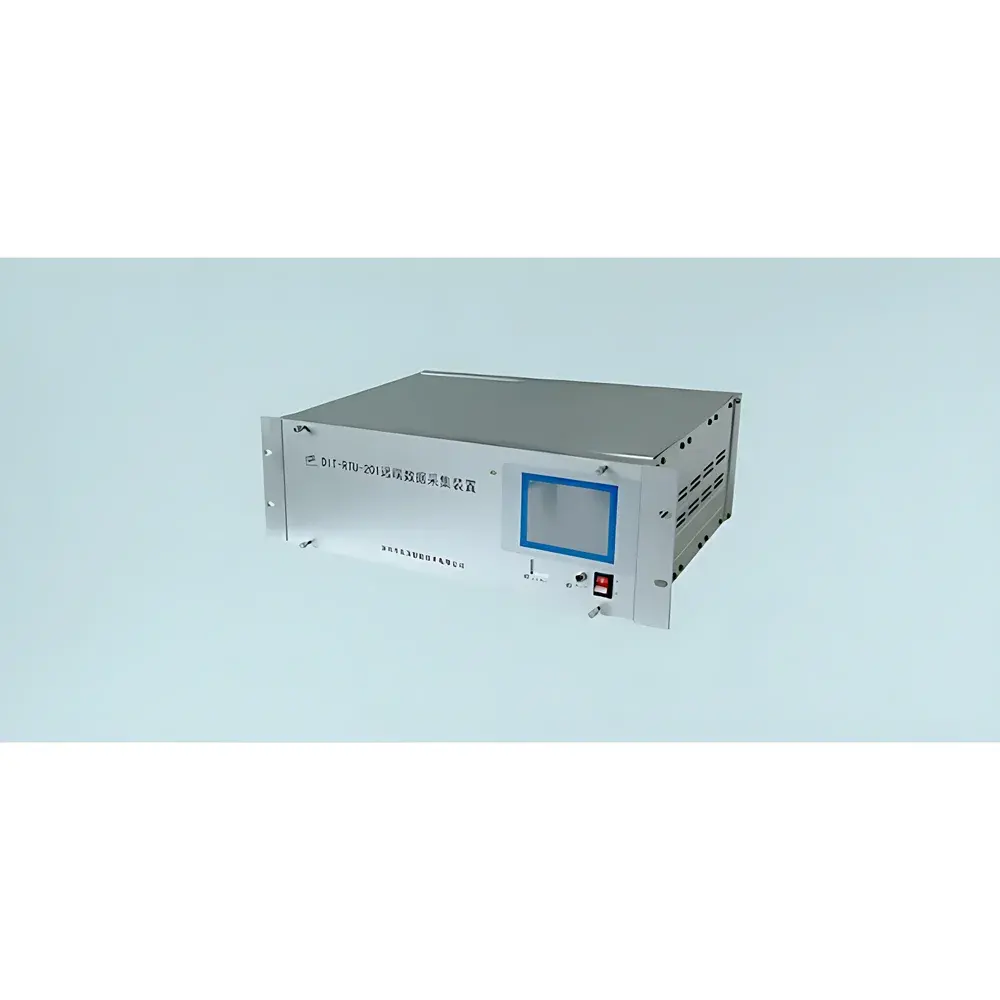
DSE DIT-RTU-201 Remote Integrated Telemetry and Control Terminal
| Brand | DSE |
|---|---|
| Origin | Shenzhen, China |
| Manufacturer Type | Authorized Distributor |
| Regional Classification | Domestic (China) |
| Model | DIT-RTU-201 |
| Pricing | Upon Request |
Overview
The DSE DIT-RTU-201 Remote Integrated Telemetry and Control Terminal is an industrial-grade RTU (Remote Terminal Unit) engineered for reliable, real-time monitoring and control of geographically dispersed water infrastructure assets. Designed in accordance with IEC 61131-3 principles and aligned with SCADA system architecture requirements, the DIT-RTU-201 serves as a field-deployable edge controller for pump stations, irrigation & drainage facilities, sluice gates, and reservoir intake structures. It acquires and processes heterogeneous process variables—including hydrostatic water level (via analog pressure transducers or ultrasonic sensors), equipment operational status (motor on/off, fault alarms), gate opening position (potentiometric or encoder-based), and electrical parameters (voltage, current, active power). Data acquisition occurs at configurable sampling intervals, with local preprocessing—including linearization, scaling, and engineering unit conversion—performed onboard to minimize transmission overhead and ensure data integrity prior to upstream dispatch.
Key Features
- Multi-protocol communication architecture supporting GPRS/CDMA cellular uplink, RS-232/RS-485 serial interfaces, and optional Ethernet connectivity for redundant or hybrid backhaul.
- Modular plug-in board design enabling field-configurable I/O expansion: up to 32 analog input channels (AI) and 32 digital input/output (DI/DO) channels via interchangeable functional boards.
- TFT true-color LCD display (≥320×240 resolution) with capacitive touch interface, supporting dynamic visualization modes—text-based status panels, bar graphs for threshold comparison, real-time trend curves (up to 72-hour history), and bitmap overlays for facility schematics.
- Isolated signal conditioning: Non-electrical AI board provides 8-channel galvanic isolation per board (input-to-ground, channel-to-channel, and power supply isolation) for 4–20 mA or 0–5 V signals; Electrical AI board integrates built-in current/voltage transducers compliant with IEC 61000-4-5 surge immunity (Level 3).
- Configurable event-driven reporting: Supports “report-on-change” (ROC), periodic polling (e.g., every 5/15/60 minutes), and user-defined conditional logic (e.g., “transmit if water level exceeds 2.5 m AND pump status = OFF”).
- ARM-based communication mainboard with embedded real-time operating system (RTOS), providing deterministic task scheduling, watchdog supervision, and firmware update over-the-air (FOTA) capability via secure HTTP(S) or FTPS.
Sample Compatibility & Compliance
The DIT-RTU-201 interfaces with industry-standard sensors and actuators used across hydraulic infrastructure: submersible pressure transmitters (e.g., Keller PA-23Y), ultrasonic level sensors (e.g., Siemens Desigo RXB), rotary encoders for gate position feedback, and DIN-rail mounted energy meters (e.g., ABB AEM-2100). All analog input circuits meet IEC 61000-4-2 (ESD ±8 kV contact), IEC 61000-4-4 (EFT ±2 kV), and IEC 61000-4-5 (surge ±2 kV line-to-earth) electromagnetic compatibility requirements. The device complies with GB/T 17626 series (Chinese national EMC standards), RoHS Directive 2011/65/EU, and CE marking prerequisites for industrial environments (EN 61000-6-2/6-4). For deployment in regulated water utilities, it supports audit-ready logging (timestamped events, configuration changes, communication logs) compatible with GLP-aligned data governance frameworks.
Software & Data Management
Configuration and diagnostics are performed locally via the touchscreen HMI or remotely using DSE’s proprietary PC-based configuration tool (DIT-Config v3.x), which exports/import project files in XML format with version control metadata. Collected data is formatted per Modbus RTU/TCP or DNP3 Level 2 protocol for seamless integration into third-party SCADA platforms (e.g., Ignition, Siemens Desigo CC, Schneider EcoStruxure). Internal non-volatile memory retains ≥30 days of high-resolution time-series data (1-minute intervals) with cyclic overwrite policy. Optional cloud gateway firmware enables MQTT 3.1.1 publishing to AWS IoT Core or Azure IoT Hub with TLS 1.2 encryption and X.509 certificate authentication. Audit trails comply with ISO/IEC 17025 Clause 7.10.2 for measurement traceability and data integrity verification.
Applications
- Automated irrigation district management: Real-time synchronization of water level, gate position, and pump runtime to optimize water allocation across multiple canals.
- Flood warning systems: Distributed deployment at river gauging stations with ROC-triggered SMS alerts upon threshold exceedance.
- Smart pump station monitoring: Integration with motor protection relays to correlate electrical consumption, vibration status, and flow rate for predictive maintenance planning.
- Drainage network telemetry: Monitoring of sump levels and pump cycles in urban stormwater systems to support dynamic control logic during rainfall events.
- Hydropower intake surveillance: Continuous acquisition of headwater level, gate opening, and grid-side voltage/current for generation scheduling compliance reporting.
FAQ
What communication protocols does the DIT-RTU-201 natively support?
It supports Modbus RTU (RS-485/RS-232), Modbus TCP (Ethernet), and DNP3 Level 2 (serial and TCP variants) out-of-the-box. Custom protocol stacks (e.g., IEC 60870-5-101/104) are available under OEM agreement.
Can the device operate autonomously during cellular network outages?
Yes. Local data buffering (≥30 days) and onboard logic execution (e.g., alarm suppression, hysteresis-based control) continue uninterrupted. Communication resumes automatically upon network recovery with guaranteed delivery of queued records.
Is firmware upgrade possible without physical access?
Yes—via secure FOTA using signed firmware packages delivered over HTTPS or FTPS, with rollback capability and CRC32 integrity validation.
How is sensor calibration traceability maintained?
Each analog channel stores calibration coefficients (gain, offset, nonlinearity correction terms) with timestamp and operator ID. Calibration logs are exportable and include pre-/post-calibration test points per ISO/IEC 17025 Annex A.3.
Does the unit support time synchronization?
Yes—via NTP over Ethernet or SNTP over GPRS, with local RTC accuracy of ±1 second/month (temperature-compensated crystal oscillator). All logged events embed UTC timestamps with millisecond resolution.
Related Products







