
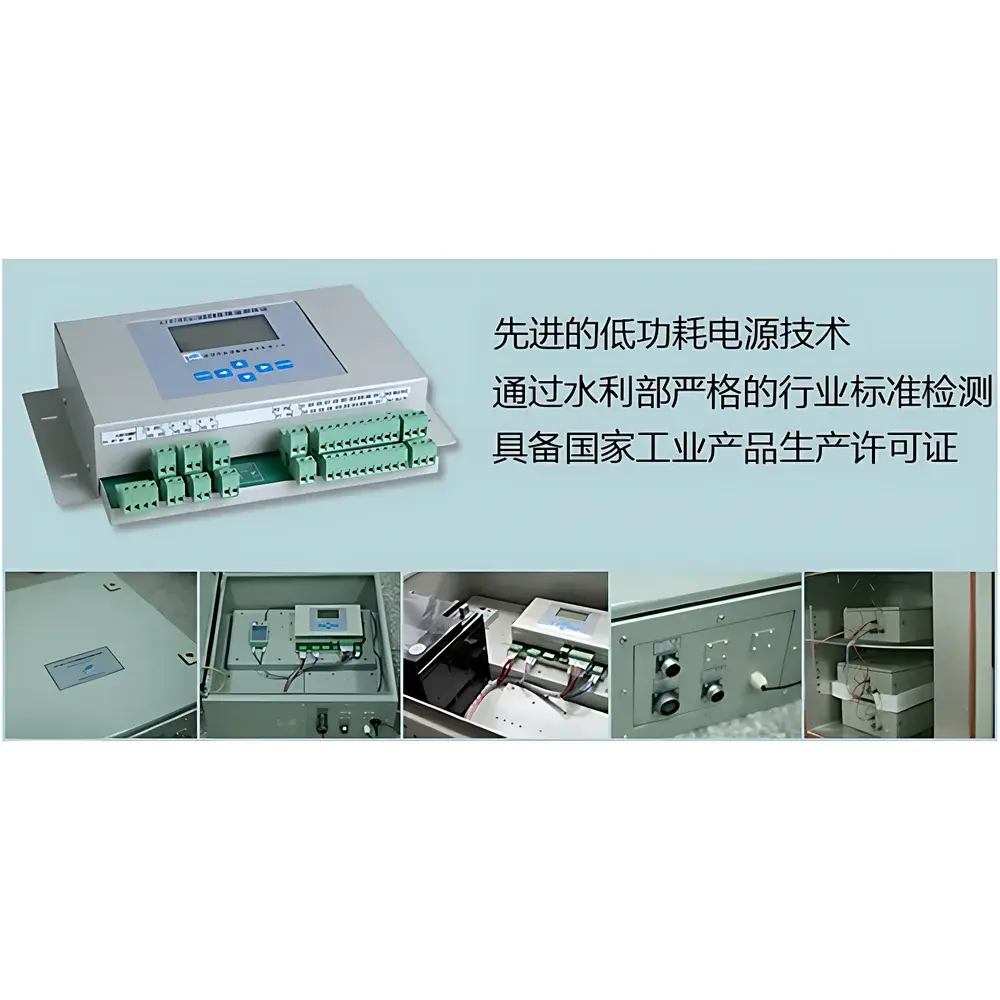
DSE DIT-RTU-80SW Hydro-Meteorological Remote Terminal Unit
| Brand | DSE |
|---|---|
| Origin | Shenzhen, China |
| Manufacturer Type | Authorized Distributor |
| Country of Origin | China |
| Model | DIT-RTU-80SW |
| Pricing | Available Upon Request |
Overview
The DSE DIT-RTU-80SW is a rugged, low-power hydro-meteorological remote terminal unit (RTU) engineered for autonomous operation in unattended water resource and environmental monitoring stations. Designed in accordance with national and industry standards for hydrological telemetry systems—including SL 61–2003 (Technical Specification for Hydrological Automatic Telemetry System) and SL 180–2015 (Specification for Remote Terminal Units in Hydrological Monitoring)—the DIT-RTU-80SW acquires, processes, stores, and transmits real-time data from diverse analog and digital sensors deployed in river basins, reservoirs, flood control zones, and meteorological observation networks. Its core architecture implements embedded ARM-based real-time processing with deterministic I/O scanning, supporting multi-sensor synchronization and event-triggered reporting logic. The device operates as a field-deployable edge node compliant with the hierarchical telemetry framework defined in China’s National Hydrological Information System (NHIS), enabling seamless integration into provincial and basin-level SCADA platforms.
Key Features
- Multi-mode communication support: GPRS/CDMA cellular, GSM short message service (SMS), UHF/VHF radio telemetry (FSK/GFSK modulation), LoRaWAN (optional firmware), and wired RS232/RS485 interfaces—ensuring adaptability across heterogeneous infrastructure environments.
- Intelligent data reporting strategies: Scheduled transmission (configurable interval from 1 min to 24 h), threshold-triggered alarm reporting (water level/rainfall exceedance), rainfall accumulation-triggered burst reporting (e.g., ≥5 mm in 10 min), on-demand polling (master station query-response), and hybrid reporting modes.
- Extended non-volatile data storage: Onboard flash memory retains ≥2 years of raw sensor data (15-min or hourly intervals) with time-stamped records, meeting SL 180–2015 requirements for long-term hydrological data integrity and auditability.
- Field-configurable power management: LCD backlight and peripheral power outputs (12/24 VDC) are software-controllable; average standby current <3 mA (at 12 VDC), enabling reliable solar-battery operation in off-grid locations.
- Industrial-grade environmental resilience: IP67-rated enclosure, operating temperature range –25°C to +70°C, ESD immunity per IEC 61000-4-2 (±8 kV contact), and surge protection on all I/O lines (IEC 61000-4-5, 4 kV line-to-ground).
Sample Compatibility & Compliance
The DIT-RTU-80SW interfaces with standardized hydrological and meteorological sensors conforming to national metrological verification regulations (JJG 213–2017 for rain gauges; JJG 978–2018 for ultrasonic water level sensors). Supported sensor types include tipping-bucket rain gauges (pulse output), float-type/pressure-type/ultrasonic/bubble-type water level sensors (4–20 mA, 0–5 V, or SDI-12), cup-anemometer/vane wind sensors (pulse & analog), and digital temperature/pressure modules (RS485 Modbus RTU). All internal firmware and configuration protocols adhere to the SL 651–2017 standard for hydrological telemetry data formats and communication protocols. Device firmware supports GLP-aligned logging of configuration changes and sensor calibration metadata, facilitating traceability during regulatory audits.
Software & Data Management
Configuration and diagnostics are performed locally via integrated 128×64 pixel monochrome LCD and membrane keypad; all parameters—including station ID, sensor scaling coefficients, reporting schedules, communication APN settings, and storage retention policies—are editable without external tools. For centralized management, the RTU supports remote firmware updates and parameter reconfiguration via secure AT-command over GPRS or radio link. Data export follows SL 651–2017 binary frame structure or ASCII CSV format (time, sensor ID, value, status flag), compatible with common hydrological databases such as HYSYS, WaterOneFlow, and custom SQL-based archives. Audit logs record timestamped events including power cycles, sensor disconnects, memory write operations, and configuration modifications—supporting compliance with internal QA procedures and third-party validation requirements.
Applications
The DIT-RTU-80SW serves as a foundational telemetry node in flood forecasting systems (e.g., North River Basin Administration), reservoir safety monitoring (e.g., Sanzhoutian Reservoir, Guangdong), tidal and estuarine water level networks (e.g., Jingfeng Lianwei Flood Control Zone), and regional drought early-warning platforms (e.g., Fengtinghe Reservoir, Guangxi). It is routinely deployed in hydropower intake monitoring, irrigation district automation (e.g., Zhongshun Dawei Irrigation District), and municipal drainage telemetry (e.g., Nanhai Pumping Station). Its dual-role capability—supporting both real-time operational decision-making and long-term climatological data archiving—makes it suitable for projects requiring alignment with China’s National Water Resources Monitoring and Assessment Program (NWRMAP) and international frameworks such as WMO’s Global Hydrometry Support Facility (GHSF).
FAQ
What communication protocols does the DIT-RTU-80SW support for upstream SCADA integration?
It natively implements SL 651–2017 over serial and GPRS; Modbus RTU/TCP and DNP3 can be enabled via optional firmware modules.
Can the device operate continuously on solar power alone?
Yes—its ultra-low quiescent current and configurable sleep/wake cycles enable stable operation with a 20 W solar panel and 40 Ah deep-cycle battery under typical southern Chinese insolation conditions.
Is historical data retrieval possible after network outages?
Yes—the device buffers unsent reports in non-volatile memory and automatically retransmits upon connection restoration, preserving chronological continuity and eliminating data gaps.
Does the RTU support sensor diagnostics and self-test functions?
It continuously monitors sensor supply voltage, signal integrity, and response timeout; fault conditions trigger local LCD alerts and priority alarm reporting to the master station.
How is firmware updated in remote deployments?
Via encrypted OTA (Over-The-Air) packages transmitted over GPRS or radio link, with CRC32 validation and rollback capability in case of update failure.
Related Products







