
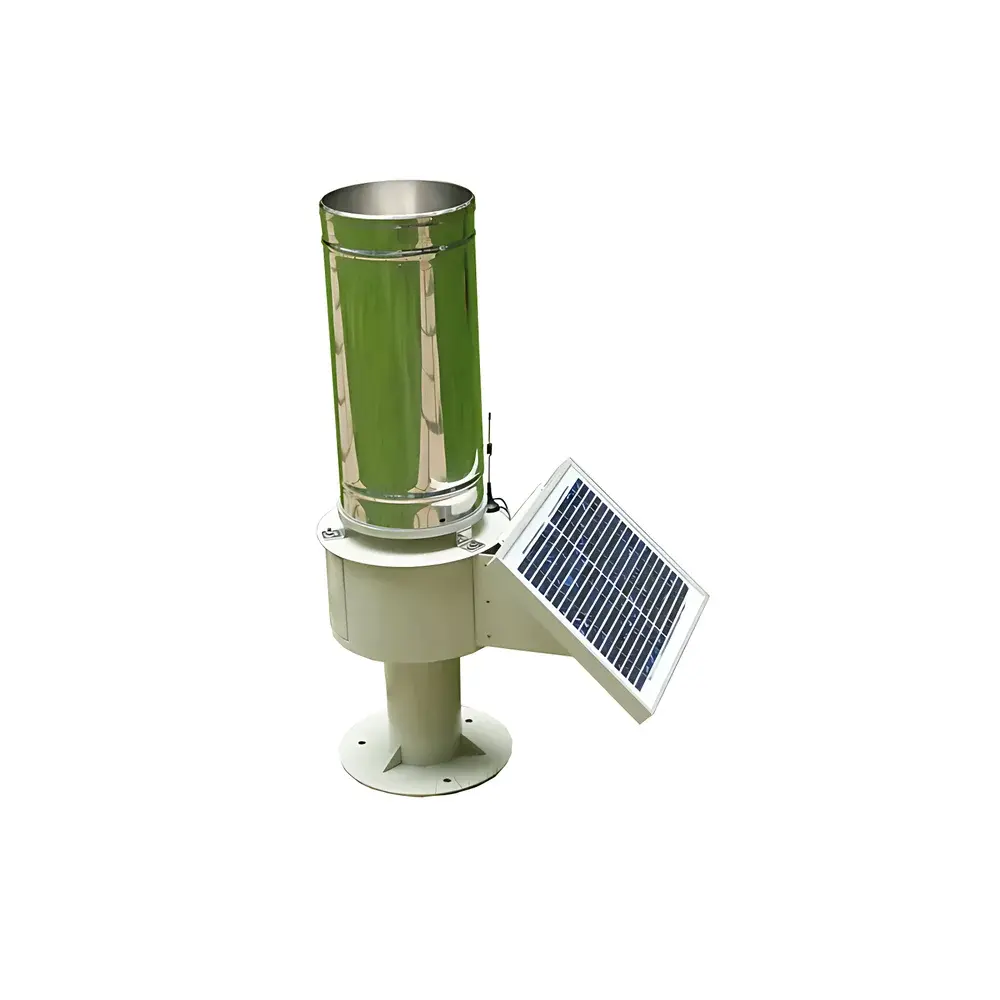
DSE DIT-SHYJ-100 Integrated Rainfall Monitoring Station
| Brand | DSE |
|---|---|
| Origin | Zhejiang, China |
| Manufacturer Type | Authorized Distributor |
| Country of Origin | China |
| Model | DIT-SHYJ-100 |
| Pricing | Available Upon Request |
Overview
The DSE DIT-SHYJ-100 Integrated Rainfall Monitoring Station is an autonomous, field-deployable hydrological sensor system engineered for continuous, unattended precipitation measurement in remote and harsh outdoor environments. It operates on the principle of tipping-bucket rainfall measurement—where each tip of the calibrated bucket corresponds to a discrete volume of collected rainwater, converted into standardized depth units (e.g., 0.1 mm per tip). Designed specifically for integration into national and regional flood early-warning infrastructure—including mountain torrent warning systems and real-time hydrometeorological telemetry networks—the station delivers high-reliability data acquisition, local storage, solar-powered operation, and GPRS-based telemetry without external grid dependency. Its monolithic mechanical and electrical architecture eliminates inter-unit cabling and alignment requirements, reducing installation time and long-term maintenance exposure while maintaining full compliance with China’s SL 379–2007 and SL 61–2003 technical standards for automatic rainfall stations.
Key Features
- Integrated tipping-bucket rain gauge with selectable resolution options: 0.1 mm, 0.2 mm, 0.5 mm, or 1.0 mm—calibrated per ISO 9408:2021 for rain gauge performance testing.
- Solar power subsystem comprising monocrystalline photovoltaic panel, sealed lead-acid battery (≥12 Ah), and intelligent charge controller—engineered to sustain uninterrupted operation for ≥30 days under zero-sunlight conditions (per IEC 61215 thermal cycling and low-light performance criteria).
- Embedded hydrological data logger supporting dual-mode transmission: scheduled reporting (configurable intervals from 5 min to 24 h) and event-triggered rainfall accumulation alerts (e.g., ≥5 mm/h or ≥10 mm/24 h).
- Low-power design with standby current <100 µA; microcontroller enters deep-sleep mode between measurements and wakes only upon bucket actuation or scheduled transmission cycles.
- Integrated GPRS communication module compliant with ETSI EN 300 328 V2.2.2 (2021–04) for robust wide-area network connectivity across public cellular infrastructure.
- Surge-protected I/O interface with built-in transient voltage suppression (TVS) diodes and hardware-level auto-reset circuitry—meeting IEC 61000-4-5 Level 3 surge immunity requirements.
- Wireless local configuration via handheld terminal using proprietary 433 MHz ISM-band protocol—eliminating need for physical port access during commissioning or parameter updates.
Sample Compatibility & Compliance
The DIT-SHYJ-100 is validated for deployment across diverse geographical and climatic zones—from subtropical monsoon regions (e.g., Guangxi, Yunnan) to mid-latitude temperate watersheds (e.g., Hubei). Its enclosure meets IP67 ingress protection rating per IEC 60529, ensuring dust-tight integrity and temporary submersion resistance. All electronic modules conform to RoHS Directive 2011/65/EU and CE marking requirements for electromagnetic compatibility (EMC Directive 2014/30/EU). The tipping-bucket mechanism is certified to GB/T 21975–2008 (Chinese national standard equivalent to ISO 9408) for accuracy class ±4% over 0.5–4 mm/h intensity range. System firmware supports audit-ready logging with timestamped event records, enabling traceability for GLP-aligned hydrometric monitoring programs.
Software & Data Management
Data output follows standardized hydrological telemetry protocols including SL 651–2014 (China’s “Hydrological Telemetry System Communication Protocol”) and optional Modbus RTU over serial/GPRS. The embedded firmware provides non-volatile memory (≥2 years of 5-minute interval data at default settings) with cyclic overwrite policy. Remote management is supported via encrypted AT-command interface and configurable APN settings for carrier-specific network registration. While no proprietary desktop software is shipped, raw binary or ASCII-formatted data streams are compatible with industry-standard platforms such as HEC-DSSVue, Aquarius Time Series, and open-source solutions like Grafana + InfluxDB for visualization and alerting workflows. Audit trails include boot count, reset events, battery voltage history, and signal strength logs—facilitating root-cause analysis during QA/QC reviews.
Applications
- Real-time flood forecasting and flash flood early warning in mountainous catchments.
- Integration into provincial water resource monitoring networks (e.g., Yunnan Green Spring County and Hekou County Mountain Torrent Warning Systems).
- Baseline precipitation data collection for climate resilience modeling and watershed-scale hydrological calibration.
- Supporting automated irrigation scheduling and reservoir inflow estimation in agricultural water management systems.
- Supplemental ground-truth validation for satellite-based rainfall estimates (e.g., GPM IMERG, FY-4A LMI).
FAQ
What is the minimum measurable rainfall increment?
The standard configuration supports 0.1 mm resolution; alternative tipping-bucket sensors with 0.2 mm, 0.5 mm, or 1.0 mm increments are available upon request.
How long can the station operate during extended overcast periods?
With fully charged battery and nominal solar panel orientation, the system maintains full functionality—including data logging and daily GPRS transmission—for ≥30 consecutive days without sunlight.
Is the device compatible with third-party SCADA or cloud platforms?
Yes—via SL 651–2014 or Modbus RTU protocol, it integrates natively with major industrial telemetry platforms and custom MQTT/HTTP-based cloud ingestion pipelines.
Does the unit support remote firmware updates?
Firmware upgrades require physical access and local wireless reprogramming using the included handheld terminal; over-the-air (OTA) updates are not supported in current release.
What lightning protection measures are implemented?
The station features TVS-diode protected signal lines, galvanically isolated rain gauge interface, and automatic hardware reset circuitry triggered by brownout or ESD-induced lockup.
Related Products







