
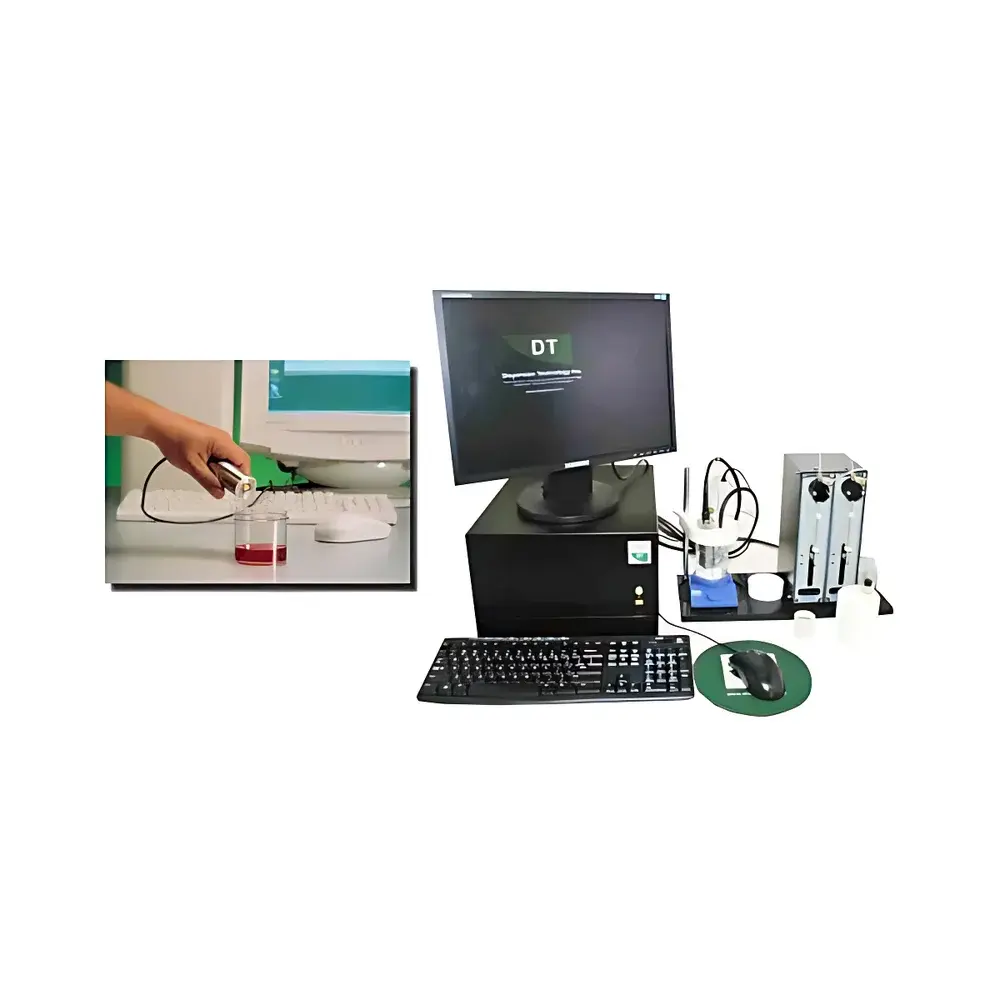
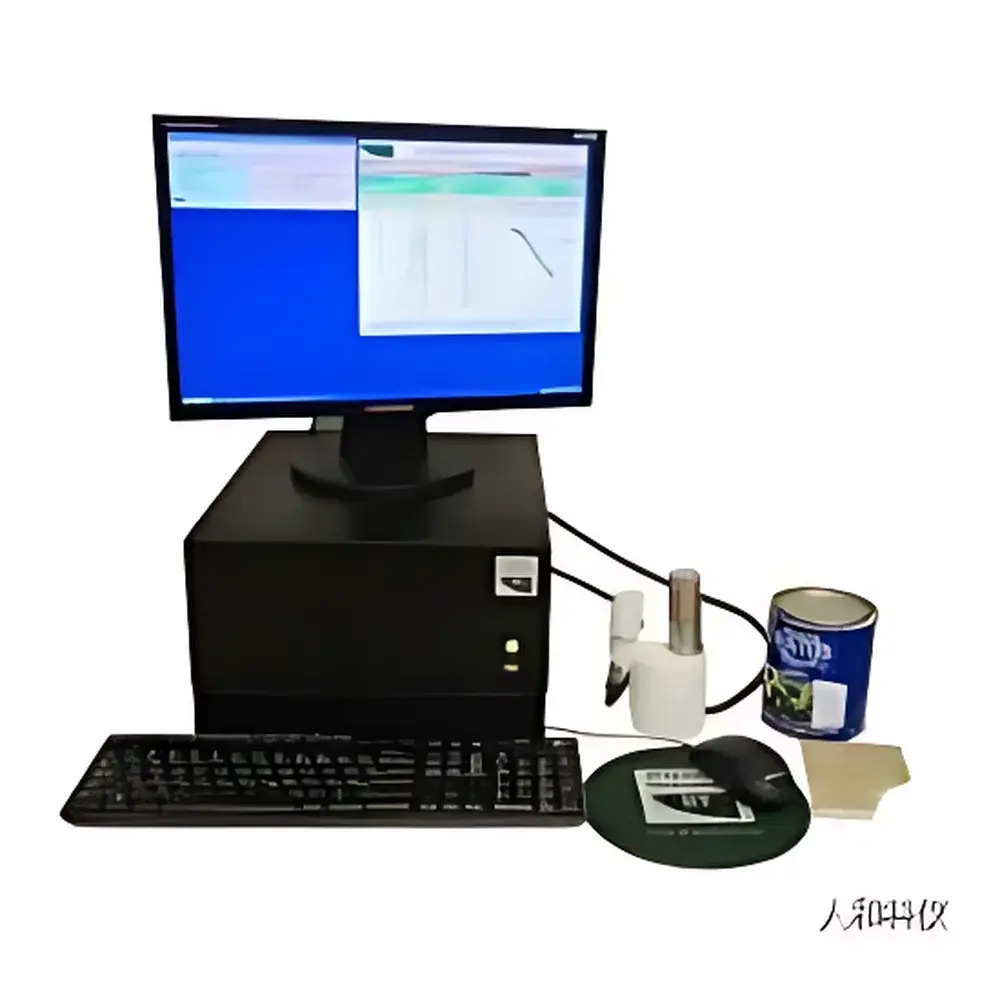
DT-330 Electroacoustic Zeta Potential Analyzer (DT Instruments, USA)
| Brand | DT Instruments |
|---|---|
| Origin | USA |
| Model | DT-330 |
| Measurement Principle | Electroacoustics (Colloid Vibration Current, CVI) & Electrophoretic Acoustics (ESA) |
| Sample Concentration Range | 0.1–50 vol% (no dilution required) |
| Minimum Sample Volume | 2 mL |
| Zeta Potential Range | No theoretical lower limit |
| Compatible Solvents | Aqueous, polar, and non-polar media |
| Porosity Measurement | Yes (via high-frequency conductivity probe) |
| Surface Zeta Potential on Porous Solids | Yes |
| Output Parameters | Dynamic electrophoretic mobility, Debye length, surface charge density, solid content, rheological properties |
| Compliance Context | Designed for GLP/GMP-aligned labs |
Overview
The DT-330 Electroacoustic Zeta Potential Analyzer is a laboratory-grade instrument engineered by DT Instruments (USA) for the in-situ characterization of concentrated heterogeneous dispersions and porous solids without sample dilution or separation. Unlike conventional electrophoretic light scattering (ELS) systems—limited to dilute suspensions—the DT-330 employs dual electroacoustic principles: Colloid Vibration Current (CVI) for zeta potential determination in concentrated slurries (0.1–50 vol%), and Electrophoretic Acoustics (ESA) for dynamic electrophoretic mobility quantification. Its core transduction relies on high-sensitivity piezoelectric detection of acoustic signals generated by charged particle oscillation under alternating electric fields. This physics-based approach enables direct measurement of interfacial electrokinetic properties in chemically complex, high-viscosity, or optically opaque systems—including battery electrode slurries, CMP polishing formulations, ceramic pastes, pharmaceutical emulsions, and cementitious suspensions—where optical methods fail.
Key Features
- Electroacoustic dual-mode operation: CVI for zeta potential and ESA for electrophoretic mobility in undiluted samples
- No-dilution capability across 0.1–50 vol% solid concentration, eliminating artifacts from ionic strength alteration or particle rearrangement
- Integrated high-frequency conductivity probe enabling simultaneous measurement of bulk electrolyte conductivity and pore-scale ionic transport
- Patented algorithm for calculating Debye length and surface charge density directly from measured CVI signal and input conductivity
- Surface zeta potential quantification on intact porous materials (e.g., membranes, filters, catalyst supports) via through-electrode electroacoustic excitation
- Minimal sample requirement: only 2 mL per analysis, reducing material consumption and cross-contamination risk
- Multi-parameter output: zeta potential, dynamic mobility, Debye length, volumetric solid content, and low-frequency rheological indicators (storage/loss moduli inferred from acoustic attenuation)
Sample Compatibility & Compliance
The DT-330 accommodates diverse dispersion media—including water, alcohols, esters, hydrocarbons, and fluorinated solvents—without optical path constraints. It characterizes particles ranging from sub-10 nm colloids to >100 µm agglomerates in suspensions, emulsions, and gels. For porous solids, surface zeta potential is derived from CVI response across interconnected pore networks, supporting ASTM F2792 (standard guide for zeta potential of porous materials) and ISO 13099-3 (colloidal systems — part 3: electroacoustic methods). The system architecture supports traceable calibration protocols and is compatible with laboratory information management systems (LIMS) for GLP-compliant workflows. When paired with validated software modules, it meets data integrity requirements outlined in FDA 21 CFR Part 11 for electronic records and signatures.
Software & Data Management
The DT-330 operates with DT’s proprietary AcouStat™ software, which provides real-time signal processing, automated baseline correction, and multi-frequency spectral deconvolution. Raw acoustic waveforms are stored in HDF5 format with embedded metadata (timestamp, temperature, conductivity, cell ID, operator ID). Software modules support batch processing, statistical trend analysis across sample sets, and export to CSV, Excel, or MATLAB-compatible formats. Audit trails record all parameter modifications, calibration events, and user actions. Optional validation packages include IQ/OQ documentation templates aligned with ISO/IEC 17025 and GAMP5 guidelines.
Applications
- Quality control of lithium-ion battery cathode/anode slurries: monitoring zeta potential stability during mixing and aging
- Optimization of chemical-mechanical polishing (CMP) slurries: correlating surface charge with removal rate and defect generation
- Formulation development of injectable oil-in-water emulsions: assessing interfacial charge stability under physiological ionic conditions
- Characterization of geopolymer and cement suspensions: tracking early-stage colloidal evolution prior to gelation
- Surface charge mapping of ceramic green bodies and 3D-printed porous scaffolds
- Regulatory submission support for nanomedicine products requiring zeta potential per USP and ICH Q5A(R2)
FAQ
Can the DT-330 measure zeta potential in non-aqueous solvents?
Yes. Its electroacoustic detection is independent of optical clarity or solvent refractive index, enabling robust measurements in ethanol, toluene, silicone oil, and other low-dielectric media.
Is sample dilution ever required?
No. The DT-330 is specifically designed for native-concentration analysis; dilution is neither recommended nor supported by its measurement model.
How does the system determine Debye length?
Debye length is calculated in real time using the measured bulk conductivity (via integrated HF probe) and temperature, combined with the Gouy-Chapman-Stern framework embedded in AcouStat™.
What is the minimum detectable zeta potential magnitude?
The system resolves zeta potentials as low as 0.1 mV in high-conductivity systems, limited primarily by signal-to-noise ratio rather than theoretical detection thresholds.
Does the DT-330 comply with regulatory data integrity standards?
When deployed with validated AcouStat™ configurations and appropriate IT infrastructure, it supports full 21 CFR Part 11 compliance, including electronic signatures, audit trails, and secure user access controls.



