
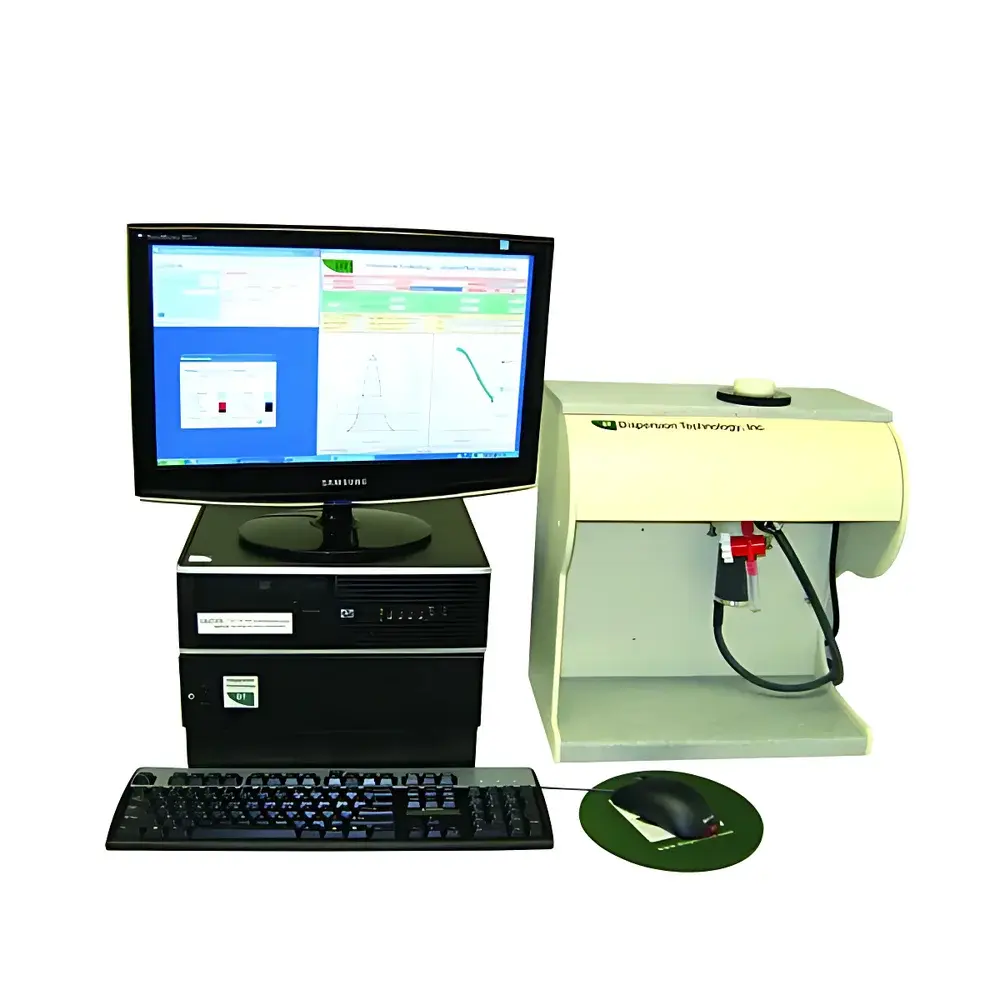
DT-600 Ultrasound Rheometer by DT (USA)
| Brand | DT (USA) |
|---|---|
| Origin | USA |
| Model | DT-600 |
| Measurement Principle | Ultrasonic Spectroscopy (1–100 MHz) |
| Sample Concentration Range | 0.1–50 vol% (no dilution required) |
| Viscosity Range | 0.5–100 cP (±3% accuracy) |
| Longitudinal Modulus (G*) Measurement | 1–100 MHz |
| Solvent Compatibility | Aqueous, polar, and non-polar media |
| Zeta Potential & Particle Size | Direct measurement in concentrated dispersions |
| Isoelectric Point (IEP) Determination | Model-independent, no Debye-Hückel or Smoluchowski approximation required |
| Titration Function | Integrated automated potentiometric titration module |
| Data Management | Microsoft Access-based local database with audit-ready export |
Overview
The DT-600 Ultrasound Rheometer is an advanced, non-invasive analytical platform engineered for the simultaneous, label-free characterization of concentrated heterogeneous systems—without sample dilution, centrifugation, or optical transparency requirements. Unlike conventional rheometers or electrophoretic light scattering instruments, the DT-600 employs high-frequency ultrasonic spectroscopy (1–100 MHz) to probe acoustic attenuation and sound speed across a broad frequency spectrum. This enables concurrent quantification of particle size distribution (PSD), zeta potential, complex longitudinal modulus (G*), volume viscosity, solid content, and pore structure in real time. The instrument operates on the physical principles of ultrasound propagation in colloidal and porous media—where scattering, absorption, and viscoelastic coupling are directly linked to microstructural parameters. Its design addresses critical limitations of optical and electrokinetic methods: it functions reliably in opaque, highly conductive (>1 S/m), viscous, or non-aqueous systems—including battery slurries, CMP polishing formulations, ceramic pastes, cementitious suspensions, and undiluted pharmaceutical emulsions.
Key Features
- Concentration-agnostic operation: Measures undiluted samples from 0.1 to 50 vol%, eliminating artifacts from dilution-induced aggregation or interface disruption.
- Model-independent zeta potential and IEP determination: Does not rely on double-layer assumptions (e.g., Smoluchowski or Henry equations); valid for high-ionic-strength and non-aqueous media.
- Multi-parameter acquisition: Simultaneous output of PSD (sub-10 nm to >10 µm), G*, viscosity, solid fraction, and acoustic porosity in a single run.
- Universal solvent compatibility: Fully functional in water, ethanol, IPA, NMP, DMF, toluene, and other polar/non-polar solvents—enabling formulation development across battery, coating, and drug delivery workflows.
- Integrated potentiometric titration: Automated acid/base or ion-specific titration with synchronized ultrasonic monitoring for real-time tracking of surface charge evolution during pH or ionic strength change.
- Robust architecture for industrial QC: Sealed transducer array, temperature-controlled cell holder (±0.1 °C), and vibration-damped base accommodate routine use in manufacturing environments.
Sample Compatibility & Compliance
The DT-600 accommodates liquid dispersions, pastes, gels, and consolidated porous solids—including monolithic ceramics, sintered metal filters, and lyophilized protein matrices. It complies with core regulatory expectations for analytical instrumentation used in GMP and GLP settings: data integrity is ensured via time-stamped, user-locked Access database storage with full audit trail (user ID, timestamp, parameter changes, raw waveform export). While the system itself is not FDA-cleared as a medical device, its outputs support compliance with USP , ISO 13320 (particle sizing), ASTM D7824 (zeta potential in non-aqueous systems), and ICH Q5A/Q5C (characterization of biopharmaceutical colloids). All calibration protocols follow NIST-traceable standards for sound velocity and attenuation reference materials.
Software & Data Management
Acquisition and analysis are performed using DT’s proprietary Ultrasizer™ software, built on a Windows-native framework with intuitive workflow navigation. Raw RF waveforms (time-domain) and spectral transforms (frequency-domain) are retained alongside processed results. Batch processing supports comparative analysis across formulation variants or stability timepoints. Export options include CSV, XML, and PDF reports compliant with 21 CFR Part 11 requirements when paired with institutional electronic signature infrastructure. Database queries can filter by batch ID, operator, date range, or material class—enabling retrospective trend analysis for process validation or root-cause investigation.
Applications
- Battery R&D: Real-time monitoring of cathode/anode slurry rheology, conductive additive dispersion homogeneity, and binder migration during drying.
- Pharmaceutical development: Quantifying micelle size evolution during solubilization, detecting protein aggregation onset in undiluted mAb formulations, and characterizing emulsion droplet coalescence without surfactant interference.
- Electronics manufacturing: CMP slurry stability assessment under shear and thermal stress; correlation of acoustic modulus with post-polish surface roughness.
- Construction materials: In-process quantification of cement particle packing density and early-age gel formation kinetics in alkali-activated binders.
- Bioprocessing: In-line monitoring of chromatographic resin fouling via acoustic impedance shifts during protein loading cycles.
FAQ
Can the DT-600 measure zeta potential in 5 M NaCl solution?
Yes—the instrument uses electroacoustic coupling (colloid vibration current, CVI) rather than electrophoretic mobility, making it insensitive to solution conductivity limitations that constrain laser Doppler electrophoresis.
Is temperature control integrated?
The standard cell holder includes Peltier-based thermostating (range: 10–60 °C, stability ±0.1 °C), with optional external recirculating bath integration for extended thermal profiling.
Does it require optical clarity?
No—ultrasonic propagation is unaffected by turbidity, color, or fluorescence; ideal for carbon-black-filled polymers, iron oxide nanofluids, or hemoglobin-rich biological lysates.
How is calibration performed?
Factory calibration uses NIST-traceable polystyrene latex standards (PSL) and glycerol/water reference mixtures; end-user verification employs built-in acoustic path-length and baseline attenuation checks prior to each session.
Can it characterize dried or sintered porous ceramics?
Yes—using through-transmission mode on disk-shaped specimens (≥5 mm thickness), it quantifies effective pore size distribution and interconnectivity via acoustic dispersion analysis in the MHz band.
Related Products



