
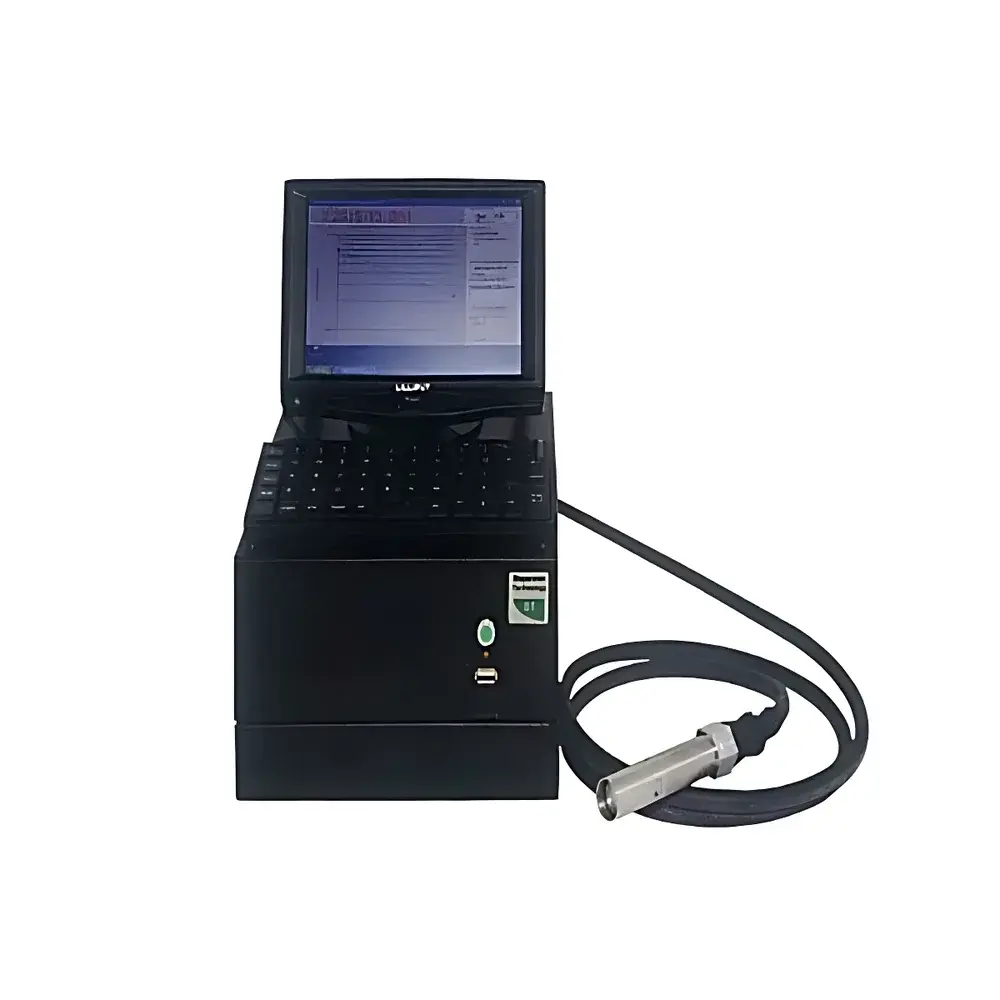
DT-700 Non-Aqueous Conductivity Meter
| Brand | DT (USA) |
|---|---|
| Origin | USA |
| Model | DT-700 |
| Measurement Range | 0–200 µS/m |
| Resolution | 1 µS/m |
| Accuracy | ±2% of reading |
| Probe Operating Temperature | −20 °C to +200 °C |
| Display | LCD |
| Interface | USB for external storage export |
| Form Factor | Portable handheld unit |
Overview
The DT-700 Non-Aqueous Conductivity Meter is a purpose-engineered portable instrument designed for precise electrical conductivity measurement in non-aqueous and low-dielectric media—such as organic solvents, hydrocarbon blends, lubricating oils, battery electrolytes, and molten salts—where conventional aqueous-based conductivity sensors fail due to polarization, electrode passivation, or insufficient ionic mobility. Unlike standard two-electrode conductivity cells optimized for water-based solutions, the DT-700 employs a temperature-compensated, corrosion-resistant dual-electrode probe with inert platinum-black plating and a sealed ceramic junction, enabling stable operation across wide thermal excursions (−20 °C to +200 °C) without calibration drift. Its measurement principle relies on AC-driven four-terminal sensing architecture (though implemented via a compact two-electrode configuration with guard ring isolation), minimizing capacitive coupling and electrode polarization errors common in low-conductivity organic systems. The device operates within a calibrated range of 0–200 µS/m, resolving changes down to 1 µS/m—critical for detecting trace ionic contamination in high-purity solvents used in semiconductor cleaning, lithium-ion battery R&D, and pharmaceutical synthesis.
Key Features
- True non-aqueous optimization: Electrode geometry, surface treatment, and signal conditioning tuned specifically for dielectric constants below 80 and conductivity values under 1 mS/m.
- Wide thermal tolerance: Probe housing and insulating materials conform to ASTM D2624 and IEC 60751 Class B specifications for thermal stability and insulation resistance at elevated temperatures.
- Onboard temperature compensation: Integrated Pt1000 RTD sensor enables automatic linear and polynomial compensation per ISO 7888 Annex C guidelines for non-aqueous media.
- USB mass-storage mode: Direct data export to FAT32-formatted USB drives without proprietary software; records timestamped readings (conductivity, temperature, date/time) in CSV format compliant with GLP audit trails.
- Low-power LCD with backlight: High-contrast monochrome display readable under laboratory fume hoods and industrial field conditions; auto-off after 5 minutes idle to preserve battery life.
- IP65-rated enclosure: Sealed against dust and low-pressure water jets, suitable for use in QC labs, pilot plants, and maintenance environments where solvent exposure is routine.
Sample Compatibility & Compliance
The DT-700 is validated for use with anhydrous acetonitrile, dimethyl sulfoxide (DMSO), N-methyl-2-pyrrolidone (NMP), ethylene carbonate/dimethyl carbonate (EC/DMC) blends, transformer oils (IEC 60296), and molten alkali metal carbonates. It complies with measurement traceability requirements outlined in ISO/IEC 17025:2017 Clause 7.7 (uncertainty evaluation) when operated with factory-certified probe calibration certificates (NIST-traceable reference standards available upon request). The instrument meets electromagnetic compatibility (EMC) requirements per EN 61326-1:2013 for laboratory equipment and satisfies RoHS 2011/65/EU material restrictions.
Software & Data Management
No host software installation is required for basic operation or data retrieval. When connected via USB, the DT-700 appears as a removable drive; exported CSV files include columns for conductivity (µS/m), temperature (°C), measurement ID, and UTC timestamp. For integration into LIMS or ELN platforms, the device supports manual import of calibration history and user-defined SOP identifiers. Audit trail functionality adheres to FDA 21 CFR Part 11 principles: all calibration events, zero adjustments, and range selections are logged with operator ID (via optional alphanumeric keypad accessory) and immutable timestamps—enabling full retraceability during regulatory inspections.
Applications
- Quality control of battery-grade electrolyte solvents in cathode/anode slurry preparation lines.
- In-process monitoring of ionic impurity accumulation in recirculated photoresist developers and etchants.
- Stability assessment of catalyst suspensions in non-polar reaction media (e.g., Grignard or Ziegler–Natta systems).
- Verification of water removal efficacy in molecular sieve-treated solvents prior to moisture-sensitive reactions.
- Field verification of transformer oil aging per IEEE C57.104 dissolved gas analysis (DGA) supporting protocols.
FAQ
Can the DT-700 measure conductivity in pure methanol or ethanol?
Yes—the probe’s surface chemistry and AC excitation frequency (1 kHz ±5%) prevent alcohol-induced electrode oxidation and support stable readings down to 0.5 µS/m in anhydrous alcohols.
Is probe recalibration required after exposure to >150 °C?
No—calibration stability has been verified over 50 thermal cycles between −20 °C and +200 °C; however, a post-thermal verification check using a certified 10 µS/m non-aqueous standard is recommended before critical measurements.
Does the USB interface support real-time data streaming to a PC?
No—the USB port is read-only mass-storage mode only; continuous logging requires external dataloggers interfaced via analog output (0–5 V proportional to conductivity), available as optional hardware module DT-IO-ANALOG.
What is the recommended cleaning procedure for the probe after measuring viscous oils?
Rinse immediately with analytical-grade toluene or xylene, followed by isopropanol; avoid ultrasonic cleaning or abrasive wiping to preserve the platinum-black coating integrity.
Related Products



