
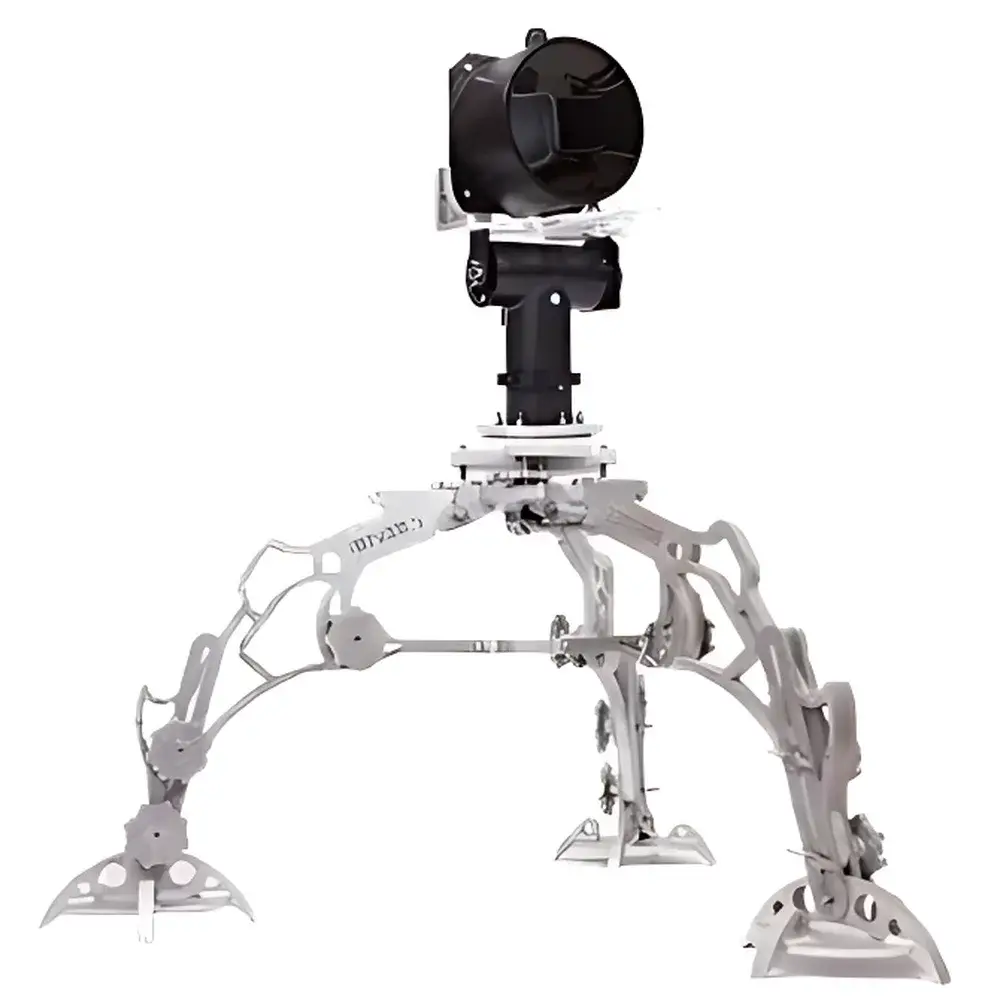
DT-AUTO Acoustic Monitoring and Assessment System for Hydraulic Engineering Projects
| Origin | USA |
|---|---|
| Manufacturer Type | Authorized Distributor |
| Origin Category | Imported |
| Model | DT-AUTO |
| Pricing | Available Upon Request |
Overview
The DT-AUTO Acoustic Monitoring and Assessment System is a purpose-engineered, fixed-point underwater surveillance platform designed for long-term, unattended operation in hydraulic infrastructure environments. It employs scientific-grade single-beam and split-beam echosounder technology to detect, track, and characterize submerged targets—including fish, marine mammals, anthropogenic debris, and unauthorized submersible intrusions—based on acoustic backscatter principles. Operating across six selectable center frequencies (38, 70, 120, 200, 420, and 1000 kHz), the system enables frequency-optimized deployment for varying water column conditions, target size ranges, and resolution requirements. Its core transducer architecture adheres to ISO 18922:2015 (Acoustics — Calibration of hydrophones) and supports quantitative echo-integration methodologies aligned with ICES Cooperative Research Report No. 338 (Hydroacoustic Sampling of Fish and Zooplankton). The system is deployed at critical hydraulic interfaces—including turbine intake tunnels, spillway aprons, fish passage structures, and coastal renewable energy installations—to support ecological impact assessment, operational safety assurance, and regulatory compliance monitoring.
Key Features
- Scientific-grade split-beam or single-beam transducers with calibrated sensitivity down to −140 dB re 1 µPa (at 1 m), enabling detection of small-bodied organisms and low-reflectivity targets
- Dynamic range exceeding 160 dB, ensuring simultaneous resolution of near-field and far-field echoes without signal saturation or clipping
- Low sidelobe level (−35 dB), delivering high angular discrimination and minimizing false-positive detections from off-axis reflections
- Programmable pulse repetition frequency (0.01–30 Hz) and pulse width (0.1–1 ms), configurable per monitoring objective and environmental noise profile
- Maximum detection range up to 500 m in freshwater; range performance validated per ASTM E1065-22 (Standard Guide for Evaluating Characteristics of Ultrasonic Search Units)
- Multi-transducer control architecture: single host unit synchronously manages ≥4 transducers via deterministic Ethernet-based command protocol
- Integrated azimuth sensor (0.1° resolution) and programmable pan-tilt actuator enabling real-time beam steering and 3D spatial tracking of moving targets
- Digital transducer interface compliant with NMEA 2000 and RS-422 standards for interoperability with third-party navigation and positioning systems
- Ruggedized IP68-rated enclosure with corrosion-resistant marine-grade aluminum housing, rated for continuous submersion at depths up to 100 m
- Modular front-panel interface featuring pull-out keyboard and high-brightness LCD display for local configuration, diagnostics, and real-time echo visualization
Sample Compatibility & Compliance
The DT-AUTO system is validated for deployment in diverse aquatic media—including turbid reservoirs, saline estuaries, tidal channels, and low-conductivity alpine lakes—without recalibration. Transducer frequency selection is matched to expected target cross-sections (e.g., 38 kHz for large-mammal detection at range; 200+ kHz for juvenile fish or microplastic aggregate characterization). All firmware and data acquisition modules comply with IEC 62443-3-3 for industrial cybersecurity, and raw binary echo data files conform to the standardized Echo Data Format (EDF v2.1) specified by the U.S. NOAA Fisheries Hydroacoustics Working Group. The system supports audit-ready metadata embedding (GPS time stamp, temperature-compensated sound speed, transducer tilt/heading) required under EU Water Framework Directive Annex V and U.S. FERC hydropower licensing conditions.
Software & Data Management
Data acquisition, visualization, and post-processing are supported through native Watchdog™ supervisory software and industry-standard third-party platforms including EchoView™, SONAR5-Pro™, and QTC Impact™. Watchdog™ provides continuous health monitoring with automated alerts for hardware faults, communication timeouts, power anomalies, or data stream discontinuities—log entries include UTC timestamps and diagnostic event codes traceable to IEC 61508 SIL-2 requirements. Raw echo data is stored in lossless HDF5 format with embedded calibration coefficients, enabling reproducible analysis across laboratories. Export options include CSV (for statistical modeling), GeoTIFF (for GIS-integrated spatial mapping), and NetCDF4 (for integration with MATLAB, Python SciPy, or R-based population dynamics frameworks). All software modules support 21 CFR Part 11-compliant electronic signatures and audit trails when deployed in GLP/GMP-regulated environmental monitoring programs.
Applications
- Fish passage effectiveness evaluation at dam bypass systems and fish ladders, supporting adaptive management per NMFS Biological Opinions
- Baseline and operational monitoring of marine mammal behavior near offshore wind turbine foundations and tidal energy converters
- Real-time intrusion detection in critical infrastructure zones, including dam forebays and intake penstocks, meeting DHS ASSET Program guidance for underwater threat mitigation
- Long-term quantification of diel vertical migration patterns and seasonal abundance indices in reservoirs and regulated rivers
- Validation of computational fluid dynamics (CFD) models using empirical target trajectory datasets derived from split-beam angular tracking
- Monitoring of suspended sediment plumes and macro-debris transport in flood control channels and stormwater outfalls
FAQ
What transducer frequencies are factory-calibrated and certified?
All six standard frequencies (38, 70, 120, 200, 420, and 1000 kHz) are individually calibrated per ISO 17681:2018 and supplied with NIST-traceable calibration certificates.
Can the system operate autonomously for extended deployments (e.g., >6 months)?
Yes—configured with external solar-charged battery banks and cellular/Iridium telemetry, the DT-AUTO has demonstrated 18-month continuous operation in remote Alaskan hydro sites per USACE ERDC Technical Report TR-22-1.
Is raw echo data export compatible with MATLAB and Python-based analysis pipelines?
Yes—HDF5-formatted datasets include full metadata headers and support direct ingestion via h5py, xarray, and echopype libraries without proprietary conversion steps.
Does the system meet cybersecurity requirements for federal infrastructure monitoring?
Yes—firmware implements TLS 1.3 encryption for remote command channels and supports role-based access control (RBAC) aligned with NIST SP 800-53 Rev. 5 AC-3 and IA-2 controls.
How is temperature-induced sound speed variation compensated during data acquisition?
Integrated CTD (Conductivity-Temperature-Depth) sensor input is used in real time to recalculate propagation delay and beam angle, applying the Mackenzie equation (JASA 1981) within the acquisition engine.







