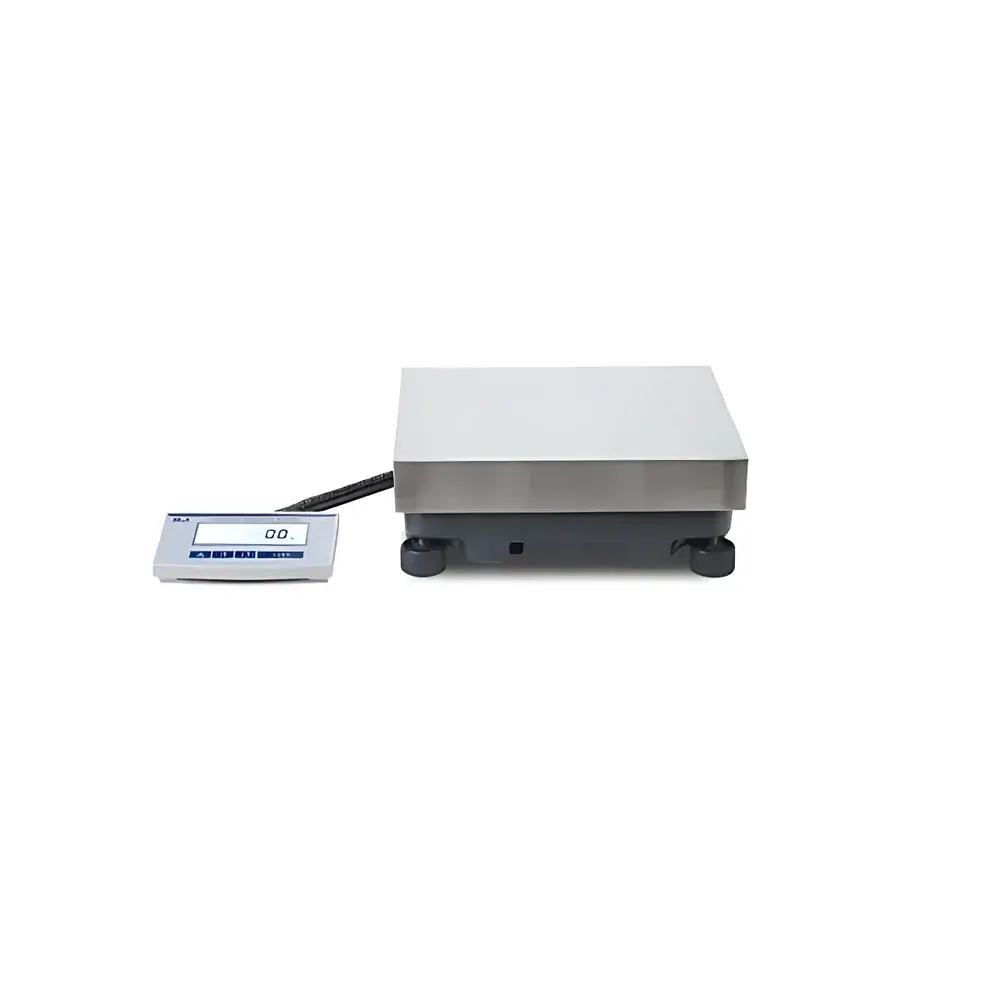
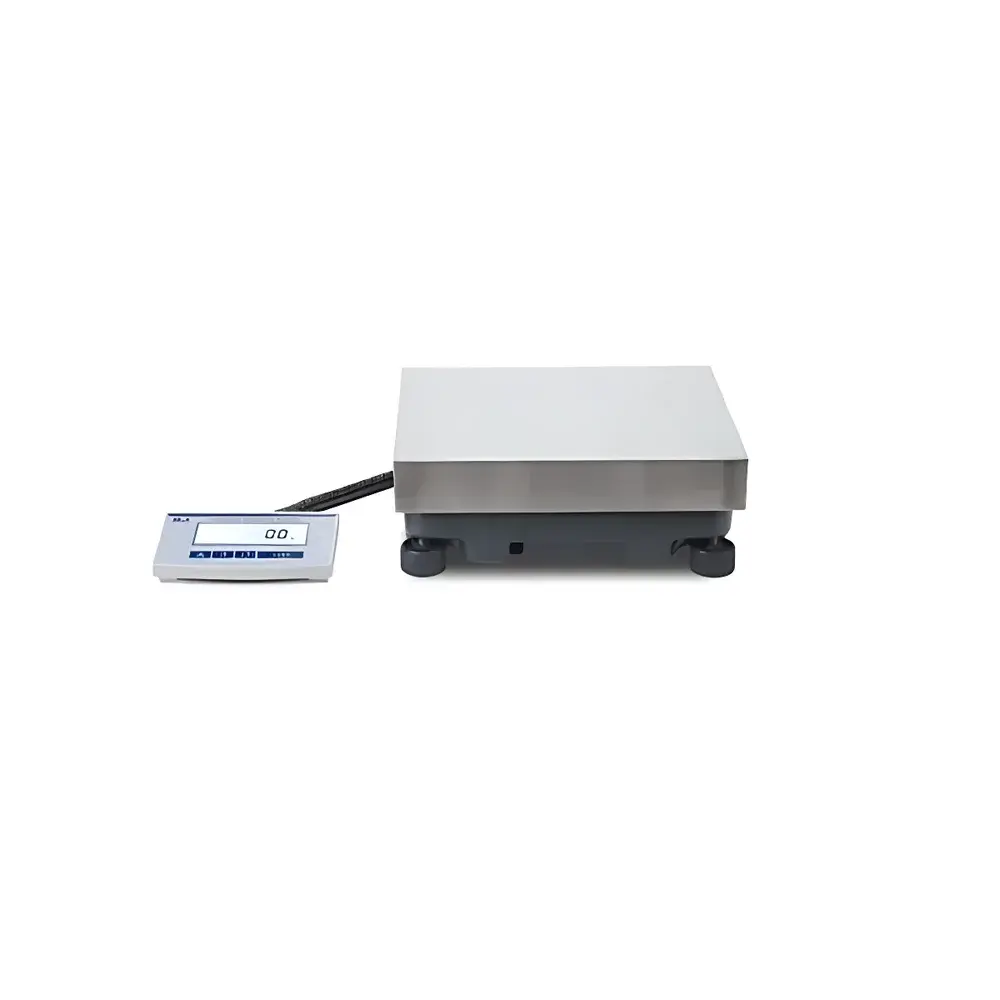
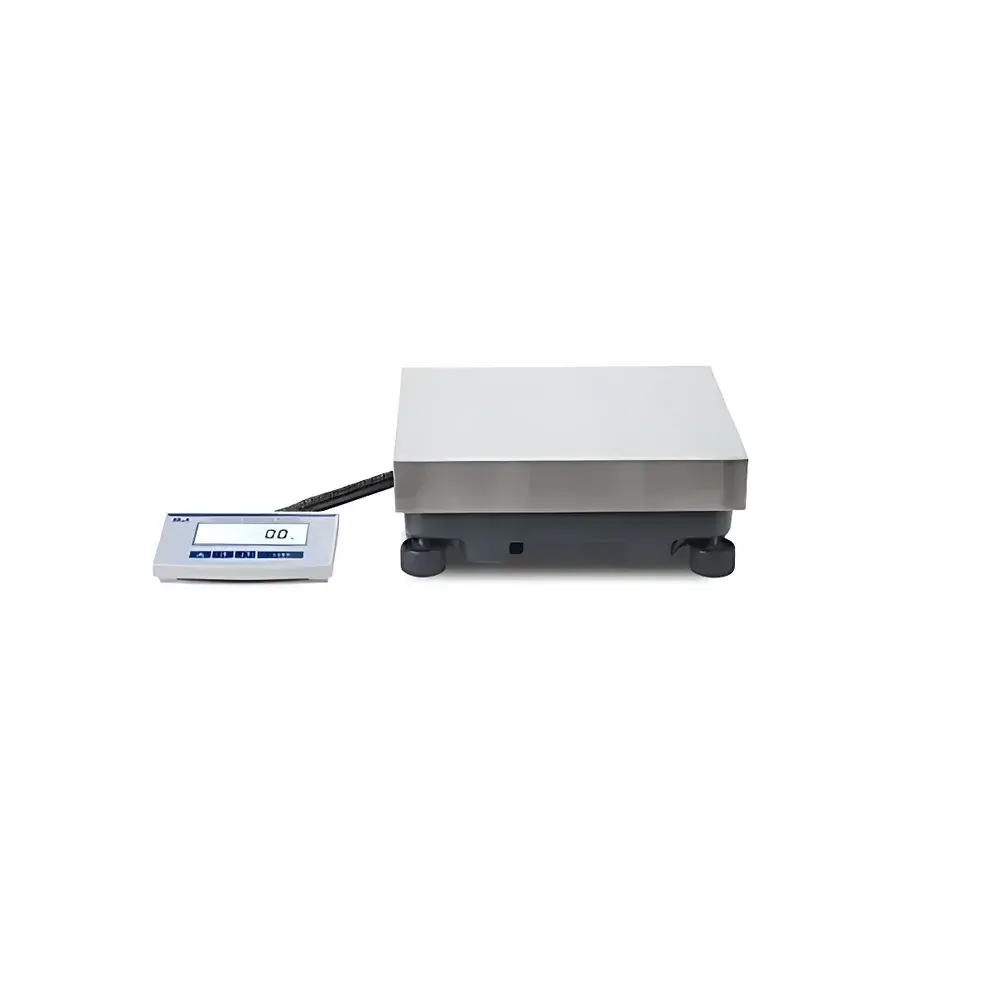
D&TCorp ES8K Industrial Precision Balance
| Brand | D&T Corp |
|---|---|
| Origin | Tianjin, China |
| Model | ES8K |
| Maximum Capacity | 8000 g |
| Readability | 0.1 g |
| Repeatability | ±0.2 g |
| Linearity Error | ±0.2 g |
| Operating Temperature | 13–25 °C |
| Operating Humidity | 10–70 % RH |
| Response Time (avg.) | ≤2.5 s |
| Display Size | 185 × 100 mm |
| Pan Size | 370 × 310 mm |
| Dimensions (W×D×H) | 370 × 310 × 140 mm |
| Warm-up Time | 30–60 min |
| Power Supply | AC 220 V / 50 Hz → DC 7.5 V / 600 mA |
| Accuracy Class | Class II |
| Sensor Type | Gold-plated ceramic variable-capacitance transducer |
| Environmental Compensation | Integrated high-precision humidity & temperature sensors |
| Communication Interface | RS232 bidirectional |
| Weighing Modes | Standard, Piece Counting, Percentage, Checkweighing |
| Units | g, ct, oz, dwt |
| Construction | Anti-static, corrosion-resistant, spill-proof stainless steel pan and reinforced streamlined chassis |
Overview
The D&TCorp ES8K Industrial Precision Balance is an ISO/IEC 17025-aligned Class II weighing instrument engineered for high-throughput industrial environments where reproducibility, environmental resilience, and long-term stability are critical. It employs a gold-plated ceramic variable-capacitance sensor architecture—distinct from traditional electromagnetic force compensation or strain-gauge designs—delivering intrinsic immunity to magnetic interference, thermal hysteresis, and mechanical creep. This sensor technology, combined with integrated dual-parameter environmental compensation (real-time humidity and temperature sensing), actively corrects for drift induced by ambient fluctuations, ensuring consistent metrological performance across shifts and seasonal transitions. With a maximum capacity of 8,000 g and 0.1 g readability, the ES8K meets the requirements of ASTM E122, ISO 9001 process control protocols, and GLP-compliant manufacturing workflows in chemical batching, pharmaceutical raw material verification, and quality assurance laboratories.
Key Features
- Gold-plated ceramic variable-capacitance transducer: Provides superior long-term calibration stability, minimal zero drift (<0.1 g/24 h under controlled conditions), and accelerated response time (≤2.5 s typical settling).
- Dual environmental compensation system: High-accuracy capacitive humidity sensor and NTC thermistor array continuously feed correction algorithms, reducing sensitivity to ambient RH and temperature gradients per ISO 9001 Annex A.3.2.
- Class II accuracy compliance: Fully conforms to OIML R76-1 and JJG 1036–2022 metrological requirements for industrial balances, including linearity error (±0.2 g) and repeatability (±0.2 g) verified at full load and 50% load.
- Robust mechanical architecture: Streamlined chassis with IP54-rated ingress protection; 370 × 310 mm stainless steel weighing pan engineered for anti-static discharge (EN 61340-5-1), corrosion resistance (ASTM B117 salt-spray tested), and spill containment.
- Optimized human-machine interface: 185 × 100 mm backlit LCD with high-contrast segmented display; intuitive soft-key navigation supporting multi-language firmware (English, Spanish, French, Chinese).
- Configurable weighing modes: Standard mass measurement, piece counting (with auto-average calculation), percentage weighing (reference-based deviation reporting), and checkweighing with configurable upper/lower tolerance limits and visual/audible alerts.
Sample Compatibility & Compliance
The ES8K accommodates heterogeneous sample forms—including powders, granules, bulk solids, and packaged components—without requiring recalibration between loads. Its large pan geometry supports standard DIN 12920 containers and ASTM D1980 test vessels. The balance is certified for use in non-hazardous industrial zones per IEC 61010-1:2010 safety standards. While not intrinsically safe, its low-voltage DC operation (7.5 V) and grounded chassis meet EN 61326-1 EMC requirements for laboratory and factory floor deployment. Documentation includes full traceable calibration certificate (NIST-traceable weights used), MRA-compliant uncertainty budget, and conformity statement per China’s CNAS-CL01:2018 accreditation framework.
Software & Data Management
RS232 serial interface enables deterministic bidirectional communication with LIMS, ERP, or MES platforms using ASCII protocol (baud rate: 9600, 8N1). Optional D&TCorp BalanceLink™ software (Windows/macOS) provides audit-trail-enabled data logging compliant with FDA 21 CFR Part 11 requirements—including user authentication, electronic signatures, and immutable timestamped records. Raw weight data export supports CSV, TXT, and XML formats; batch summary reports include statistical process control (SPC) metrics: mean, SD, CV%, and capability indices (Cp/Cpk) calculated per ISO 22514-2.
Applications
- Raw material intake verification in API manufacturing (USP and EP 2.1.3 compliance support)
- Batch formulation control in food processing (HACCP critical control point monitoring)
- Quality inspection of machined components (weight-based dimensional correlation)
- Recycling facility sorting validation (density proxy via mass/volume ratio)
- Educational metrology labs requiring OIML-compliant teaching instruments
FAQ
What is the warm-up time required before first-use calibration?
A minimum of 30 minutes is recommended; 60 minutes ensures full thermal equilibrium of the sensor and internal reference circuits.
Does the ES8K support external calibration with user-provided weights?
Yes—it accepts external calibration via two-point linear adjustment (zero and full-scale) using Class M2 or better certified masses per ISO 9001 Section 7.1.5.2.
Is the RS232 interface compatible with modern USB-to-serial adapters?
Yes, when configured with standard null-modem wiring and driver-certified FTDI chipsets (e.g., FT232RL), with latency <15 ms per frame.
Can the balance operate continuously for 24/7 production cycles?
Yes—the power management circuitry and ceramic sensor design enable uninterrupted operation; mean time between failures (MTBF) exceeds 50,000 hours per MIL-HDBK-217F prediction.
How is traceability maintained during software updates?
Firmware updates preserve all calibration coefficients and audit logs; version-controlled binaries are digitally signed and validated pre-installation per IEC 62443-3-3 SL2 requirements.