
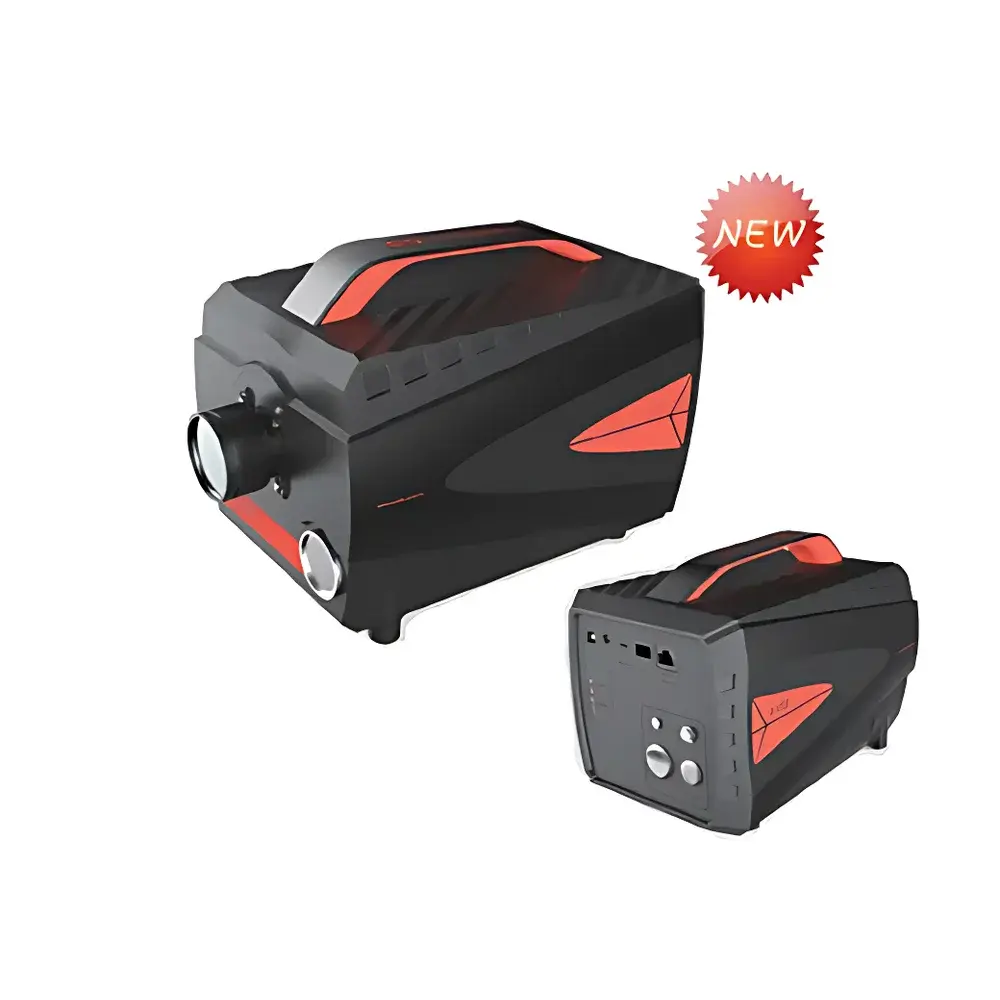
Dualix GaiaField Pro Portable Hyperspectral Imaging System
| Brand | Dualix Spectral Imaging |
|---|---|
| Origin | Sichuan, China |
| Model | GaiaField Pro |
| Spectral Range | 400–2500 nm (configurable by variant) |
| Spectral Resolution | 2.8–10 nm |
| Spatial Resolution | Up to 640 × 700 pixels (spatial × spectral) |
| FOV | 18°–24° (lens-dependent) |
| IFOV | ≤ 0.5 mrad (with standard 23–30 mm lenses) |
| Frame Rate | 4–8 s per hyperspectral cube |
| Detector Types | CCD, InGaAs, T2SL |
| Dynamic Range | 12–14 bits |
| Interface | USB 3.0 / GigE / USB 2.0 |
| Weight | 3–8.5 kg |
| Integrated Battery | 80–120 Wh (≥2 h operation) |
| Onboard Processing | ARM-based real-time analysis engine |
| Wireless Control | Wi-Fi (Android/iOS/iPadOS) |
| Data Output Format | ENVI-compatible .hdr/.bil, Evince, SpecSight-ready |
| Calibration | Radiometric, reflectance, flat-field, lens distortion, and non-uniformity correction |
Overview
The Dualix GaiaField Pro Portable Hyperspectral Imaging System is a field-deployable, push-broom scanning instrument engineered for quantitative spectral-spatial data acquisition across visible, near-infrared (VNIR), short-wave infrared (SWIR), and mid-wave infrared (MWIR) bands. Operating on the principle of spatial-spectral scanning—where a linear array detector captures one spatial line per integration while mechanical motion translates the system across the scene—the GaiaField Pro generates full hyperspectral data cubes (x, y, λ) with calibrated radiance or reflectance values. Its modular architecture supports six distinct optical configurations (V10, V10E, N17E, N17E-HR, N235E-XE, N25E-XE), enabling mission-specific selection of spectral range (400–1000 nm, 900–1700 nm, or 1000–2500 nm), detector technology (CCD, InGaAs, or Type-II Superlattice), and spatial-spectral sampling trade-offs. Designed for airborne, tripod-mounted, or handheld deployment, the system integrates all core functions—including optics, detector, FPGA-based preprocessing, embedded Linux OS, and battery—within a single ruggedized enclosure weighing between 3.0 and 8.5 kg.
Key Features
- Self-contained acquisition and real-time processing: No external PC required; onboard ARM-based computing unit executes calibration, georeferencing, and model inference.
- Dual-camera workflow: High-definition RGB preview camera enables precise region-of-interest framing, co-registration verification, and contextual annotation prior to hyperspectral capture.
- Application-optimized onboard analytics: Preloaded algorithms include NDVI, EVI, red-edge indices, camouflage detection, mineral identification (e.g., kaolinite, goethite), and spectral angle mapper (SAM) matching.
- User-defined model support: Python-based scripting interface allows integration of custom spectral classifiers, regression models, or spectral unmixing routines directly into the acquisition pipeline.
- Real-time spectral library search: On-the-fly matching against user-loaded or factory-provided spectral libraries (e.g., USGS, ECOSTRESS, ASTER) with configurable match thresholds and distance metrics (SID, SAM, Euclidean).
- Comprehensive radiometric calibration suite: Includes dark current subtraction, flat-field correction, non-uniformity compensation, lens vignetting modeling, and bidirectional reflectance distribution function (BRDF)-aware normalization.
- Modular optical design: Interchangeable lenses (23 mm, 30 mm, and optional telecentric variants) enable adaptation to varying standoff distances and ground sample distances (GSD).
- Wireless operational flexibility: Native Wi-Fi connectivity supports remote control, live preview streaming, and metadata synchronization from iOS, Android, and iPadOS devices.
- Extended-range telemetry option: Optional RS-232/RS-422 serial interface enables long-distance (>1 km) command-and-control and image streaming via UHF radio or fiber-optic link.
- Standards-compliant data packaging: Outputs ENVI BIL/BIP/HDR, SpecSight XML, and Evince-compatible binary formats with embedded geotags, acquisition timestamps, and sensor metadata (per ISO 19115-2).
Sample Compatibility & Compliance
The GaiaField Pro accommodates heterogeneous sample geometries—from vegetation canopies and soil transects to man-made structures and tactical surfaces—without contact or sample preparation. Its push-broom architecture ensures consistent illumination geometry and eliminates motion blur under typical UAV or vehicle-mounted scanning conditions. The system complies with electromagnetic compatibility (EMC) requirements per IEC 61326-1:2013 and meets IP54 ingress protection standards for dust and water resistance during field use. All firmware and calibration workflows adhere to traceable metrology practices aligned with ISO/IEC 17025:2017 principles. While not FDA-cleared as a medical device, its radiometric stability and NIST-traceable calibration protocols support GLP-compliant environmental monitoring, agricultural research, and defense-related spectral signature validation per MIL-STD-810H and ASTM E2792-21 guidelines.
Software & Data Management
The embedded GaiaOS operating system provides a secure, deterministic execution environment for acquisition and preprocessing. All raw and calibrated data are stored on removable microSDXC cards (UHS-I Class 10) with automatic checksum generation (SHA-256). The Dualix SDK (v4.2+) delivers C/C++ and Python APIs for integration into laboratory LIMS, GIS platforms (QGIS, ArcGIS Pro), or cloud-based analytics pipelines (AWS Ground Station, Google Earth Engine). Audit trails—including operator ID, GPS coordinates, UTC timestamps, calibration version, and processing flags—are recorded in machine-readable JSON logs compliant with 21 CFR Part 11 requirements for electronic records and signatures when deployed in regulated environments. Exported datasets retain full spectral fidelity and support batch reprocessing using updated atmospheric correction (QUAC, FLAASH) or geometric rectification modules.
Applications
- Agricultural phenotyping: Quantitative assessment of chlorophyll content, water stress, nitrogen status, and disease onset via narrowband vegetation indices and partial least squares regression (PLSR) models.
- Environmental remote sensing: Mapping of invasive species, soil organic carbon gradients, heavy metal contamination (via spectral absorption features), and post-wildfire burn severity classification.
- Defense and security: Real-time detection of camouflage netting, painted decoys, and concealed materials using spectral anomaly detection and endmember extraction (N-FINDR, VCA).
- Geological surveying: Identification of alteration minerals (e.g., alunite, jarosite), lithological boundaries, and hydrothermal alteration zones in open-pit and outcrop settings.
- Forensic material analysis: Non-destructive discrimination of ink formulations, paint layers, textile dyes, and counterfeit pharmaceutical tablets based on spectral fingerprinting.
- Industrial quality assurance: In-line inspection of coated surfaces, polymer blends, and recycled plastic sorting using supervised classification (SVM, Random Forest) trained on spectral libraries.
FAQ
Is the GaiaField Pro suitable for drone-mounted operation?
Yes—it is certified for integration with Class I and II UAVs (max payload ≥3.5 kg); vibration-damped mounting kits and GNSS/IMU fusion modules are available as accessories.
What spectral calibration standards are supported?
Factory calibration uses NIST-traceable tungsten-halogen and deuterium lamps; users may perform field recalibration using Spectralon® reference panels (99% reflectance) or calibrated LED sources.
Can the system operate in low-light or twilight conditions?
The VNIR variants (V10/V10E) maintain usable SNR down to 10,000 lux; SWIR/MWIR variants require active illumination or solar irradiance >30,000 lux for optimal performance.
How is spectral data synchronized with GPS/IMU metadata?
Integrated u-blox M8T GNSS and Bosch BMI088 IMU provide time-stamped pose data at 100 Hz; hardware-level PPS triggering ensures sub-millisecond synchronization with frame acquisition.
Does the system support automated flight path planning?
No—flight planning is performed externally (e.g., using DroneDeploy or Pix4Dcapture); the GaiaField Pro accepts position/attitude commands via MAVLink over serial or UDP for coordinated acquisition.





