
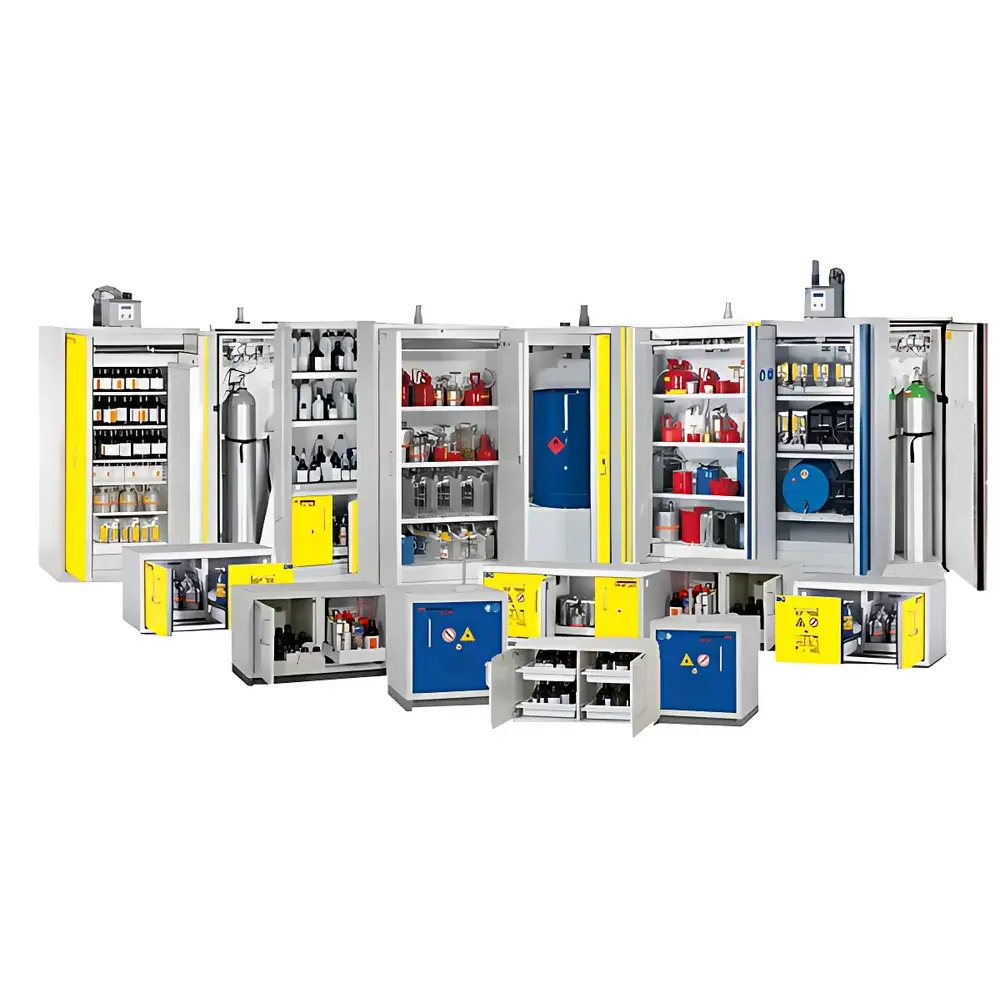
Dueperthal CLASSIC XL Wing-Door Fire-Resistant Safety Cabinet
| Brand | Dueperthal |
|---|---|
| Origin | Germany |
| Model | CLASSIC XL – Version XL 1 |
| Fire Resistance Rating | 90 min |
| Construction Material | Steel (standard) / Stainless Steel (optional) |
| External Dimensions (W×D×H) | 1195 × 595 × 2080 mm |
| Internal Dimensions (W×D×H) | 1099 × 446 × 1830 mm |
| Net Weight | 469 kg |
| Capacity | 105 L total storage volume (configurable for spray cans, tin cans, lab glassware up to 2.5 L) |
| Compliance | DIN 12927, GS/CE Marked, ISO 9001 Certified |
| Optional Accessories | Perforated inserts, spill containment sump (1 x), 3 adjustable shelves, anti-slip mats, cable/port sealing kits, ventilation ducting interface |
Overview
The Dueperthal CLASSIC XL Wing-Door Fire-Resistant Safety Cabinet is an engineered solution for the secure, code-compliant storage of hazardous substances in research laboratories, pharmaceutical production facilities, and industrial R&D environments. Designed and manufactured in Germany to stringent European fire safety standards, this cabinet employs a double-walled steel construction with intumescent insulation to achieve certified 90-minute fire resistance (DIN 12927). Its wing-door configuration—featuring two independently operable hinged doors—optimizes spatial access while maintaining structural integrity under thermal stress. Unlike standard ventilated cabinets, the CLASSIC XL integrates passive fire containment with active hazard mitigation: sealed seams, self-closing mechanisms (tested to EN 1125), and a floor-level spill containment sump (100 mm deep) prevent lateral leakage during fire exposure or accidental tipping. The cabinet is not rated for explosion protection (ATEX) but is fully compatible with external forced-air ventilation systems per DIN 12927 Annex B, enabling safe vapor extraction when storing volatile organic compounds.
Key Features
- 90-minute fire resistance certification per DIN 12927 for structural integrity and internal temperature limitation (< 180 °C at 30 min, < 220 °C at 90 min)
- Wing-door design with dual independent hinges, allowing full-width access without compromising door alignment or seal performance
- Robust 2-mm cold-rolled steel housing (stainless steel variant available per Ref. No. 29-201260-002) with epoxy-polyester powder coating (RAL 3000)
- Integrated 100-mm-deep galvanized steel spill containment sump with removable perforated insert (PP material, Ref. No. 29-81260-314) for chemical compatibility
- Three adjustable steel shelves (Ref. No. 29-81260-114) with 50-kg uniform load capacity each; shelf height spacing: 220 mm
- Self-closing mechanism activated by fusible link (70 °C) and mechanical latch override for emergency egress compliance
- Pre-drilled cable/port entry points with optional hermetic sealing kits (Ref. Nos. 29-70000-045 / -048) supporting Class I, Division 2 electrical installations
Sample Compatibility & Compliance
The CLASSIC XL accommodates heterogeneous chemical inventories under a single fire-rated enclosure: flammable liquids (Class I A/B/C per NFPA 30), corrosives (acids, alkalis), toxic agents (GHS Category 1–3), aqueous pollutants, pressurized aerosol containers (up to 400 mL), and sealed glass vessels (1–2.5 L). It is explicitly validated for storage of UN 1263 (paint-related materials), UN 1993 (flammable liquids, n.o.s.), and UN 2794 (corrosive liquids, acidic). All variants comply with EU Machinery Directive 2006/42/EC, PED 2014/68/EU (for pressure-rated accessories), and are CE-marked under EN 14470-1:2019. Documentation includes full traceability of weld seam testing, insulation batch certification, and third-party fire test reports (TÜV Rheinland Report No. 0000021564). For GLP/GMP-regulated labs, optional audit-ready labeling kits and serialized asset tags support 21 CFR Part 11-aligned inventory tracking.
Software & Data Management
While the CLASSIC XL is a passive mechanical system without embedded electronics, its design supports digital integration within laboratory infrastructure management platforms. Each unit ships with a QR-coded asset label containing model-specific technical data (fire rating, dimensions, weight, accessory matrix) compliant with ISO/IEC 15459-3. Optional RFID tags (upon request) enable real-time location tracking in warehouse management systems (WMS). Dueperthal provides native BIM objects (Revit .rfa format) and CAD drawings (DWG/DXF) for facility planning compliance. Maintenance logs—including hinge torque verification, seal compression testing, and sump integrity checks—are documented per ISO 55001 guidelines and archived via Dueperthal’s secure customer portal (access granted upon registration).
Applications
This cabinet serves critical functions across regulated environments: long-term archival storage of reference standards in QC labs (USP compliant); segregated holding of pyrophoric reagents in synthetic chemistry suites; secondary containment for HPLC mobile phase solvents in analytical departments; and interim staging of cytotoxic drug intermediates in oncology manufacturing (aligned with EMA Guideline on Risk-Based Approach to GMP Inspections). Its modular interior allows reconfiguration for hybrid use cases—e.g., combining acid-resistant PP-lined shelves with stainless-steel drawers for multi-hazard workflows. In cleanroom applications (ISO 14644-1 Class 5–8), the stainless-steel variant (Ref. No. 29-201260-002) meets particle shedding requirements when paired with HEPA-filtered exhaust ducting.
FAQ
Does the CLASSIC XL meet OSHA 29 CFR 1910.106 requirements for flammable liquid storage?
Yes—when installed with proper clearance (36″ front access, 18″ side/rear), grounded, and connected to approved ventilation per local AHJ interpretation.
Can the cabinet be anchored to the floor in seismic zones?
Yes—pre-tapped M10 anchor points are integrated into the base frame (4 locations), compatible with Simpson Strong-Tie SEBZ seismic brackets.
Is the sump depth sufficient for EPA SPCC compliance?
The 100-mm sump retains ≥110% of the largest container’s volume (per 40 CFR 112.7(f)), satisfying secondary containment mandates for most lab-scale operations.
What maintenance intervals are recommended for fire-rated integrity?
Annual visual inspection of door seals, hinge function, and sump corrosion status; full third-party recertification every 5 years or after any fire exposure event.
Are replacement parts traceable to original manufacturing batches?
Yes—every component (shelves, inserts, locks) carries a laser-etched serial number linked to Dueperthal’s ERP system for full material pedigree and RoHS/REACH documentation.



