
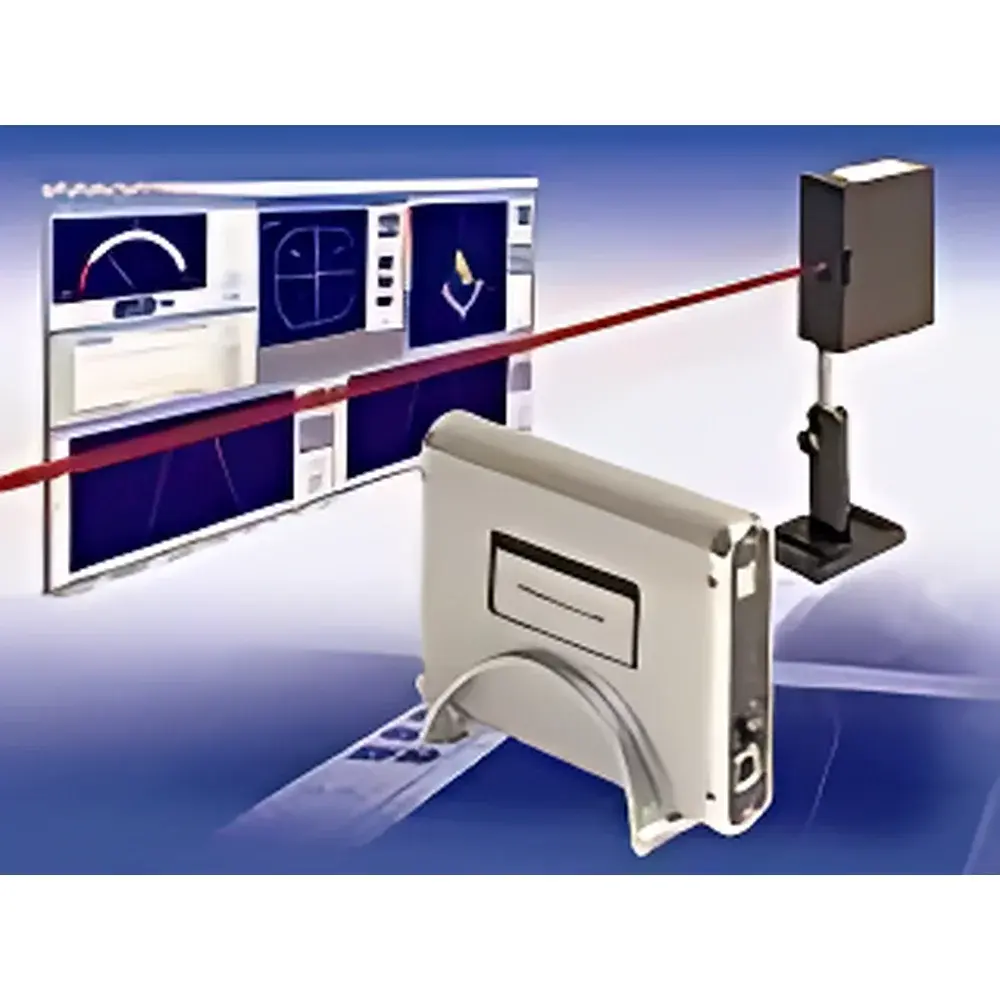
Duma Optronics BA Series High-Precision Multi-Blade Laser Beam Profiler
| Origin | Israel |
|---|---|
| Manufacturer Type | Authorized Distributor |
| Product Origin | Imported |
| Model | BA Series |
| Detector Options | Si (350–1100 nm), UV-enhanced Si (190–1100 nm), InGaAs (800–1800 nm, 1200–2700 nm) |
| Blade Configurations | 3-blade or 7-blade scanning slit architecture |
| Detector Apertures | 5 mm circular (Si/UV), 9 mm square (Si/UV), 3 mm or 5 mm circular (InGaAs) |
| Interface | USB 2.0 |
| Software | BeamGage-compatible CD-based analysis suite |
| Compliance | Designed for ISO 11146-1:2005 and ISO 13694-compliant beam parameter extraction |
Overview
The Duma Optronics BA Series High-Precision Multi-Blade Laser Beam Profiler is an engineered solution for non-intrusive, real-time characterization of continuous-wave (CW) and pulsed laser beams in industrial, R&D, and metrology environments. Based on the scanning-slit principle—where multiple precision-machined blades sequentially occlude the beam while a calibrated photodetector records transmitted intensity—the system reconstructs two-dimensional beam profiles with high spatial resolution and minimal perturbation. Unlike camera-based profilers, this architecture eliminates saturation artifacts, blooming, and pixelation limitations, making it especially suitable for high-power, tightly focused, or highly divergent beams where dynamic range and linearity are critical. Each BA model is optimized for specific spectral bands and power regimes, supporting rigorous adherence to ISO 11146-1:2005 (determination of beam widths, divergence, and propagation parameters) and ISO 13694 (laser beam profile measurement methods). The system delivers traceable, repeatable measurements of beam width (D4σ, knife-edge, 1/e²), centroid position, ellipticity, asymmetry, and total power—all without requiring neutral density attenuation for many mid-power applications.
Key Features
- Multi-blade scanning architecture (3-blade or 7-blade variants) enabling high-fidelity reconstruction of near-field and far-field intensity distributions
- Spectral flexibility across four detector platforms: standard silicon (350–1100 nm), UV-enhanced silicon (190–1100 nm), extended-range InGaAs (800–1800 nm), and deep-IR InGaAs (1200–2700 nm)
- Modular mechanical design with interchangeable detector heads and standardized USB 2.0 interface for plug-and-play operation
- Optional integrated touchscreen control unit (SAT version) for standalone configuration, real-time visualization, and on-device parameter adjustment
- High-precision slit geometry with sub-micron blade alignment tolerance, ensuring reproducible beam width uncertainty < ±2% (k=2) under controlled environmental conditions
- Robust mechanical housing rated for laboratory and light industrial deployment; compatible with standard optical table mounting via included kinematic bracket
Sample Compatibility & Compliance
The BA Series accommodates free-space beams from low-power alignment lasers (<1 mW) up to multi-watt industrial sources—when used with optional accessories such as the SAM3-B beam sampler or SAM3-HP high-power attenuator module (custom-engineered per application). All models meet electromagnetic compatibility requirements per EN 61326-1 and operate within ambient temperature ranges of 15–30 °C at ≤70% non-condensing humidity. Data acquisition and reporting workflows support GLP/GMP-aligned documentation practices, including timestamped measurement logs, user-defined metadata fields, and export formats compatible with LIMS integration (CSV, XML, PDF). While not FDA-cleared as a medical device, the system’s measurement traceability aligns with calibration hierarchies referenced in ISO/IEC 17025-accredited laboratories.
Software & Data Management
The included BeamGage-compatible software provides comprehensive analysis tools compliant with ISO 11146 definitions. Users can configure acquisition parameters—including scan speed, averaging depth, and background subtraction mode—and generate automated reports with embedded pass/fail thresholds against user-specified tolerances. Audit-trail functionality records operator ID, timestamp, instrument serial number, and calibration status for each measurement session. Raw scan data is stored in binary format with header metadata, enabling post-processing in MATLAB, Python (via provided API libraries), or third-party statistical packages. Software updates are distributed via secure HTTPS portal; no cloud storage or telemetry is enabled by default.
Applications
- Laser resonator optimization and cavity alignment verification
- Quality assurance of fiber-coupled and diode laser modules in manufacturing
- Characterization of ultrafast amplifier output pre-chirp compensation
- Validation of beam delivery optics performance in material processing systems
- Calibration reference for camera-based profilers and wavefront sensors
- Teaching and demonstration of fundamental Gaussian and multimode beam propagation theory
FAQ
What beam diameters can the BA Series accurately measure?
Minimum measurable beam diameter is determined by slit width and sampling resolution—typically ≥10 µm for Si-based models and ≥25 µm for IR variants. Maximum measurable diameter is constrained by detector active area (e.g., 9 mm square for BA7-Si-USB); larger beams require beam reduction optics.
Is the system compatible with pulsed lasers?
Yes—provided pulse repetition rate exceeds the scanner’s minimum dwell time per slit position (≥1 kHz typical). Single-shot profiling requires external trigger synchronization via TTL input (available on SAT models).
How often does the system require recalibration?
Duma Optronics recommends annual calibration against NIST-traceable standards. Detector responsivity drift is monitored internally; deviation >±1.5% triggers advisory alert in software.
Can I integrate the BA Series into an automated production line?
Yes—USB HID protocol enables direct integration with LabVIEW, Python, or PLC-based control systems. Optional Ethernet-to-USB bridge modules support remote monitoring over local networks.
Does the software support 21 CFR Part 11 compliance?
The base software does not include electronic signature or role-based access control; however, validated installation packages and SOP templates are available upon request for regulated environments.





