
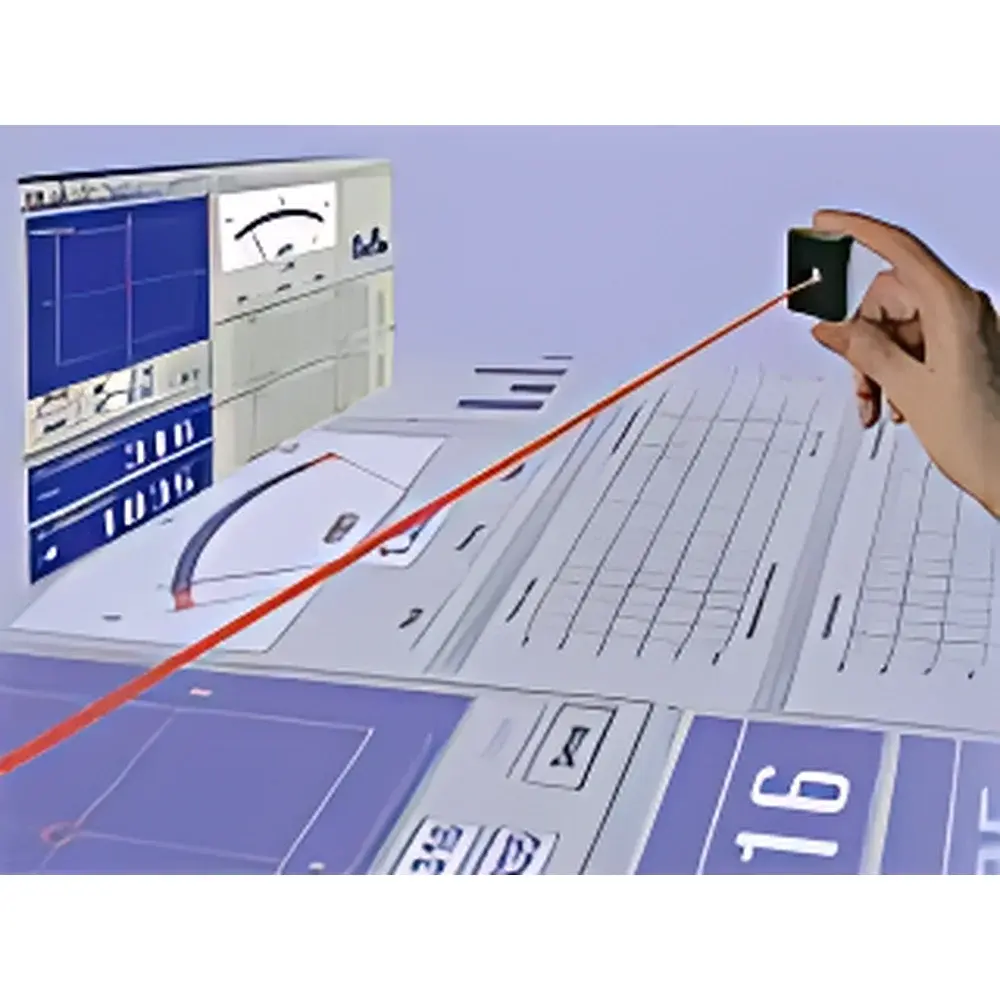
Duma Optronics SPOTCOM Series Compact Position-Sensitive Detector (PSD) System
| Brand | Duma Optronics |
|---|---|
| Origin | Israel |
| Model | SPOTCOM-L / SPOTCOM-Q / SPOTCOM-L04 |
| Spectral Range | 350–1100 nm |
| Position Accuracy | ±0.1 µm (Lateral Effect) or ±0.025% of beam diameter (Quadrant) |
| Active Area Options | 9×9 mm (SPOTCOM-L), 10×10 mm (SPOTCOM-Q, 30 µm gap), 4×4 mm (SPOTCOM-L04) |
| Output Interface | Plug-and-Play analog voltage (X/Y) |
| Housing | Bare sensor, no glass cover |
| Optional Accessories | NG4/NG9/NG10 ND filters (3/4"-32 threaded housing), 55 mm ambient light suppression hood |
Overview
The Duma Optronics SPOTCOM Series is a family of compact, OEM-optimized position-sensitive detector (PSD) systems engineered for high-precision beam alignment, laser stabilization, and real-time centroid tracking in space-constrained optical setups. Based on lateral-effect photodiode (LEPD) or quadrant photodiode (QPD) technology, these detectors operate across a broad spectral range of 350–1100 nm—covering UV-visible to near-infrared wavelengths essential for diode lasers, solid-state lasers, and fiber-coupled sources. Unlike camera-based beam profilers, PSDs deliver analog X/Y coordinate outputs with microsecond-level response time and sub-micron positional resolution—making them ideal for closed-loop feedback control in adaptive optics, interferometry, and precision motion stages. The SPOTCOM platform integrates signal conditioning electronics directly into the sensor housing, eliminating external amplifiers and reducing noise susceptibility. Its bare-sensor design (no protective glass window) ensures minimal wavefront distortion and maximizes optical throughput—critical for low-power or polarization-sensitive applications.
Key Features
- Three standardized form factors: SPOTCOM-L (9×9 mm lateral-effect PSD), SPOTCOM-Q (10×10 mm quadrant PSD with 30 µm inter-quadrant gap), and SPOTCOM-L04 (4×4 mm miniaturized lateral-effect variant) — all optimized for PCB-level integration.
- True plug-and-play analog output: Differential X and Y voltage signals referenced to ground, calibrated for linear response across full active area; no firmware or driver installation required.
- High intrinsic linearity: <0.5% nonlinearity over 80% of active area (per ISO 11146-2), enabling traceable beam position metrology without pixelation artifacts.
- Robust mechanical architecture: Aluminum alloy housing with precision-machined mounting features; compatible with standard optomechanical rails and kinematic mounts.
- Thermal stability: Designed for operation from 15°C to 40°C with <5 ppm/°C gain drift, supporting stable long-term alignment in laboratory and industrial environments.
- OEM-ready interface: 0.1″ pitch header pins (2×5 configuration) for power (±15 VDC), analog outputs (X+, X−, Y+, Y−), and reference ground—fully compliant with IPC-7351B footprint standards.
Sample Compatibility & Compliance
The SPOTCOM Series supports continuous-wave and pulsed laser sources with average powers up to 10 mW (unattenuated) and peak powers below 1 kW (for nanosecond pulses). Beam diameters from 10 µm to 8 mm are reliably resolved depending on model selection and optional neutral density filtering. All variants comply with IEC 61000-6-3 (EMC emission limits) and IEC 61000-6-2 (immunity requirements) for industrial environments. While not certified as medical devices, the system meets general requirements for optical measurement instrumentation per ISO/IEC 17025:2017 when used within validated calibration protocols. Traceable calibration reports (NIST-traceable reference standards) are available upon request for GxP-aligned installations requiring documented uncertainty budgets.
Software & Data Management
Although the SPOTCOM operates autonomously as an analog subsystem, Duma Optronics provides optional LabVIEW™ and MATLAB® instrument drivers for digitization and post-processing. These drivers support synchronization with DAQ hardware (e.g., National Instruments USB-6211) and enable real-time centroid logging, statistical process control (SPC) charting, and export to CSV or HDF5 formats. For regulated environments, raw analog outputs may be acquired via FDA 21 CFR Part 11–compliant data acquisition systems with audit trail functionality. No embedded firmware update mechanism exists—hardware-level calibration is fixed at manufacture, ensuring long-term measurement integrity without software dependency.
Applications
- Laser cavity alignment and resonator mode monitoring in R&D and production laser systems.
- Active beam steering stabilization in free-space optical communication terminals.
- Real-time focus position correction in ultrafast laser micromachining platforms.
- Centroid tracking in Michelson and Fabry–Pérot interferometers for vibration analysis.
- OEM integration into automated wafer inspection tools and semiconductor lithography alignment subassemblies.
- Telescope secondary mirror tip/tilt correction in small-aperture adaptive optics demonstrators.
FAQ
What is the difference between lateral-effect and quadrant PSD configurations?
Lateral-effect PSDs (e.g., SPOTCOM-L) provide continuous, analog centroid position over their entire active area with inherently high linearity but reduced dynamic range in low-signal conditions. Quadrant detectors (e.g., SPOTCOM-Q) offer superior signal-to-noise ratio for small-spot tracking and faster response at the expense of discrete region transitions near quadrant boundaries.
Can SPOTCOM sensors be used in vacuum environments?
Yes—the bare-sensor construction and absence of adhesives or epoxy-sealed components allow operation under moderate vacuum (<10⁻³ mbar); however, thermal management must be addressed externally due to lack of convection cooling.
Is calibration certificate included with shipment?
A factory calibration report listing linearity deviation, zero offset, and sensitivity (mV/µm) is provided with each unit. NIST-traceable certification is available as a value-added service.
Do SPOTCOM models support TTL synchronization or trigger input?
No—these are purely analog-output devices without digital interfaces. Synchronization must be implemented externally via analog threshold detection or parallel DAQ sampling.
How is ambient light rejection achieved?
The optional 55 mm light hood suppresses off-axis illumination, while the absence of anti-reflection coating on the bare silicon surface minimizes stray-light coupling. For high-ambient settings, NG-series ND filters (NG4/NG9/NG10) can be threaded directly onto the housing front flange.





