
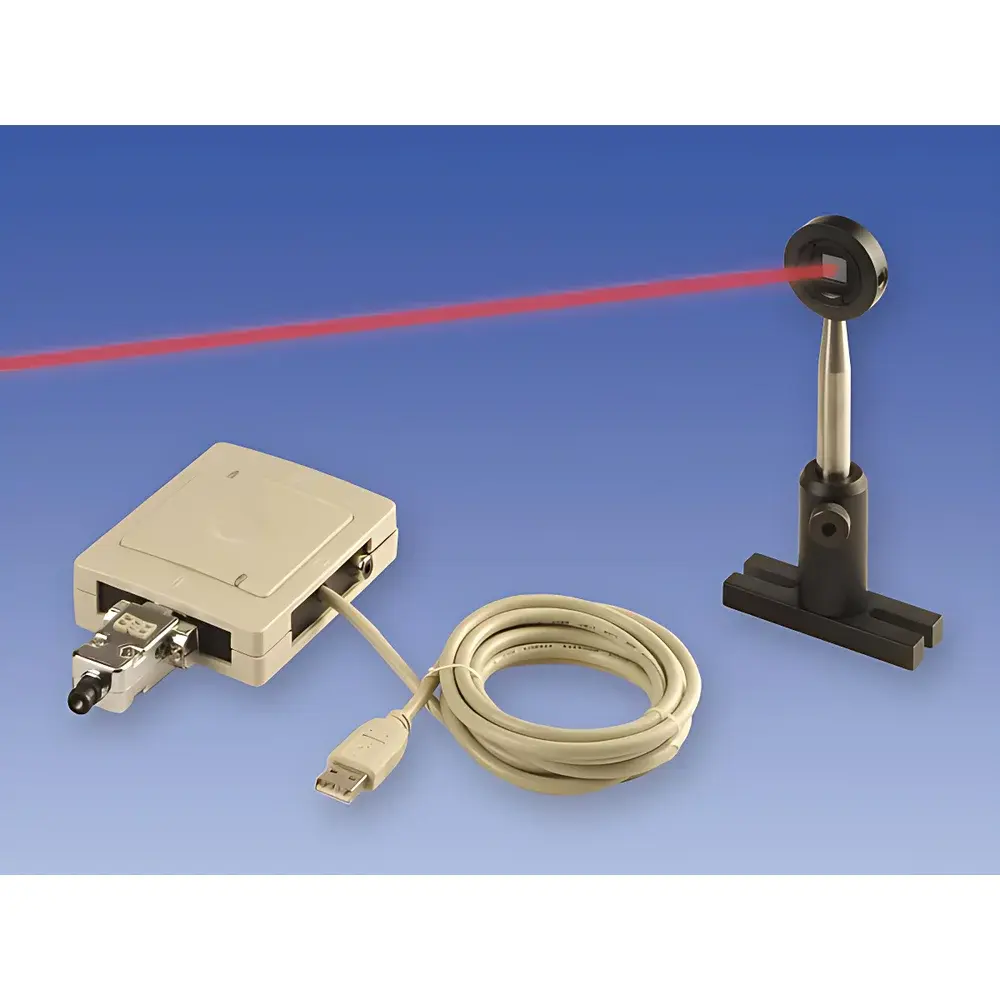
Duma Optronics SpotOn USB & Analog Position-Sensitive Detector (PSD)
| Brand | Duma Optronics |
|---|---|
| Origin | Israel |
| Model | SpotOn USB & Analog |
| Detector Type | Lateral Effect or Quadrant PnP |
| Active Area | 10×10 mm or 9×9 mm |
| Position Resolution | 0.1 µm |
| Position Accuracy | ±1 µm to ±25 µm (depending on model) |
| Power Range | 10 µW – 10 mW |
| Power Accuracy | ±5% |
| Spectral Range | 350–1100 nm |
| Interface | USB 2.0 + Analog Output |
| Beam Diameter Max | 9 mm |
Overview
The Duma Optronics SpotOn USB & Analog Position-Sensitive Detector (PSD) is a high-precision, real-time beam diagnostics instrument engineered for quantitative measurement of laser beam position, displacement, and optical power in industrial, metrological, and research-grade optical systems. Based on lateral-effect or quadrant photodiode principles—both implemented in silicon-based PnP (p-type/n-type/p-type) semiconductor structures—the SpotOn series delivers sub-micron positional resolution and calibrated power readout within a single compact sensor head. Unlike CCD/CMOS-based centroid analysis systems, which rely on pixelated integration and interpolation, the analog output of lateral-effect PSDs provides inherently continuous, high-bandwidth (up to 10 kHz typical) position tracking without quantization artifacts or frame-rate limitations. This makes the SpotOn particularly suited for dynamic alignment tasks, closed-loop stabilization, and high-speed beam steering validation where latency and linearity are critical. The device operates across the visible and near-infrared spectrum (350–1100 nm), covering common laser sources including HeNe, diode, DPSS, and fiber lasers.
Key Features
- Simultaneous real-time measurement of beam centroid position (X/Y) and total incident power
- Four configurable detector variants: lateral-effect (10×10 mm with glass window; 9×9 mm bare), and quadrant types with 30 µm or 10 µm inter-element gaps (both 10×10 mm, with or without protective window)
- Position resolution down to 0.1 µm; accuracy ranging from ±1 µm (quadrant models with tight gap) to ±25 µm (lateral-effect with window), referenced to beam size (±0.025% of measured diameter)
- Optical power measurement range: 10 µW to 10 mW (unattenuated); calibrated accuracy ±5% across full spectral band
- Dual-output interface: high-speed USB 2.0 digital communication (with vendor-supplied Windows/Linux SDK and GUI) plus analog voltage outputs (±5 V, scalable per axis) for direct integration into PLCs, DAQ systems, or feedback controllers
- Robust mechanical design with precision-machined aluminum housing; designed for stable mounting in vibration-sensitive optical tables and OEM equipment integration
Sample Compatibility & Compliance
The SpotOn USB & Analog is compatible with continuous-wave (CW) and quasi-CW laser sources operating within its specified spectral and power envelope. It supports Gaussian, top-hat, and multimode beams up to 9 mm in diameter—provided beam intensity distribution remains within the linear response region of the photodiode active area. For pulsed lasers, average power must remain within the stated range; peak power density should not exceed 10 kW/cm² to avoid thermal saturation or surface damage. The instrument complies with IEC 61000-6-3 (EMC emission standards) and IEC 61010-1 (safety requirements for electrical equipment). While not certified for medical or aerospace-specific regulatory frameworks, its analog signal chain and firmware architecture support traceable calibration protocols aligned with ISO/IEC 17025 laboratory practices. Raw data logging enables full audit trails required under GLP environments when paired with validated software configurations.
Software & Data Management
Duma Optronics provides the SpotOn Control Software—a native 64-bit application for Windows (with Linux API support)—enabling real-time visualization of X/Y trajectories, power trends, statistical histograms (e.g., beam wander RMS), and user-defined pass/fail thresholds. All measurements are timestamped with microsecond resolution. Export formats include CSV, TXT, and binary (for MATLAB/Python post-processing). The SDK includes C/C++, .NET, and Python bindings, supporting custom automation in manufacturing QA workflows or adaptive optics control loops. Data integrity is preserved via internal EEPROM-stored calibration coefficients (wavelength-dependent responsivity, position scaling factors), eliminating manual recalibration during field deployment. Audit-ready features include user-access logging, configuration versioning, and optional 21 CFR Part 11-compliant electronic signature modules (available upon request for regulated industries).
Applications
- Laser system alignment and active collimation in fiber coupling, free-space optical interconnects, and ultrafast amplifier chains
- Real-time monitoring of optical component drift—including mounts, mirrors, and lenses—in environmental test chambers or long-duration experiments
- Non-contact displacement sensing in precision machining tools, coordinate measuring machines (CMM), and CNC stage calibration
- Vibration analysis of optical elements using FFT-based spectral decomposition of positional time-series data
- Beam quality assessment in R&D labs: centroid stability (µrad-level angular jitter), pointing stability over temperature cycles, and focal spot tracking in scanning systems
- Integration into automated wafer inspection platforms for lithography tool alignment verification
FAQ
What is the difference between lateral-effect and quadrant PSD configurations?
Lateral-effect PSDs provide continuous analog position output based on current division across a monolithic resistive layer—ideal for smooth, high-bandwidth tracking. Quadrant detectors offer higher intrinsic accuracy at the cost of dead-zone sensitivity near the gap; tighter inter-element gaps (e.g., 10 µm) reduce nonlinearity near center but require more precise optical alignment.
Can the SpotOn measure pulsed lasers?
Yes—provided the average power falls within the 10 µW–10 mW range and pulse repetition rate does not induce thermal accumulation beyond the detector’s thermal time constant (~10 ms for standard models). Peak fluence must remain below damage threshold.
Is NIST-traceable calibration available?
Duma Optronics offers factory calibration with uncertainty budgets per ISO/IEC 17025; NIST-traceable certificates (including beam position and power) are available as an optional service with documented chain-of-custody.
Does the USB interface support USB 3.0 or higher?
No—the device is USB 2.0 compliant (480 Mbps) and fully backward-compatible with USB 1.1 ports; bandwidth is sufficient for >1 kHz sampling across all axes and power channels.
How is temperature drift compensated?
Internal temperature sensors feed into real-time gain/offset correction algorithms embedded in firmware; additional compensation can be applied in post-processing using provided thermal coefficient parameters (±0.02%/°C typical for position scale factor).





