
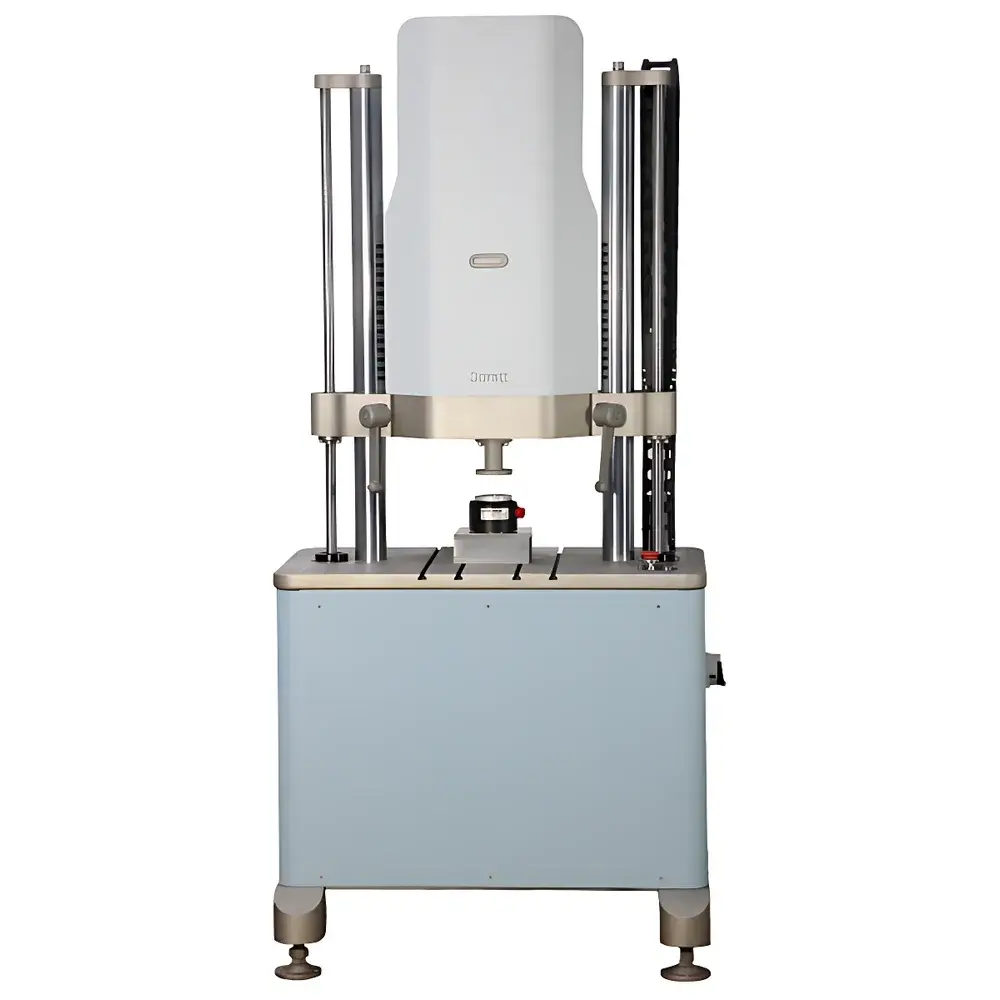
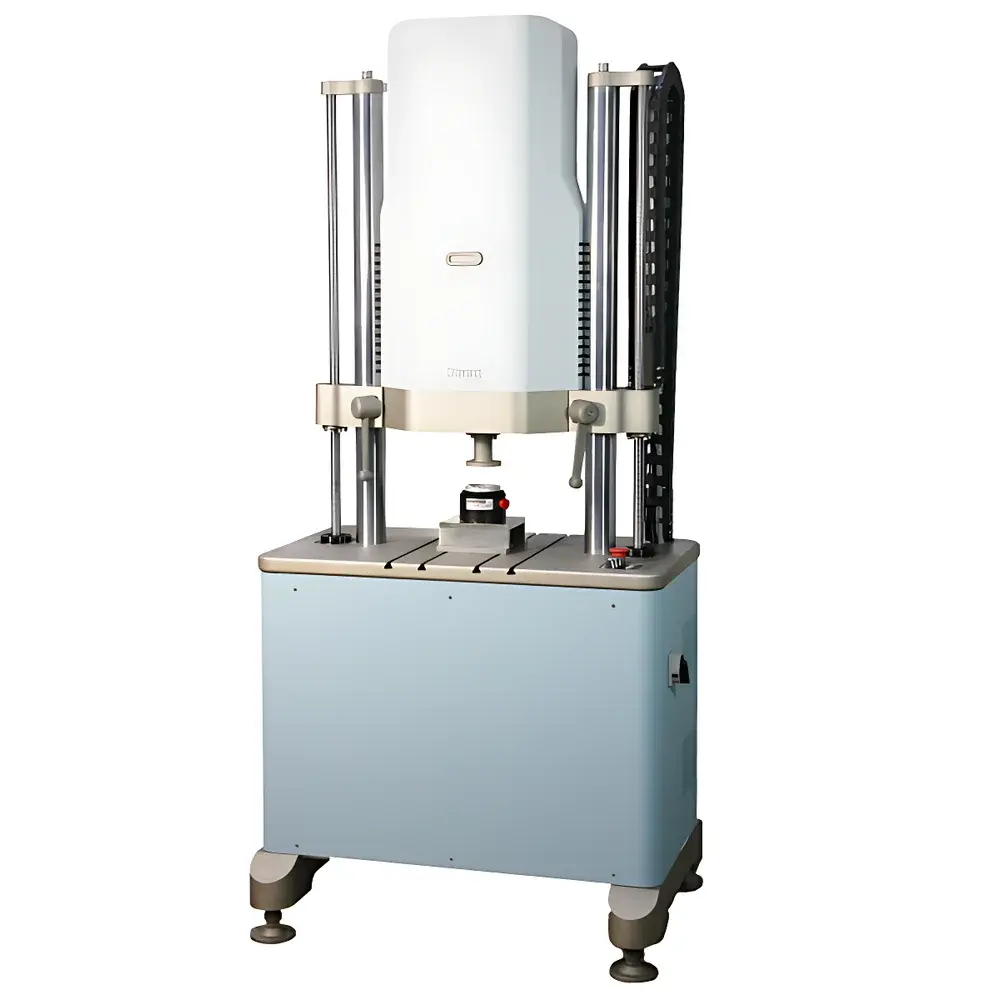
Duratt D10000 High-Load Electromagnetic Dynamic Fatigue Testing Machine
| Brand | Duratt |
|---|---|
| Origin | Shanghai, China |
| Manufacturer Type | Authorized Distributor |
| Product Category | Domestic |
| Model | D10000 High-Load Electromagnetic Dynamic Testing Machine |
| Instrument Type | High-Frequency Fatigue Testing Machine |
| Max Test Force | ±10,000 N |
| Frequency Range | 0.01–100 Hz |
| Host Weight | 950 kg |
| Max Continuous Load | ±7,000 N |
| Max Sampling Rate | 10,000 Hz |
| Max Peak Torque | 70 N·m |
| Displacement Range | ±32.5 mm |
| Max Torsional Speed | 120 rpm |
| Max Linear Velocity | 2 m/s |
| Operating Temperature | 5–30 °C |
| Vertical Test Space (No Torsion) | 805 mm |
| Vertical Test Space (With Torsion) | 735 mm |
| Horizontal Test Space | 460 mm |
| Dimensions (L×W×H) | 950×700×1800 mm |
| Displacement Sensor Resolution | 0.5 µm |
| Load Cell Resolution | ±0.2% FS |
| Power Supply | 380 V / 50 Hz / 40 A |
| Cooling | External Oil-Circulation System with Auto-Start/Stop Logic |
Overview
The Duratt D10000 is a high-performance electromagnetic dynamic fatigue testing machine engineered for precision mechanical characterization of advanced materials and medical devices under controlled cyclic loading conditions. Utilizing a custom-designed high-power linear motor actuator and closed-loop digital control architecture, the system delivers true broadband dynamic excitation—from quasi-static (0.01 Hz) up to 100 Hz—with force fidelity and displacement repeatability validated across its full operational envelope. Its core measurement principle relies on electromagnetic force generation coupled with high-resolution load cell feedback (±0.2% FS) and sub-micron displacement sensing (0.5 µm resolution), enabling rigorous compliance with ASTM E466, ISO 1099, and ISO 14801 standards for axial and torsional fatigue testing. The D10000 is specifically optimized for demanding applications in orthopedic implant validation, biomaterials research, and structural component endurance assessment where long-term stability, thermal management, and data traceability are critical.
Key Features
- Electromagnetic actuation system delivering ±10,000 N peak force and ±32.5 mm stroke with zero hydraulic fluid dependency—eliminating seal wear, viscosity drift, and maintenance downtime.
- Integrated oil-circulation cooling architecture with external heat exchanger; fully automated start/stop logic responsive to real-time motor thermal load—ensuring stable performance during extended high-duty-cycle tests.
- Rigid monolithic frame with precision-ground vertical columns and ball-screw-driven motor elevation mechanism for rapid, repeatable test setup and alignment verification.
- CE-compliant electrical architecture with redundant safety interlocks, emergency stop circuitry, and dual-channel overload protection aligned with IEC 61800-5-1 and EN ISO 13857 requirements.
- High-speed data acquisition at up to 10,000 Hz sampling rate, synchronized across force, displacement, torque, and optional environmental sensor channels (e.g., temperature, saline bath conductivity).
- Modular test configuration support: axial tension/compression, 3-/4-point bending, pure torsion, combined axial-torsional loading, frequency sweep, and step-stress protocols.
Sample Compatibility & Compliance
The D10000 accommodates specimens ranging from miniature metallic bone plates (ASTM F3065) and spinal fusion cages (ISO 12189) to polymer-based joint components and ceramic dental implants. Its open-test-space geometry supports integration with auxiliary environmental chambers—including ±80 °C thermal enclosures (per ISO 1099 Annex C), 37 °C saline immersion baths (per ASTM F2129), and custom gas-controlled environments. All firmware and control software are designed to meet GLP and GMP documentation requirements, supporting audit-ready test logs with timestamped metadata, user authentication, and electronic signature capability compliant with FDA 21 CFR Part 11. Calibration certificates are traceable to NIM (China National Institute of Metrology) and include as-found/as-left data per ISO/IEC 17025.
Software & Data Management
The proprietary Duratt TestSuite v4.x platform provides intuitive graphical workflow configuration, real-time parameter monitoring, and post-test spectral analysis (FFT, S-N curve generation, hysteresis loop quantification). It supports automated pass/fail evaluation against user-defined acceptance criteria, batch test sequencing, and direct export to CSV, HDF5, or MDF4 formats for third-party analysis (MATLAB, Python, or commercial FE solvers). All raw data files are stored with embedded calibration coefficients, environmental context tags, and SHA-256 checksums to ensure integrity and reproducibility. Remote access and multi-user role management (administrator, operator, reviewer) are enabled via secure TLS 1.2 encrypted connections.
Applications
- Fatigue life validation of orthopedic implants: titanium alloy bone plates, PEEK spinal cages, cobalt-chromium knee components.
- Dynamic viscoelastic characterization of thermoplastics and hydrogels under physiological strain rates and temperatures.
- High-cycle fatigue testing of additively manufactured aerospace alloys (e.g., Ti-6Al-4V, Inconel 718) per ASTM E1039.
- Dynamic stiffness and damping coefficient measurement of elastomeric mounts and composite laminates.
- Corrosion-fatigue coupling studies in simulated body fluid (SBF) or chloride-rich electrolytes using integrated electrochemical impedance spectroscopy (EIS) synchronization.
- Temperature-dependent fatigue threshold determination for piezoceramics and shape-memory alloys.
FAQ
What standards does the D10000 comply with for medical device fatigue testing?
The system meets the mechanical and software validation requirements of ISO 14801 (dental implants), ISO 12189 (spinal implants), ASTM F2129 (corrosion fatigue), and ASTM F3065 (bone plate fatigue), with full documentation support for regulatory submissions.
Can the D10000 perform combined axial-torsional fatigue tests?
Yes—the system supports simultaneous independent control of axial force and torsional torque, with phase-shifted waveforms and real-time cross-channel synchronization at up to 100 Hz.
Is remote operation and data review supported?
Yes—TestSuite v4.x includes web-based remote monitoring, live dashboard viewing, and secure cloud backup options with configurable retention policies and access controls.
What cooling infrastructure is required for continuous 100 Hz operation?
An external chiller unit (recommended capacity: ≥3 kW @ 20 °C ΔT) connected via quick-disconnect oil lines is required; no internal plumbing or cabinet penetrations are needed.
How is calibration maintained over time?
The system supports on-site recalibration using NIST-traceable load cells and displacement references; all calibration events are logged with operator ID, date, and uncertainty budgets per ISO/IEC 17025.



