
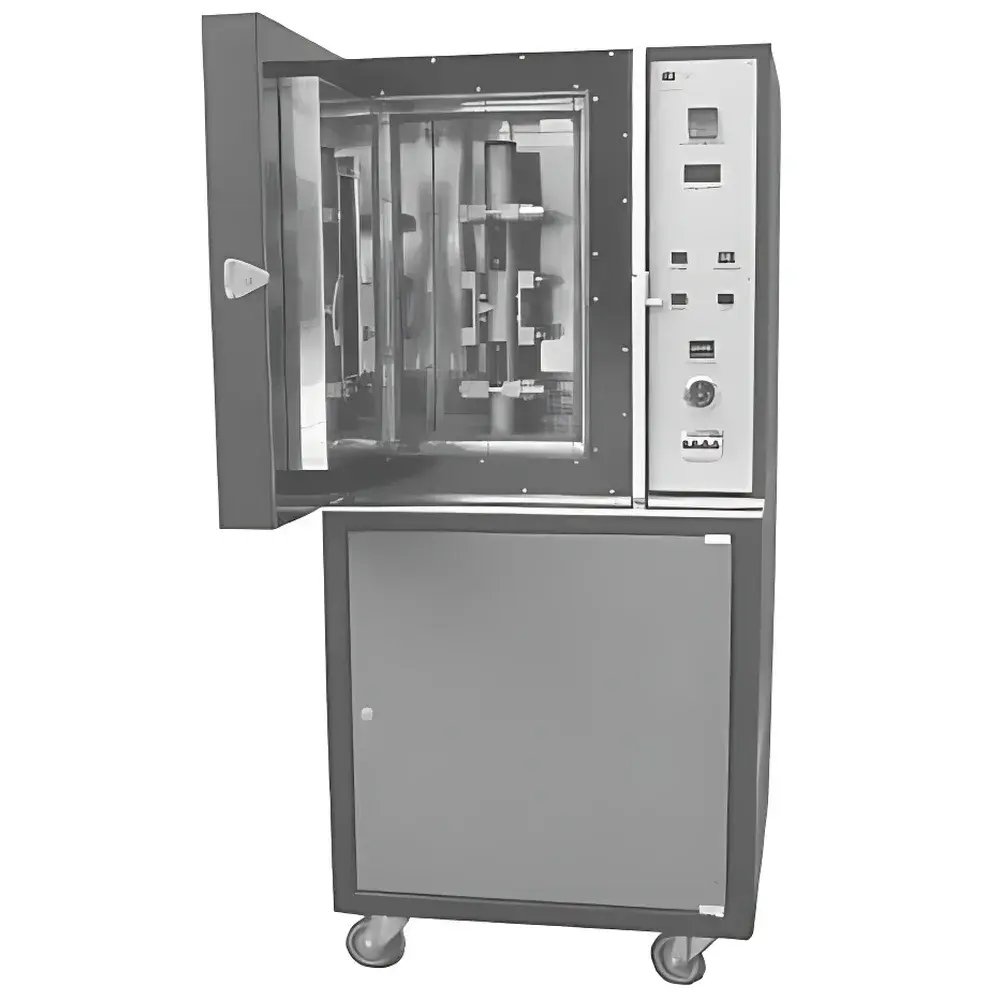
Dynamic Fatigue Testing Machine ATSFAAR DE MATTIA FLEXING APPARATUS
| Brand | ATSFAAR |
|---|---|
| Origin | Italy |
| Model | DE MATTIA FLEXING APPARATUS |
| Test Frequency | 300 ± 10 cycles/min |
| Maximum Deflection | 100 mm |
| Operating Temperature Range (Standard) | Ambient |
| Optional Low-Temp Version | –40 °C |
| Optional High-Temp Version | +120 °C |
| Compliance | ASTM D813 |
| Sample Preparation | Integrated notching tool included |
Overview
The ATSFAAR DE MATTIA FLEXING APPARATUS is a precision-engineered dynamic fatigue testing machine designed for the standardized evaluation of crack initiation and propagation resistance in vulcanized rubber and elastomeric materials under repeated mechanical deformation. Based on the principle of controlled cyclic flexing—typically employing a pendulum or cam-driven bending mechanism—the instrument subjects standardized test specimens to continuous, reproducible sinusoidal or reciprocating motion. This simulates real-world service conditions such as repeated bending in automotive hoses, conveyor belts, footwear soles, and sealing components. The system operates in strict accordance with ASTM D813, “Standard Test Method for Determining Resistance to Cracking of Vulcanized Rubber Under Dynamic Flexing Conditions,” ensuring traceable, inter-laboratory comparable results essential for QC release, material qualification, and R&D benchmarking.
Key Features
- Fixed-frequency flexing drive calibrated to 300 ± 10 cycles per minute, meeting the nominal requirement of ASTM D813 and enabling high-throughput screening of fatigue life.
- Electronically programmable cycle counter with independent presetting for total test duration (e.g., 10,000–500,000 cycles) and automatic termination upon completion or specimen failure detection.
- Adjustable deflection amplitude up to 100 mm, allowing systematic investigation of strain magnitude effects on crack growth kinetics.
- Modular thermal enclosure options: ambient-temperature base configuration; optional low-temperature chamber rated to –40 °C for cold-flex performance assessment; high-temperature version with forced-air convection heating up to +120 °C for accelerated aging studies.
- Integrated sample preparation kit including ASTM D813-compliant notching tool for standardized pre-crack initiation—ensuring consistent stress concentration geometry across all specimens.
- Rigid cast-iron frame with precision-ground guide rails and backlash-free motion transmission, minimizing parasitic vibrations and maximizing test repeatability (CV < 3% typical across replicate runs).
Sample Compatibility & Compliance
The DE MATTIA FLEXING APPARATUS accommodates standard dumbbell-shaped or rectangular test specimens per ASTM D813 (Type A or B), with thicknesses ranging from 2.0 to 6.0 mm. Specimen clamping is achieved via hardened steel jaws with pneumatic or manual actuation, ensuring uniform contact pressure without localized creep or slippage. All mechanical and control subsystems are designed to meet CE marking requirements for laboratory equipment. Data acquisition and test execution comply with GLP principles; optional audit trail logging and user access control modules support FDA 21 CFR Part 11 readiness when integrated with validated software platforms. Full documentation—including calibration certificates, conformity declarations, and installation qualification (IQ) templates—is provided with each unit.
Software & Data Management
While the base model features embedded microcontroller-based cycle counting and status indication, ATSFAAR offers an optional PC-based control and analysis suite compatible with Windows 10/11. This software enables remote start/stop, real-time cycle monitoring, failure event timestamping, and export of raw cycle-count vs. time logs in CSV or XML format. Data files include metadata fields for operator ID, sample ID, temperature setpoint, deflection amplitude, and compliance standard reference. For regulated environments, the software supports electronic signatures, role-based permissions, and encrypted database storage—facilitating integration into LIMS or QMS infrastructures aligned with ISO/IEC 17025 and ICH Q5A quality assurance frameworks.
Applications
- Evaluation of crack resistance in natural rubber (NR), styrene-butadiene rubber (SBR), nitrile rubber (NBR), EPDM, and thermoplastic elastomers (TPEs).
- Comparative ranking of antioxidant and antiozonant package efficacy under dynamic stress.
- Validation of extrusion or molding process parameters affecting filler dispersion and interfacial adhesion.
- Supporting ASTM D412 tensile property correlation studies through fatigue life mapping versus modulus and elongation at break.
- Accelerated durability testing of medical-grade elastomers used in peristaltic pump tubing and respiratory mask interfaces.
FAQ
What is the primary measurement output of this fatigue tester?
Cycle count to first visible crack (per ASTM D813 visual inspection criteria) or complete rupture—recorded automatically by the built-in counter.
Can the machine operate unattended overnight?
Yes. Once programmed, it runs autonomously with audible/visual alarms triggered upon test completion or specimen failure.
Is third-party calibration certification available?
Yes. ATSFAAR provides NIST-traceable calibration reports for frequency accuracy, deflection amplitude, and thermal chamber uniformity—valid for 12 months.
Does the system support custom test profiles beyond ASTM D813?
The base controller follows fixed-frequency operation, but the optional PC software allows user-defined stepwise frequency or amplitude modulation for non-standard protocols.
What maintenance is required for long-term reliability?
Quarterly lubrication of cam followers and guide rails; annual verification of motor encoder alignment and thermal sensor calibration—detailed in the included maintenance logbook.



