
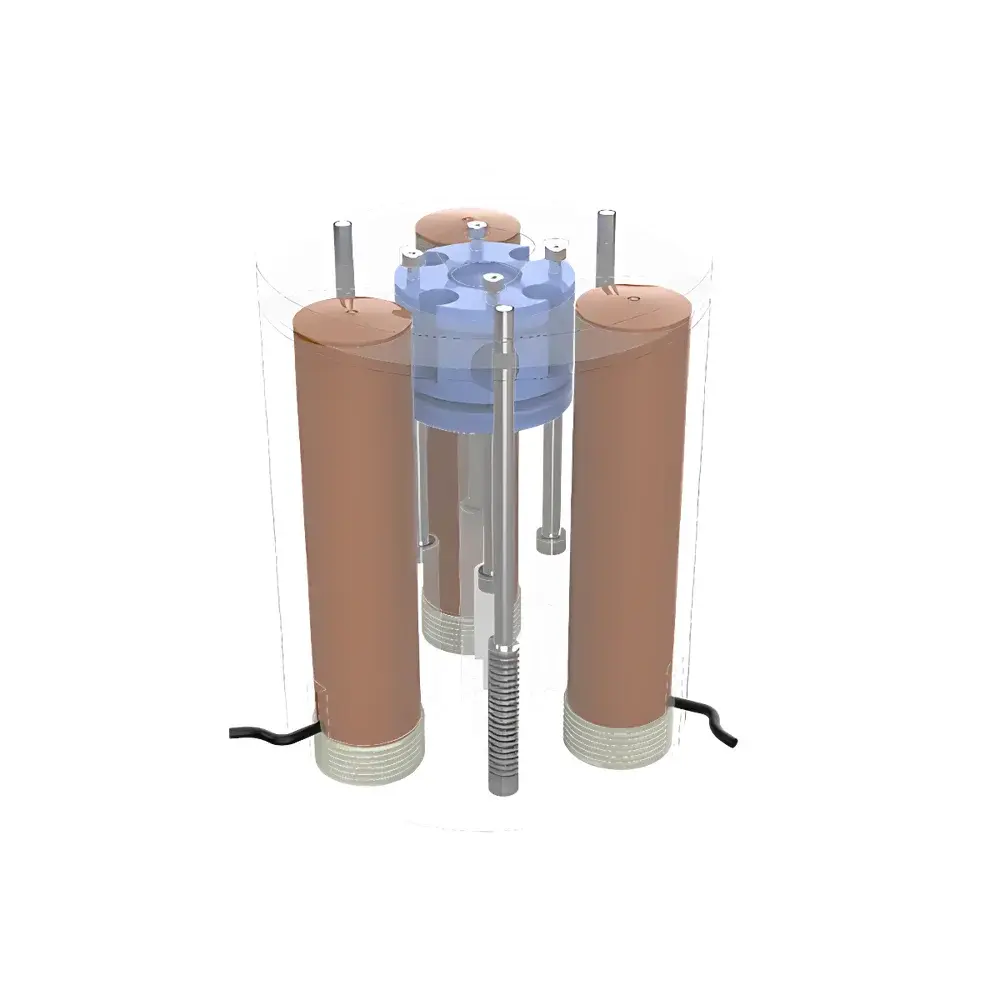
Dynamic Loading Device for Diamond Anvil Cell Systems
| Brand | GKInst |
|---|---|
| Origin | Anhui, China |
| Manufacturer Type | Authorized Distributor |
| Country of Origin | China |
| Model | Custom-Engineered DAC Dynamic Actuation System |
| Pricing | Available Upon Technical Inquiry |
Overview
The Dynamic Loading Device for Diamond Anvil Cell (DAC) Systems is a precision electromechanical actuation platform engineered to enable controlled, high-speed mechanical loading and unloading of samples under extreme static pressure conditions. Unlike conventional quasi-static DAC configurations, this system integrates piezoelectric ceramic actuators with sub-millisecond response dynamics to impose transient stress states—enabling time-resolved studies of material behavior under non-equilibrium thermodynamic conditions. It operates on the fundamental principle of coupling static pre-compression (via standard symmetric DAC geometry) with rapid dynamic perturbation, thereby generating well-defined strain-rate histories (≥200 TPa/s) across micron-scale sample volumes. This capability bridges the gap between static high-pressure science and shock physics, supporting investigations into metastable phase formation, kinetic barriers in solid-state transformations, and deformation mechanisms in geophysically relevant minerals under Earth’s mantle–core pressure–strain-rate regimes.
Key Features
- Sub-millisecond actuation latency: Full mechanical load application achieved in <1 ms, enabling synchronization with ultrafast diagnostics (e.g., time-resolved X-ray diffraction, femtosecond spectroscopy)
- Strain-rate controllability: Programmable loading/unloading rates exceeding 200 TPa/s—calibrated against reference interferometric displacement measurements
- Modular DAC integration: Compatible with standard symmetric diamond anvil cells; anvils and gaskets are field-replaceable without realignment or recalibration
- Dual-mode operation: Supports discrete dynamic loading, symmetric dynamic unloading, and programmable cyclic loading protocols (up to 10⁴ cycles at 10 Hz)
- Integrated motion control architecture: Closed-loop piezoelectric driver with analog voltage input (±10 V), digital trigger interface (TTL), and real-time position feedback via capacitive sensor
- Thermal and mechanical stability: Aluminum alloy carrier structure with low thermal expansion coefficient (<23 µm/m·K) and vibration-damped mounting interface for synchrotron or laboratory X-ray beamlines
Sample Compatibility & Compliance
The device accommodates standard DAC sample geometries (e.g., 100–300 µm culet diamonds, 50–150 µm sample chambers) and supports common pressure-transmitting media (e.g., neon, helium, methanol–ethanol mixtures) and laser-heated configurations. All mechanical interfaces comply with ISO 80000-4 (mechanics) and ISO 10816-3 (vibration severity standards for instrumentation). The controller firmware supports audit-trail logging per GLP/GMP-aligned data integrity requirements and is compatible with third-party DAQ systems adhering to IEEE 1451.2 transducer electronic data sheet (TEDS) specifications. While not certified for medical or aerospace use, the system meets CE marking essential requirements for electromagnetic compatibility (EMC Directive 2014/30/EU) and low-voltage safety (LVD Directive 2014/35/EU).
Software & Data Management
The device operates via GKInst’s DAC-DynControl Suite—a cross-platform (Windows/Linux) application built on Qt and Python 3.9, supporting deterministic real-time waveform generation (minimum step resolution: 10 ns), synchronized trigger output for external detectors (XRD, Raman, streak cameras), and raw binary data export in HDF5 format compliant with NeXus conventions. All experimental parameters—including voltage ramp profiles, trigger timestamps, and actuator displacement estimates—are stored with SHA-256 checksums and embedded metadata (sample ID, operator, timestamp, DAC configuration). The software supports FDA 21 CFR Part 11–compliant user authentication, electronic signatures, and immutable audit logs—configurable for institutional compliance workflows.
Applications
- Time-resolved high-pressure phase transition kinetics in silicates, oxides, and hydrous minerals
- In situ study of dislocation nucleation and shear banding under ultra-high strain rates
- Validation of thermoelastic equations of state beyond quasi-static assumptions
- Shock-induced amorphization and re-crystallization pathways in planetary materials
- Calibration of constitutive models for geodynamic simulations incorporating rate-dependent plasticity
- Development of pressure–strain-rate phase diagrams for functional materials (e.g., superconductors, ferroelectrics)
FAQ
What DAC configurations are supported?
Standard symmetric two-anvil DACs with 100–500 µm culets and conventional rhenium or tungsten carbide gaskets.
Can the system be integrated with synchrotron X-ray diffraction beamlines?
Yes—designed for direct mounting on standard DAC stages with 6-axis kinematic alignment; includes TTL-compatible trigger I/O for pump–probe experiments.
Is real-time displacement measurement included?
Capacitive position sensing is integrated into the actuator module; absolute displacement resolution is 0.1 nm (typical), traceable to NIST-traceable interferometry standards.
What is the maximum static pressure range achievable during dynamic loading?
Depends on DAC geometry and medium; validated up to 120 GPa with helium pressure medium and laser heating—dynamic perturbations applied within this static envelope.
Does the system support custom waveform programming?
Yes—arbitrary voltage waveforms (sine, square, sawtooth, user-defined CSV) can be loaded and executed with microsecond timing precision.






