
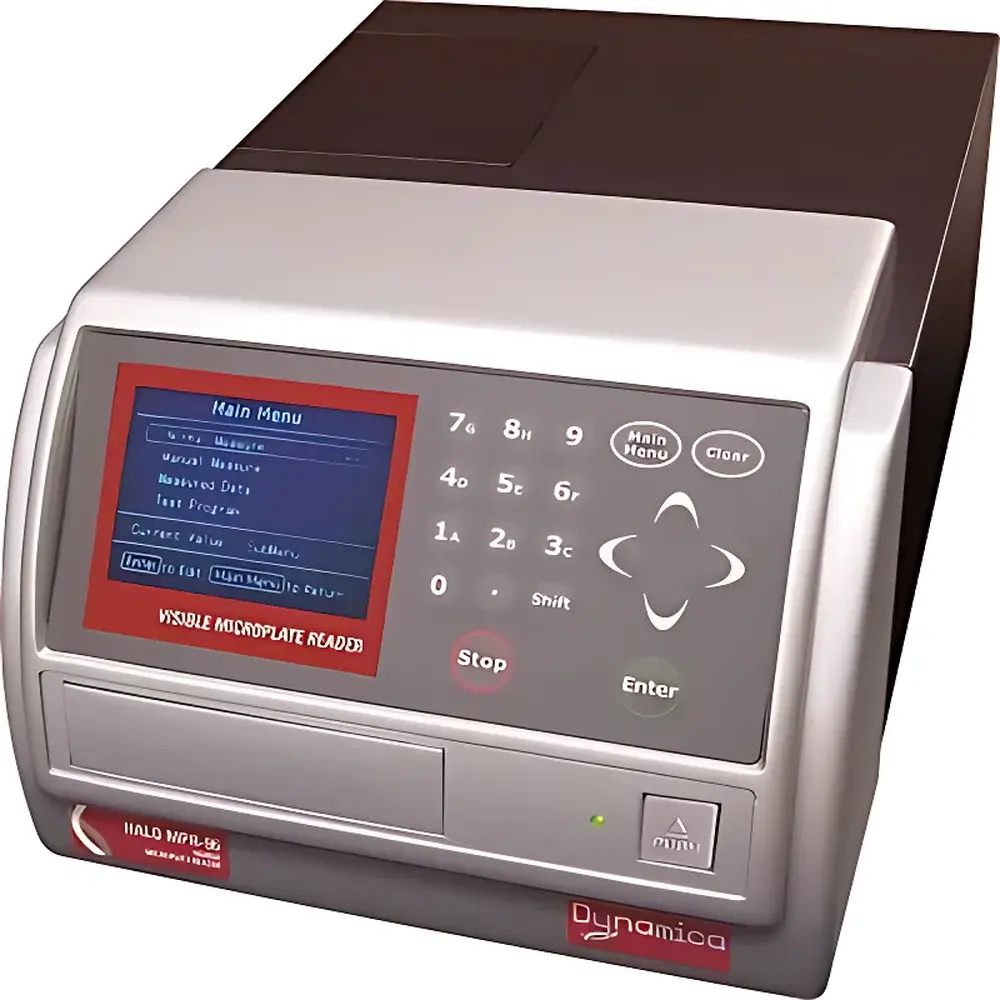
Dynamica HALO MPR-96 Microplate Reader
| Brand | Dynamica |
|---|---|
| Model | HALO MPR-96 |
| Origin | Switzerland |
| Wavelength Range | 400–750 nm (MPR-96UV: 340–750 nm) |
| Absorbance Range | 0–4.0 OD |
| Resolution | 0.001 OD |
| Stability | ±0.001 OD (after 15 min warm-up) |
| Accuracy | ±1.0% ±0.01 OD (405 nm, 0.000–2.500 OD) |
| Repeatability | ±0.5% ±0.005 OD (405 nm, 0.000–2.500 OD) |
| Linearity | ±1.0% (405 nm, 0.000–2.500 OD) |
| Filter Positions | 5 (4 fixed + 1 user-selectable, 400–750 nm) |
| Read Time | ≤10 s (single wavelength, 96-well) |
| Plate Formats | 96-well flat, U-bottom, V-bottom |
| Optical Channels | 8 measurement + 1 reference |
| Detector | Silicon photodiode |
| Light Source | Tungsten-halogen lamp |
| Display | Backlit LCD, 320×240 px |
| Incubation (optional) | Ambient +4°C to +50°C, ±0.5°C accuracy |
| Dimensions (W×D×H) | 290×425×200 mm |
| Weight | 15 kg (net), 20 kg (gross) |
| Power | 110–220 V auto-switching, 50/60 Hz, 50 W (standby), 100 W (operational) |
Overview
The Dynamica HALO MPR-96 is a high-performance, filter-based absorbance microplate reader engineered for precision endpoint and kinetic assays in life science laboratories. It operates on the principle of spectrophotometric absorbance measurement—quantifying light attenuation at defined wavelengths as it passes through samples in standard 96-well microplates. Its optical architecture features an 8-channel parallel detection system with a dedicated reference channel, enabling rapid, synchronized acquisition across all wells while minimizing inter-channel variability. The tungsten-halogen light source delivers stable, broad-spectrum output from 400 nm to 750 nm (extendable to 340 nm in the MPR-96UV variant), supporting common ELISA, protein quantification (e.g., Bradford, BCA), cell viability (MTT, XTT), and enzyme activity assays. Designed for robustness and operational continuity, the instrument integrates a maintenance-optimized motorized plate handler and long-life illumination—achieving thermal and photometric stability within 15 minutes of startup and sustaining ±0.001 OD baseline drift over extended runs.
Key Features
- High-fidelity absorbance measurement with 0.001 OD resolution and traceable accuracy per ISO 8655 and ASTM E275 standards
- Five-position filter wheel accommodating four pre-installed wavelengths (405 nm, 450 nm, 492 nm, 620 nm) plus one user-configurable slot (400–750 nm)
- Dual-mode operation: standalone via integrated 320×240-pixel backlit LCD or PC-controlled via USB interface using compliant data export protocols
- Onboard data storage for up to 1,000 assay results with timestamped metadata—including plate ID, wavelength, read mode, and user-defined notes
- Linear orbital shaking with four programmable intensity levels to ensure homogeneous suspension prior to reading
- Optional temperature-controlled incubation module (ambient +4°C to +50°C) with ±0.5°C uniformity across the plate surface, validated per CLSI EP23 guidelines
- Low-power architecture: 50 W standby consumption, 100 W peak; compatible with uninterruptible power supplies for GLP-compliant environments
Sample Compatibility & Compliance
The HALO MPR-96 supports ANSI/SBS-standard 96-well plates with flat, U-bottom, and V-bottom well geometries. Its 8-channel optical path ensures consistent pathlength correction across well formats without mechanical recalibration. All performance specifications—including linearity, repeatability, and photometric accuracy—are verified using NIST-traceable neutral density filters and calibrated liquid standards per ISO/IEC 17025-accredited procedures. The system meets essential regulatory expectations for routine QC testing under FDA 21 CFR Part 11 when operated with audit-trail-enabled software (e.g., HALO Control Suite v3.2+), supporting electronic signatures, user access control, and immutable result archiving. It is routinely deployed in ISO 13485-certified IVD manufacturing labs and academic core facilities requiring GLP-aligned documentation workflows.
Software & Data Management
HALO Control Suite (Windows-compatible) provides full instrument control, protocol templating, real-time curve visualization, and multi-parameter analysis (e.g., 4PL curve fitting, % inhibition, ΔOD/min kinetics). Raw absorbance values are exported in CSV, Excel (.xlsx), and XML formats compliant with LIMS integration frameworks. The embedded firmware supports direct printing via USB-connected PCL-5–compatible printers—enabling immediate hardcopy generation of QC reports with header/footer fields (lab ID, operator, date/time stamp). Internal memory retains full plate maps and raw OD matrices, even during power interruption, and permits retrospective re-analysis without reacquisition. All data files include embedded calibration logs and hardware event timestamps, satisfying ALCOA+ data integrity principles.
Applications
- Quantitative ELISA and sandwich immunoassays across infectious disease, oncology, and autoimmune research
- Cell-based assays including proliferation (BrdU), cytotoxicity (LDH release), and oxidative stress (DCFDA)
- Enzyme kinetics (e.g., horseradish peroxidase, alkaline phosphatase) with dual-wavelength background subtraction
- Protein concentration determination via A280 or colorimetric methods (Bradford, Lowry)
- Microbial growth monitoring in antimicrobial susceptibility testing (AST) and biofilm quantification
- Quality control of recombinant proteins, monoclonal antibodies, and vaccine intermediates
FAQ
Is the HALO MPR-96 compliant with FDA 21 CFR Part 11 for regulated environments?
Yes—when used with HALO Control Suite v3.2 or later and configured with role-based user accounts, electronic signatures, and audit-trail logging enabled.
Can the instrument perform kinetic measurements?
Yes—it supports time-resolved absorbance acquisition at user-defined intervals (1 second to 24 hours), with automatic calculation of initial rates and slope-based endpoint detection.
What validation documentation is provided with the system?
Each unit ships with a Factory Performance Verification Report, including photometric accuracy, linearity, and wavelength verification against NIST SRM 2034 and 930D filters.
Is third-party software integration supported?
Yes—via ASCII-based serial command protocol (RS-232 over USB virtual COM port) and open CSV export, enabling compatibility with LabVantage, STARLIMS, and custom Python/R automation pipelines.
Does the optional incubation module support humidity control?
No—the MPR-96’s temperature module maintains thermal uniformity only; for humidity-sensitive assays (e.g., long-term cell culture), external humidified incubators are recommended.



