
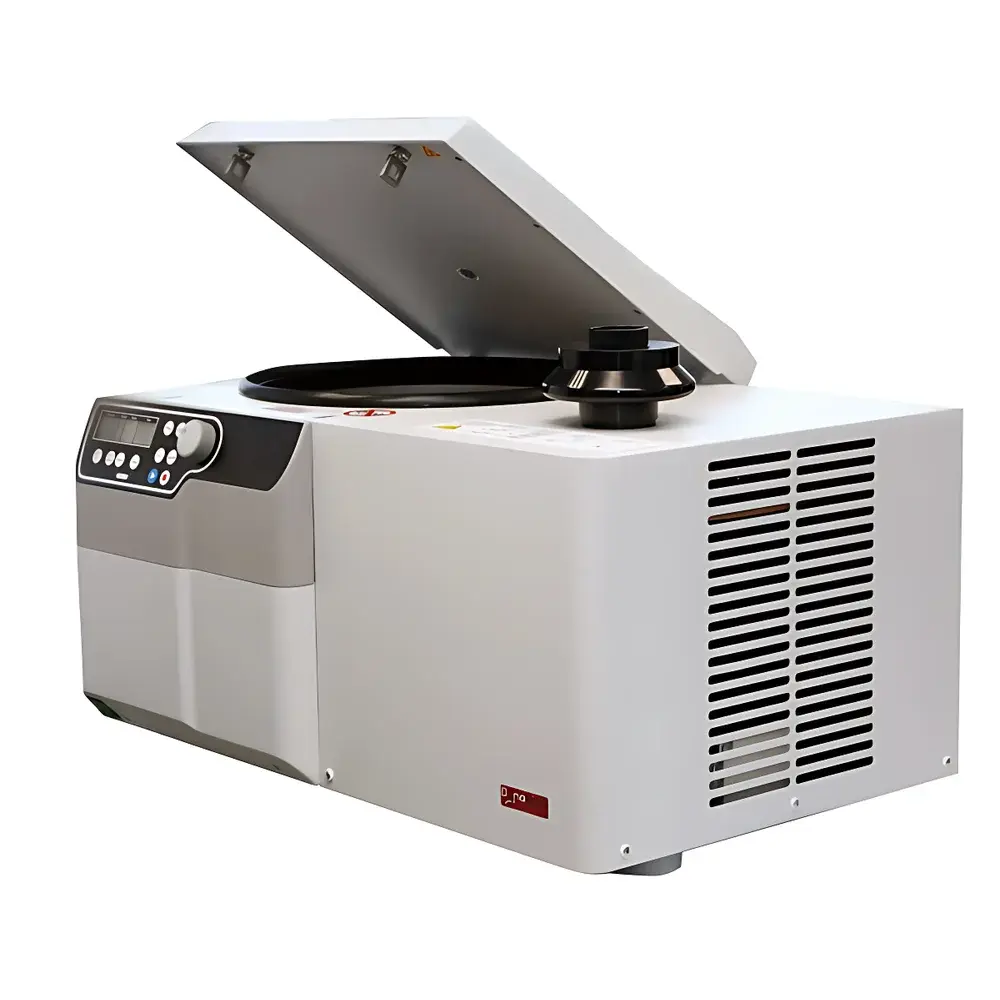
Dynamica V30R High-Speed Refrigerated Centrifuge
| Brand | Dynamica |
|---|---|
| Origin | Germany |
| Model | V30R |
| Instrument Type | Benchtop High-Speed Refrigerated Centrifuge |
| Speed Range | 200–30,000 rpm (10 rpm increments) |
| Max RCF | 66,410 × g |
| Max Capacity | 6 × 250 mL |
| Temperature Range | −20 °C to +40 °C (1 °C increment) |
| Temperature Accuracy | ±1 °C |
| Acceleration/Deceleration Steps | 10/10 |
| Noise Level | <60 dB(A) |
| Dimensions (L×D×H) | 715 × 510 × 420 mm |
| Net Weight | 91 kg |
| Power Supply | 230 V, 50/60 Hz |
| Drive System | Brushless Induction Motor |
| Control System | Microprocessor-Based |
| Rotor Auto-Recognition | Yes (with overspeed protection) |
| Imbalance Detection | Yes |
| Timer Range | 30 s – 99 h 59 min + HOLD |
| Speed/RCF Conversion | Yes |
| Programmable Methods | 99 |
| Display | LCD |
Overview
The Dynamica V30R is a high-performance benchtop refrigerated centrifuge engineered for demanding separation tasks in life science, clinical diagnostics, and pharmaceutical research laboratories. Operating on the principle of sedimentation under controlled gravitational forces, the V30R delivers precise, reproducible separations of subcellular components—including mitochondria, lysosomes, microsomes, and viral particles—through regulated rotor speed, temperature, and acceleration/deceleration profiles. Its brushless induction motor ensures long-term operational stability with minimal maintenance, while the integrated refrigeration system maintains sample integrity across extended runs. Designed and assembled in Germany, the V30R complies with IEC 61010-1 (Safety Requirements for Electrical Equipment for Measurement, Control, and Laboratory Use) and meets electromagnetic compatibility (EMC) standards per EN 61326-1. Its compact footprint (715 × 510 × 420 mm) and 91 kg mass reflect a robust mechanical architecture optimized for vibration damping and acoustic isolation—critical for shared core facilities and ISO Class 5 cleanroom-adjacent environments.
Key Features
- High-speed capability up to 30,000 rpm with maximum RCF of 66,410 × g—validated for pelleting large organelles and enveloped viruses.
- Active refrigeration system maintaining precise temperature control from −20 °C to +40 °C in 1 °C increments; pre-cool function available prior to run initiation.
- Microprocessor-based control with real-time monitoring of speed, RCF, time, temperature, and rotor status via backlit LCD interface.
- Automatic rotor recognition with embedded RFID or optical encoding—prevents operation beyond certified speed limits and enforces rotor-specific safety protocols.
- Integrated imbalance detection with immediate deceleration and audible/visual alarm—compliant with risk mitigation requirements under ISO 13485 and GLP Annex 11.
- Programmable storage for up to 99 user-defined methods, supporting audit-ready workflow replication in regulated environments.
- Quiet operation (<60 dB[A]) achieved through dynamic balancing, reinforced chamber insulation, and optimized airflow management.
Sample Compatibility & Compliance
The V30R supports standard fixed-angle rotors (e.g., 6 × 250 mL configurations), compatible with polypropylene, polycarbonate, and stainless-steel tubes meeting ISO 8573-1 purity class 4 for sterile processing. It accommodates common biosafety level 2 (BSL-2) sample containers and enables closed-lid operation during centrifugation—reducing aerosol generation risk. All rotor certifications conform to ISO 21501-4 for particle size distribution validation and are traceable to DAkkS-accredited calibration reports. The instrument’s design satisfies key regulatory expectations for data integrity: electronic records include timestamped run logs, operator ID (when integrated with LDAP or local authentication), and full parameter audit trails—supporting compliance with FDA 21 CFR Part 11 when deployed with validated LIMS interfaces.
Software & Data Management
While the V30R operates as a standalone instrument, its microprocessor architecture supports optional RS-232 or USB-to-serial connectivity for integration into centralized laboratory informatics systems. Exportable run logs include start/stop timestamps, actual vs. setpoint deviations (speed, temperature), rotor serial number, and error codes—all formatted as CSV or XML for downstream analysis. Firmware updates are performed via secure USB media with cryptographic signature verification, ensuring traceability and version control per GAMP 5 guidelines. No cloud dependency or proprietary software installation is required for basic operation, preserving IT security policies in highly regulated institutions.
Applications
- Isolation of membrane-bound organelles (e.g., Golgi apparatus, endoplasmic reticulum fragments) from mammalian cell homogenates.
- Purification of lentiviral and AAV vectors at clinical-grade titers using iodixanol density gradients.
- Clarification of bacterial lysates prior to chromatographic purification of recombinant proteins.
- Routine plasma/serum separation in clinical chemistry workflows requiring consistent hematocrit control.
- Preparative nucleic acid fractionation where thermal stability of RNA/DNA complexes must be preserved during ultracentrifugal pelleting.
FAQ
What is the maximum permissible tube volume per position in the 6-place rotor?
Each position accepts up to 250 mL in certified conical or round-bottom tubes—total capacity is 1,500 mL. Tube wall thickness and material must comply with Dynamica’s rotor safety specifications (PP, PC, or SS only).
Does the V30R support vacuum-sealed rotor chambers?
No—the V30R uses ambient-pressure refrigerated chamber design. Vacuum capability is reserved for ultracentrifuge models (e.g., >50,000 rpm platforms) and is not applicable to this high-speed benchtop configuration.
Can the instrument be validated for GMP manufacturing environments?
Yes—Dynamica provides IQ/OQ documentation templates, factory calibration certificates (traceable to PTB), and change-control records for firmware revisions, enabling full qualification under EU Annex 15 and USP .
Is rotor lifetime monitored by the system?
Rotor usage is tracked automatically upon recognition; cumulative run hours and maximum speed history are stored and exportable—supporting preventive maintenance scheduling per ISO 17025 clause 6.4.10.



