
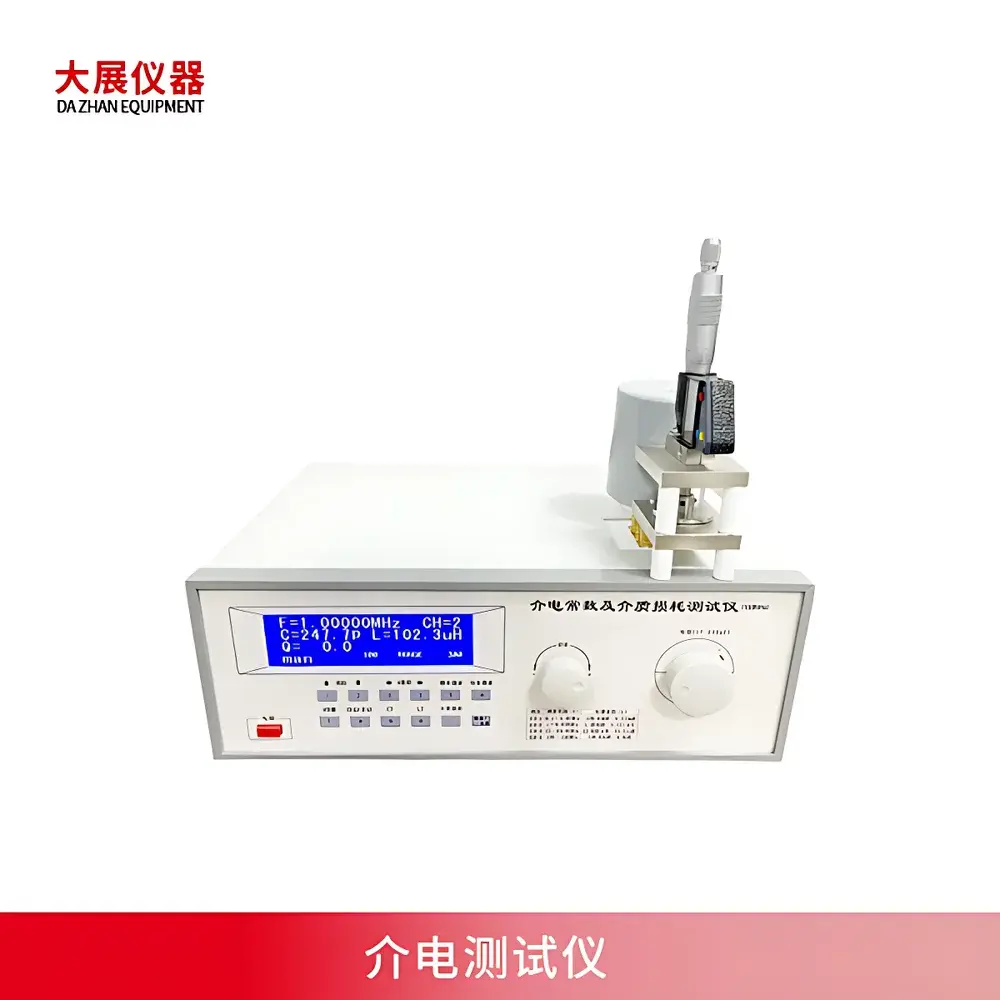
DZ5001 DAZHAN Dielectric Constant and Loss Tangent Analyzer
| Brand | DAZHAN |
|---|---|
| Model | DZ5001 |
| Measurement Principle | High-Frequency Resonance Method (Q-Factor Based) |
| Frequency Range | 10 kHz – 100 MHz |
| Frequency Accuracy | ±3×10⁻⁵ (6-digit resolution) |
| Q Factor Range | 1–1000 |
| Q Resolution | 0.1 (4-digit effective) |
| Q Measurement Error | <5% |
| Inductance Range | 1 nH – 140 mH |
| Inductance Resolution | 0.1 nH |
| Inductance Error | <3% |
| Capacitance Range (Tuning) | 17–240 pF |
| Capacitance Direct Measurement | 1 pF – 25 nF |
| Capacitance Accuracy | ±1 pF or <1% |
| Capacitance Resolution | 0.1 pF |
| AD Sampling | 12-bit |
| Automatic Residual Inductance Compensation | Yes |
| Motorized Capacitor Tuning | Yes |
| Display | LCD with Real-Time Parameters (F, L, C, Q, Lt, Ct, εᵣ, Tn) |
Overview
The DZ5001 DAZHAN Dielectric Constant and Loss Tangent Analyzer is a precision high-frequency impedance characterization instrument engineered for the quantitative determination of complex permittivity (ε* = ε′ − jε″) and dielectric loss tangent (tan δ = ε″/ε′) in solid and thin-film dielectric materials. It operates on the principle of series-resonant cavity perturbation using a digitally synthesized variable-frequency oscillator and a high-Q tunable LC resonator. By precisely measuring the resonant frequency shift (Δf) and Q-factor degradation (Δ(1/Q)) induced by sample insertion into the calibrated electromagnetic field region, the system calculates relative permittivity (εᵣ) and loss tangent with traceable accuracy across a broad frequency band from 10 kHz to 100 MHz. This method complies with fundamental standards for RF/microwave material characterization—including ASTM D150 (Standard Test Methods for Dielectric and Resistivity Properties of Solid Electrical Insulating Materials) and IEC 60250 (Methods of Test for Determination of the Permittivity and Dielectric Dissipation Factor of Electrical Insulating Materials)—and is widely adopted in R&D laboratories validating dielectric behavior for PCB substrates, capacitor dielectrics, ferroelectric ceramics, and aerospace-grade composites.
Key Features
- High-stability DDS signal source with 6-digit frequency resolution and ±3×10⁻⁵ absolute accuracy ensures repeatable resonance tracking under thermal drift conditions.
- Motor-driven precision tuning capacitor (17–240 pF, silver-plated monolithic construction) enables automated resonance search with sub-pF resolution (0.1 pF) and repeatability better than ±1 pF.
- Integrated residual inductance compensation algorithm dynamically subtracts parasitic inductance contributions from test fixtures and cabling—critical for accurate low-loss (<0.001 tan δ) measurements on high-purity ceramics and single-crystal oxides.
- 12-bit high-speed ADC acquisition delivers stable Q-factor readings even at low signal-to-noise ratios, supporting reliable characterization of ultra-low-loss materials such as sapphire, fused quartz, and polyimide films.
- Real-time LCD interface displays synchronized parameters including resonant frequency (F), series inductance (L), tuning capacitance (C), Q-factor, loaded/unloaded Q, calculated εᵣ, and temperature-normalized values (Tn).
Sample Compatibility & Compliance
The DZ5001 accommodates standard solid-dielectric geometries including disk-shaped specimens (diameter 10–50 mm, thickness 0.5–5 mm), rectangular plates, and thin films mounted on low-permittivity carriers. Sample holders are designed for reproducible electrode contact and minimal fringing-field distortion. The instrument meets essential requirements for GLP-compliant testing environments: all measurement data—including raw resonance curves, calibration logs, operator ID, timestamp, and environmental metadata—are timestamped and stored in non-volatile memory. While not FDA 21 CFR Part 11-certified out-of-the-box, its audit-trail-ready architecture supports validation protocols required for ISO/IEC 17025-accredited labs performing material qualification per IPC-4101 (Base Materials for Printed Boards) or MIL-STD-202 (Test Methods for Electronic and Electrical Component Parts).
Software & Data Management
Data export is supported via RS-232 or USB virtual COM port to external PCs running Windows-based analysis software (supplied). Export formats include CSV and ASCII-compatible tab-delimited files containing full resonance sweep datasets (frequency vs. Q, Δf, phase), enabling post-processing in MATLAB, Python (SciPy), or OriginLab for Cole-Cole plot generation, Debye relaxation modeling, and temperature-dependent ε*(f) fitting. Calibration records—including open/short/load correction coefficients and reference capacitor verification logs—are password-protected and version-stamped to satisfy internal QA documentation requirements.
Applications
- Quality control of high-k ceramic dielectrics (e.g., BaTiO₃, SrTiO₃) used in multilayer ceramic capacitors (MLCCs).
- Development and screening of low-loss polymer matrix composites for 5G mmWave antenna substrates.
- Characterization of gate oxides and high-κ dielectrics in semiconductor process R&D.
- Validation of insulating properties in aerospace-grade glass-ceramics and alumina-based radomes.
- Academic research on relaxor ferroelectrics, piezoelectric polymers, and ion-conducting solid electrolytes.
FAQ
What materials can be measured with the DZ5001?
Solid insulators including ceramics, glasses, polymers, composites, and thin-film coatings—provided they fit within the specified geometry and exhibit bulk resistivity >10¹⁰ Ω·cm.
Does the instrument support temperature-controlled measurements?
No built-in temperature chamber; however, the unit is compatible with external environmental chambers when used with shielded coaxial feedthroughs and calibrated thermal sensors.
How is calibration performed?
Using certified reference capacitors and open/short standards; factory calibration certificate includes traceability to NIM (National Institute of Metrology, China) standards.
Can the DZ5001 measure conductivity or resistivity?
Indirectly—via derived loss tangent and permittivity, bulk DC conductivity may be estimated using the relationship σ = ωε₀ε″, but dedicated four-point probe systems are recommended for direct resistivity measurement.
Is firmware upgrade supported?
Yes—field-upgradable via USB stick with signed firmware binaries distributed through authorized DAZHAN technical support channels.



