
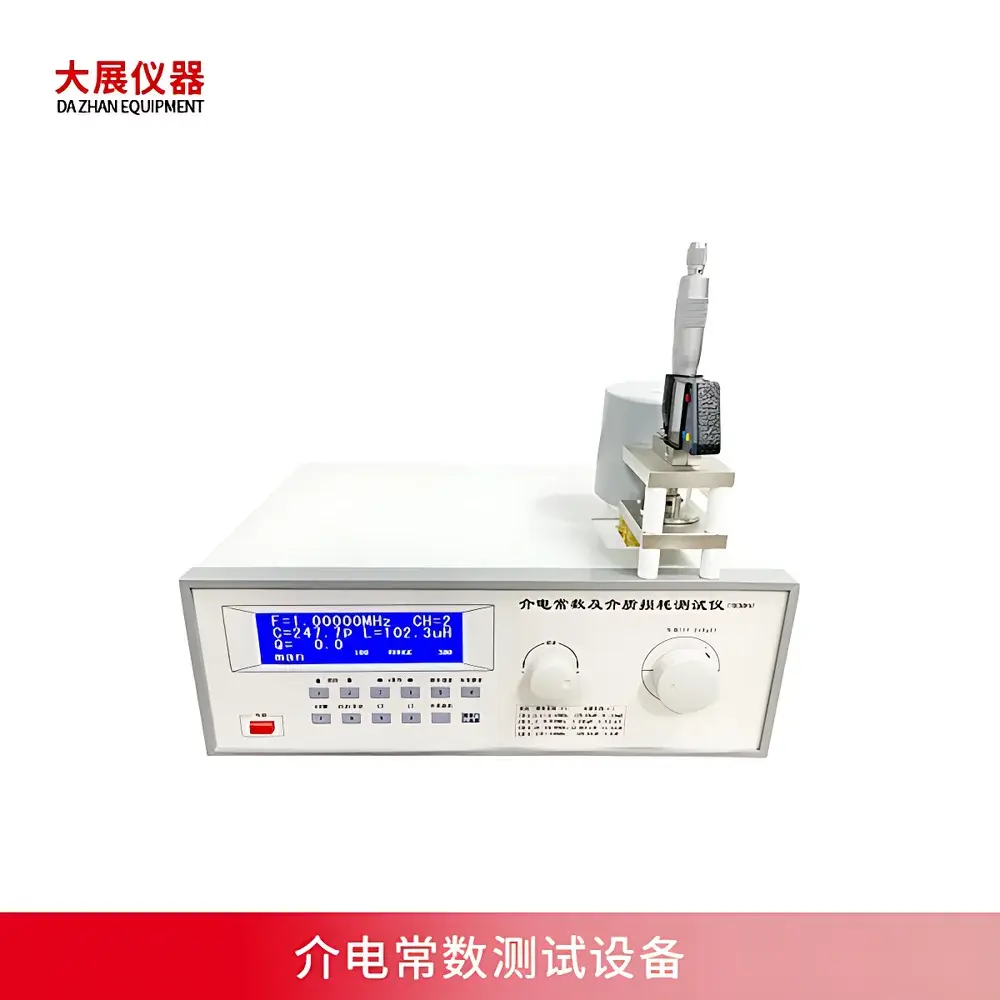
DZ5001 DAZHAN Dielectric Constant and Loss Tangent Analyzer
| Brand | DAZHAN |
|---|---|
| Model | DZ5001 |
| Measurement Principle | High-Frequency Resonance Method |
| Frequency Range | 10 kHz – 100 MHz |
| Q Factor Range | 1–1000 |
| Q Resolution | 0.1 (4-digit) |
| Q Accuracy | <5% |
| Inductance Range | 1 nH – 140 mH (0.1 nH resolution) |
| Capacitance Range | 1 pF – 25 nF (0.1 pF resolution) |
| Main Tuning Capacitor | 17–240 pF (silver-plated, ±1 pF or <1% error) |
| Signal Source Stability | 3×10⁻⁵ ±1 digit |
| ADC Resolution | 12-bit |
| Auto-Null Compensation | Residual inductance & lead inductance |
| Display | LCD with real-time F, L, C, Q, Lₜ, Cₜ, εᵣ, tan δ |
Overview
The DZ5001 DAZHAN Dielectric Constant and Loss Tangent Analyzer is a precision benchtop instrument engineered for the quantitative characterization of dielectric properties in solid and ceramic insulating materials. It operates on the high-frequency resonance method—a well-established technique standardized in ASTM D150 and IEC 60250—where a sample forms part of a resonant LC circuit, and changes in resonant frequency and bandwidth are used to derive complex permittivity (ε* = ε′ − jε″) and loss tangent (tan δ = ε″/ε′). Unlike broadband impedance analyzers or time-domain reflectometry systems, the DZ5001 leverages discrete-frequency harmonic resonance at selectable points across a wide 10 kHz to 100 MHz range, delivering high signal-to-noise ratio and superior repeatability for low-loss materials (tan δ < 0.001). Its architecture is optimized for R&D laboratories, quality control departments, and material certification facilities requiring traceable, physics-based measurements compliant with GLP documentation workflows.
Key Features
- Wide-frequency resonance sweep: DDS-based digital signal synthesis ensures stable, low-phase-noise excitation from 10 kHz to 100 MHz with 6-digit frequency accuracy (±3×10⁻⁵), enabling precise identification of material dispersion behavior across multiple relaxation regions.
- Automated residual inductance compensation: Real-time nulling of fixture parasitics—including lead inductance and internal stray inductance—eliminates systematic bias in Q and capacitance readings, critical for thin-film or low-permittivity samples where parasitic effects dominate.
- High-resolution parameter extraction: 12-bit ADC sampling coupled with adaptive gain control ensures stable Q measurement down to <0.5% uncertainty, even for ultra-low-loss ceramics (e.g., Al₂O₃, sapphire) and polymer films (e.g., polyimide, PTFE).
- Integrated tuning capacitor with motorized drive: A silver-plated, temperature-stable main capacitor (17–240 pF, ±1 pF tolerance) enables rapid, repeatable resonance tracking; auto-scan mode locates peak resonance within ±0.05% of center frequency.
- Direct dielectric parameter readout: On-screen display of εᵣ (relative permittivity), tan δ, resonant frequency (F), inductance (L), capacitance (C), and Q factor—without external calculation or post-processing—reducing operator dependency and transcription errors.
Sample Compatibility & Compliance
The DZ5001 supports standardized electrode configurations per ASTM D2520 and IEC 60664-1, including parallel-plate, guarded-ring, and coaxial fixtures for bulk solids, pressed pellets, and thin sheets (≥0.1 mm thickness). It is routinely deployed for characterizing metal oxides (TiO₂, ZnO), technical ceramics (AlN, Si₃N₄), glass substrates, thermoset laminates (FR-4), and high-frequency PCB dielectrics. All measurements adhere to ISO/IEC 17025 calibration traceability requirements when used with NIST-traceable reference capacitors and certified quartz resonators. The instrument’s firmware supports audit-ready data logging—including timestamped operator ID, environmental conditions (optional sensor input), and raw resonance curve metadata—to satisfy FDA 21 CFR Part 11 and EU Annex 11 compliance frameworks for regulated environments.
Software & Data Management
While the DZ5001 operates as a stand-alone analyzer with full local control via its front-panel LCD interface, optional PC connectivity (RS-232 or USB-C) enables integration with third-party laboratory information management systems (LIMS) or custom MATLAB/Python analysis scripts. Export formats include CSV and ASCII text with column headers aligned to ISO 10816-1 metadata conventions. Built-in memory stores up to 256 test records with full parameter sets; all stored entries include automatic checksum validation and write-protection flags to prevent accidental overwrites. Audit trail functionality logs every configuration change—including frequency selection, Q-range switching, and null calibration events—with immutable timestamps and user attribution.
Applications
- Quality assurance of high-frequency substrate materials for 5G RF modules and millimeter-wave antennas
- Development and screening of low-k dielectrics for advanced semiconductor interconnects
- Characterization of ferroelectric phase transitions in perovskite ceramics under variable temperature (with external cryo/thermal stage)
- Validation of moisture-induced permittivity drift in polymer encapsulants per IPC-TM-650 2.6.3.1
- Comparative analysis of filler dispersion homogeneity in composite dielectrics using frequency-dependent ε′ and tan δ dispersion profiles
FAQ
What standards does the DZ5001 comply with for dielectric measurements?
The instrument implements measurement algorithms consistent with ASTM D150, IEC 60250, and GB/T 1409—supporting both fixed-frequency and swept-frequency modes required by these standards.
Can the DZ5001 measure anisotropic dielectrics such as layered Li-ion battery separators?
Yes, when paired with directional electrode fixtures (e.g., vertical compression cells), it quantifies through-plane vs. in-plane permittivity differences at frequencies relevant to electrochemical impedance modeling.
Is calibration required before each test series?
A single open/short/load (OSL) calibration is recommended before daily operation; the system retains calibration coefficients across power cycles and supports user-defined reference standards.
Does the analyzer support temperature-controlled measurements?
It features analog voltage outputs (0–5 V) for synchronization with external environmental chambers, allowing triggered acquisition at defined thermal setpoints.
How is measurement uncertainty quantified for low-loss materials (tan δ < 0.0005)?
Uncertainty is derived from combined Type A (repeatability) and Type B (instrumental resolution, frequency stability, capacitor tolerance) components per GUM (JCGM 100:2018), with typical expanded uncertainty (k=2) of ±(0.8% + 0.0002) for tan δ in the 1 MHz–10 MHz band.



