
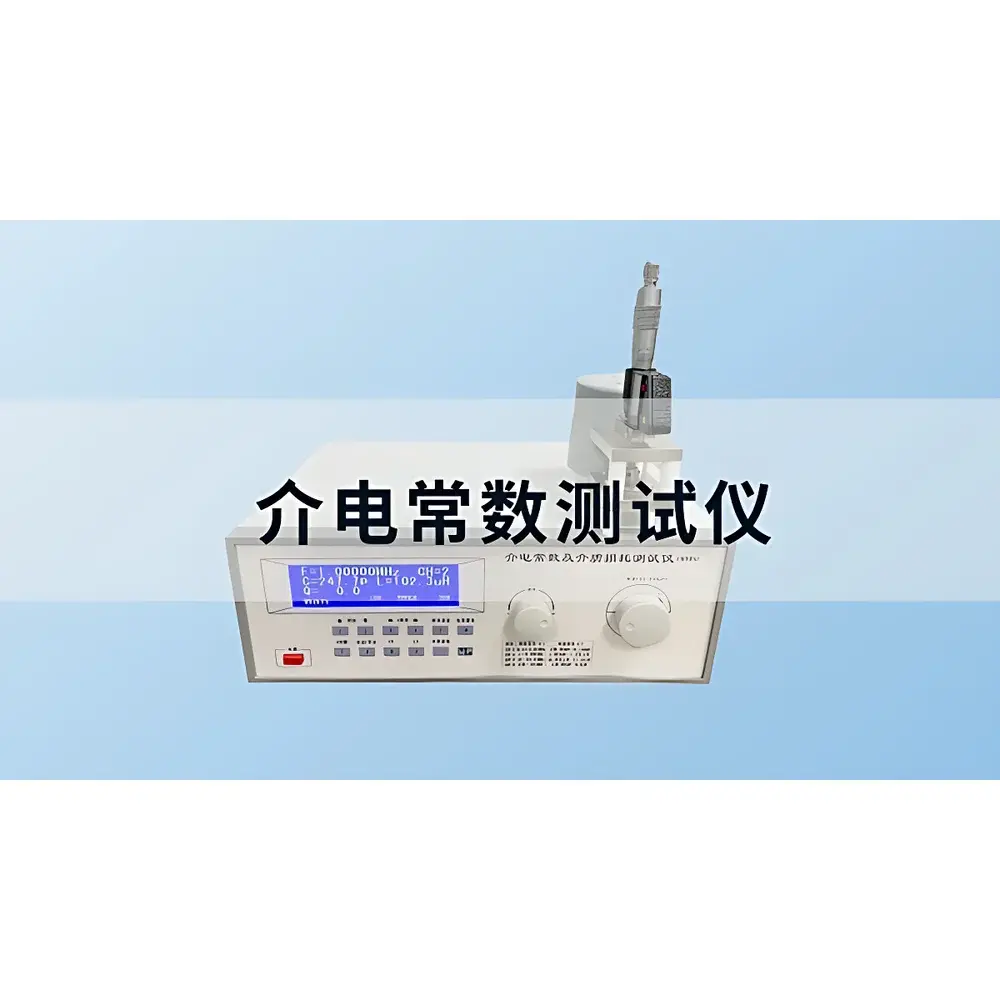
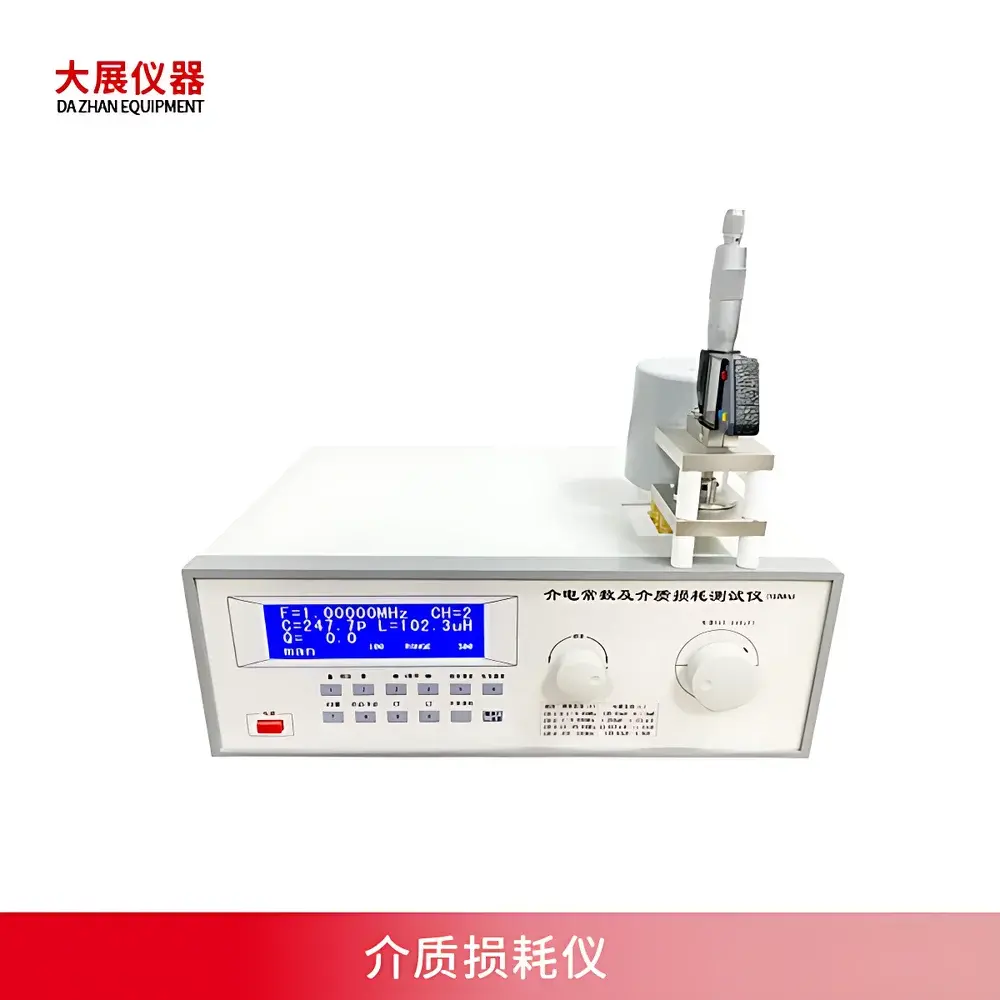
DZ5001 Dielectric Loss Analyzer by DAZHAN
| Brand | DAZHAN |
|---|---|
| Model | DZ5001 |
| Measurement Principle | High-Frequency Resonance Method |
| Frequency Range | 10 kHz – 100 MHz |
| Frequency Accuracy | ±3×10⁻⁵ (6-digit resolution) |
| Q Factor Range | 1–1000 |
| Q Resolution | 0.1 (4-digit effective) |
| Q Measurement Error | <5% |
| Inductance Range | 1 nH – 140 mH |
| Inductance Resolution | 0.1 nH |
| Inductance Error | <3% |
| Tuning Capacitance | 17–240 pF (silver-plated monolithic) |
| Capacitance Direct Measurement Range | 1 pF – 25 nF |
| Capacitance Accuracy | ±1 pF or <1% |
| Capacitance Resolution | 0.1 pF |
| Auto Capacitance Search | Yes (stepper motor driven) |
| Display | LCD showing F, L, C, Q, Lt, Ct, εᵣ, Tn, etc. |
| Residual Inductance Compensation | Yes |
| Data Interface | RS-232/USB for PC connectivity |
| Compliance | Designed per IEC 60250 and ASTM D150 guidelines for dielectric property measurement |
Overview
The DZ5001 Dielectric Loss Analyzer by DAZHAN is a precision benchtop instrument engineered for high-accuracy characterization of dielectric properties in solid, liquid, and thin-film materials. It operates on the high-frequency resonance method—specifically, a modified series/parallel resonant circuit technique—where a sample forms part of a tunable LC oscillator. By precisely measuring resonant frequency (F), dynamic Q factor, inductance (L), and capacitance (C), the system calculates complex permittivity (ε* = ε′ − jε″), loss tangent (tan δ = ε″/ε′), and relative permittivity (εᵣ) across a broad frequency spectrum from 10 kHz to 100 MHz. Its 7000:1 frequency coverage ratio enables comparative analysis across multiple material classes—from low-loss ceramics and polymer films to conductive composites and electrolytic solutions—without hardware reconfiguration. The analyzer’s core architecture integrates a direct digital synthesis (DDS) signal source with 6-digit frequency stability and 12-bit high-speed ADC acquisition, ensuring repeatability in Q and εᵣ measurements critical for R&D validation and QC release testing.
Key Features
- High-stability DDS signal generator with frequency resolution down to 0.01 Hz and long-term accuracy of ±3×10⁻⁵
- Automated resonant point search via stepper-motor-driven tuning capacitor (17–240 pF range), eliminating manual nulling and reducing operator-induced variability
- Integrated residual inductance compensation algorithm that corrects for fixture and lead parasitics—essential for sub-pF and nanohenry-level measurements
- Simultaneous real-time display of eight key parameters: resonant frequency (F), measured inductance (L), tuning capacitance (Ct), loaded/unloaded Q, calculated εᵣ, tan δ, temperature-normalized values (Tn), and dissipation factor (D = 1/Q)
- Dual-mode operation: fully automatic sweep-and-lock mode for rapid screening, and manual fine-tuning mode for deep parametric investigation
- RS-232 and USB 2.0 interfaces compliant with standard VISA protocols, enabling seamless integration into LabVIEW, MATLAB, or custom Python-based test automation frameworks
Sample Compatibility & Compliance
The DZ5001 supports standardized electrode configurations—including parallel-plate, coaxial line, and split-post dielectric resonator fixtures—allowing adaptation to ASTM D150 (Standard Test Methods for Dielectric and Resistivity Properties of Solid Electrical Insulating Materials), IEC 60250 (Measurement of the Permittivity and Dielectric Dissipation Factor of Electrical Insulating Materials at Power, Audio and Radio Frequencies), and ISO 1183-2 (Plastics — Methods of Determining the Density of Non-Cellular Plastics). Its calibrated capacitance channel (1 pF–25 nF, ±1 pF absolute accuracy) permits direct measurement of electrode-sample geometry effects, supporting traceable εᵣ determination per NIST-traceable reference standards. The system includes built-in GLP-compliant data logging with timestamped metadata (operator ID, ambient temperature/humidity, calibration date), satisfying audit requirements under FDA 21 CFR Part 11 when paired with validated software environments.
Software & Data Management
Bundled DZ-Analysis Suite v3.2 provides full remote control, automated report generation (PDF/CSV/XLSX), and multi-curve overlay for time- or temperature-dependent dielectric spectroscopy. Raw measurement logs include full parameter history with audit trail—recording every Q-range switch, capacitance step, and user-initiated recalibration. Exported datasets embed SI-unit metadata and comply with MIAME/MINSEQ conventions for inter-laboratory data exchange. Optional add-on modules support FFT-based harmonic distortion analysis and Cole-Cole plot generation for Debye/non-Debye relaxation modeling. All firmware updates are digitally signed and verified against DAZHAN’s secure OTA repository, ensuring integrity in regulated environments.
Applications
- Quality assurance of high-frequency PCB substrates (e.g., Rogers RO4000®, polyimide, PTFE composites)
- Development of low-loss gate dielectrics for GaN and SiC power devices
- Characterization of ferroelectric thin films (BaTiO₃, PZT) for MEMS actuators
- Moisture content assessment in hygroscopic polymers via ε″ peak shift at 1–10 MHz
- Validation of microwave absorber formulations (carbon-black-loaded elastomers, ferrite composites)
- Educational labs for hands-on instruction in electromagnetic material theory and impedance spectroscopy fundamentals
FAQ
What frequency range is supported for dielectric loss measurement?
The DZ5001 operates continuously from 10 kHz to 100 MHz with programmable step resolution down to 0.01 Hz.
Can the instrument measure both ε′ and ε″ independently?
Yes—by combining measured Q, resonant frequency, and calibrated capacitance, the system computes ε′ and ε″ using first-principles circuit models consistent with IEEE Std 1689-2018.
Is calibration traceable to national standards?
Factory calibration uses NIST-traceable LCR standards (Keysight E4980AL reference set); users may perform in-house verification using supplied ceramic and air-dielectric reference samples.
Does the system support temperature-controlled measurements?
While the base unit does not integrate environmental chambers, its analog/digital I/O ports enable synchronization with external thermal controllers (e.g., Linkam LTS420) via TTL triggers and analog voltage feedback.
How is data security handled during PC communication?
All USB/RS-232 transactions use encrypted command framing; no raw memory dumps or unsecured configuration writes are permitted without authenticated session handshake.



