
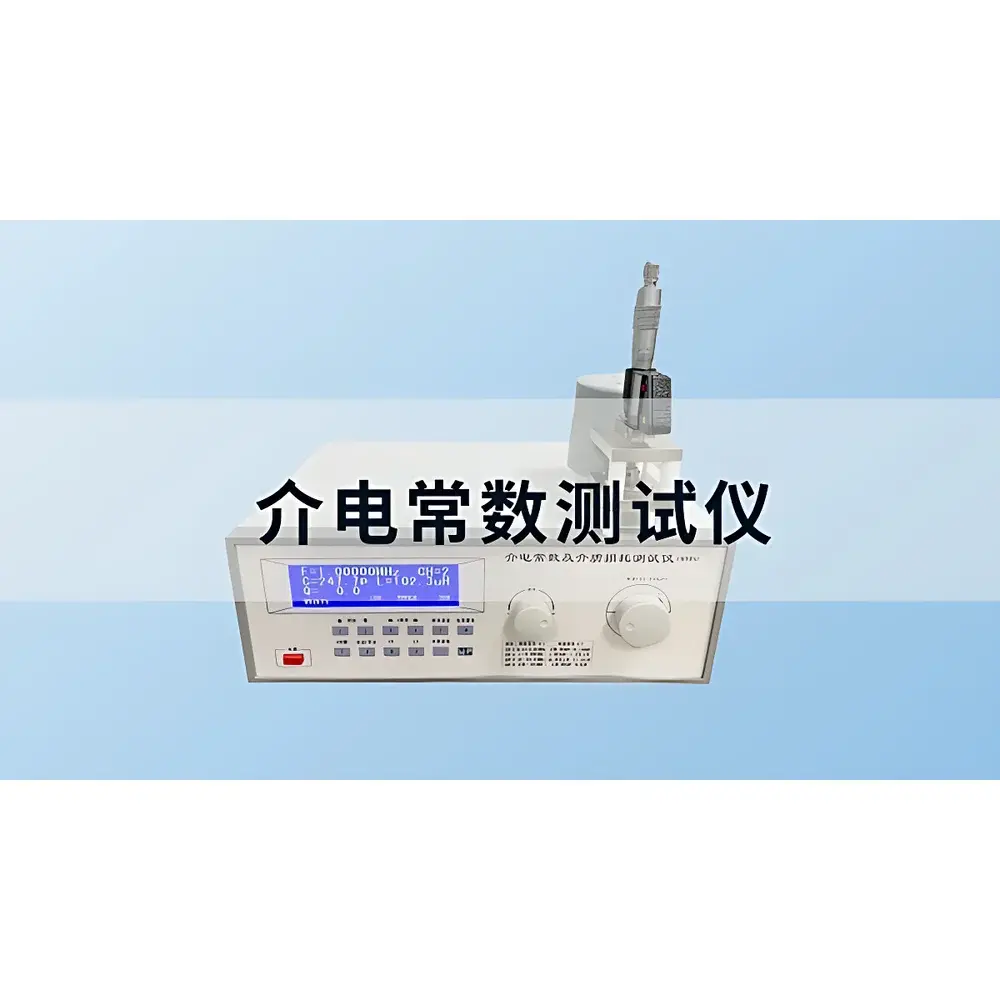
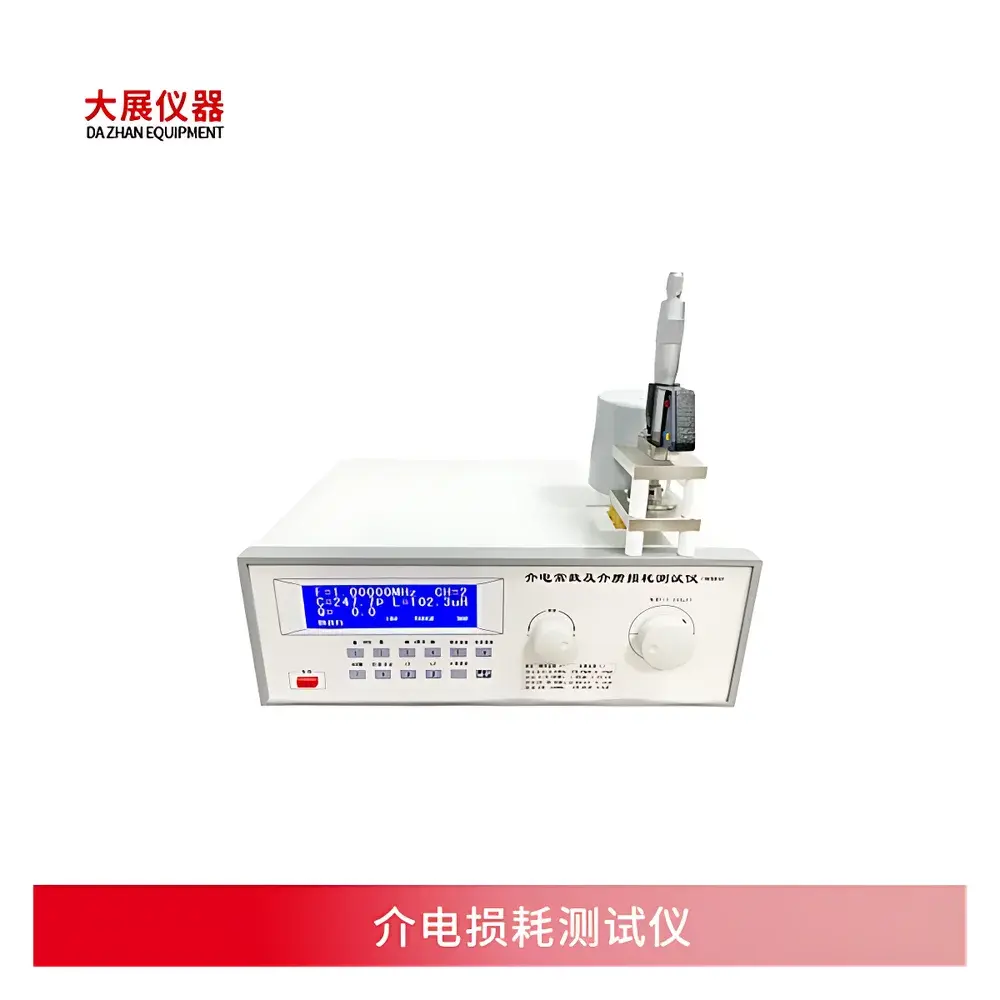
DZ5001 Dielectric Loss and Permittivity Analyzer by DAZHAN
| Brand | DAZHAN |
|---|---|
| Model | DZ5001 |
| Measurement Principle | High-Frequency Resonance Method |
| Frequency Range | 10 kHz – 100 MHz |
| Frequency Accuracy | ±3×10⁻⁵ (6-digit resolution) |
| Q Factor Range | 1–1000 |
| Q Resolution | 0.1 (4-digit display) |
| Q Measurement Error | <5% |
| Inductance Range | 1 nH – 140 mH |
| Inductance Resolution | 0.1 nH |
| Inductance Error | <3% |
| Main Tuning Capacitance | 17–240 pF (silver-plated monolithic capacitor) |
| Capacitance Measurement Range | 1 pF – 25 nF |
| Capacitance Resolution | 0.1 pF |
| Capacitance Error | ±1 pF or <1% |
| Automatic Residual Inductance Compensation | Yes |
| Auto-Resonance Search | Yes (stepper motor–driven) |
| Display | LCD showing F, L, C, Q, Lt, Ct, εᵣ, Tn, etc. |
| Compliance | Designed for ASTM D150, IEC 60250, GB/T 1409, and ISO 18732-compliant dielectric characterization workflows |
Overview
The DZ5001 Dielectric Loss and Permittivity Analyzer is a precision benchtop instrument engineered for the quantitative determination of complex permittivity (ε* = ε′ − jε″) and dielectric loss tangent (tan δ = ε″/ε′) in solid and thin-film insulating materials. It operates on the principle of high-frequency series-resonant cavity perturbation, where the sample’s dielectric properties are derived from shifts in resonant frequency (f₀) and quality factor (Q) of a calibrated LC tank circuit. Unlike broadband impedance analyzers or time-domain reflectometry systems, the DZ5001 employs direct digital synthesis (DDS) to generate stable, low-phase-noise excitation signals across a 10 kHz–100 MHz range—enabling high signal-to-noise ratio measurements critical for low-loss materials such as fused silica, polyimide films, and high-purity alumina ceramics. Its architecture integrates automatic residual inductance compensation and stepper-motor–controlled tuning capacitance, eliminating manual nulling and reducing operator-induced variability—a key requirement for GLP-compliant material qualification in R&D labs and QC environments.
Key Features
- DDS-based signal source with 6-digit frequency resolution and ±3×10⁻⁵ absolute accuracy, ensuring traceable calibration across the full 10 kHz–100 MHz sweep range
- Integrated silver-plated monolithic tuning capacitor (17–240 pF), delivering sub-pF repeatability and long-term drift stability essential for comparative aging studies
- Real-time automatic resonance search with stepper-motor actuation, enabling unattended acquisition of f₀ and Q without manual peak hunting
- Dual-mode Q measurement (auto/manual range selection) with 0.1-Q resolution and <5% full-scale error—validated per IEC 60250 Annex B protocols
- Onboard calculation of relative permittivity (εᵣ) and loss tangent (tan δ) using standard cavity perturbation equations, with user-configurable reference temperature (Tn) input
- 12-bit high-speed ADC sampling synchronized to DDS clock, minimizing quantization noise during low-dissipation measurements (tan δ < 10⁻⁴)
- LCD interface displaying simultaneous real-time readouts of frequency (F), inductance (L), capacitance (C), Q-factor, loaded inductance (Lt), tuned capacitance (Ct), εᵣ, and normalized temperature (Tn)
Sample Compatibility & Compliance
The DZ5001 accommodates disk-shaped, rectangular, or toroidal specimens with diameters from 10 mm to 50 mm and thicknesses between 0.5 mm and 10 mm. It supports standardized electrode configurations per ASTM D150 (guard-ring electrodes) and IEC 60250 (three-terminal measurement), enabling direct comparison with published literature values. The system is routinely deployed for characterizing ceramic dielectrics (e.g., BaTiO₃, Al₂O₃), polymer films (PET, PI, PTFE), glass substrates, and composite laminates used in RF/microwave packaging and high-voltage insulation. All firmware algorithms adhere to the mathematical models defined in ISO 18732 for resonant dielectric spectroscopy, and raw data export (CSV) supports 21 CFR Part 11–compliant audit trails when integrated into validated laboratory information management systems (LIMS).
Software & Data Management
While the DZ5001 operates autonomously via its front-panel interface, optional PC connectivity (RS-232 or USB-to-serial) enables remote control and batch data logging using DAZHAN’s certified DZ-DataLink software. This application supports automated test sequences—including multi-frequency sweeps, temperature ramp correlation (when paired with external environmental chambers), and pass/fail Q-threshold evaluation (programmable 5–1000 window with audible/visual alerts). All measurement metadata—including instrument ID, operator tag, date/time stamp, and calibration certificate ID—is embedded in exported files. Data integrity is preserved through SHA-256 hashing of each dataset, satisfying GMP documentation requirements for material release testing in regulated electronics manufacturing.
Applications
- Quality control of capacitor dielectrics and substrate materials in PCB and RF component fabrication
- Development of low-loss antenna substrates and 5G millimeter-wave packaging materials
- Accelerated aging studies of high-voltage insulators under thermal and humidity stress
- Validation of nanocomposite permittivity models (e.g., Maxwell-Garnett, Bruggeman) against experimental εᵣ/tan δ spectra
- Comparative analysis of sintering effects on grain-boundary polarization in polycrystalline ceramics
- Supporting USP and ICH Q5C guidelines for dielectric characterization of pharmaceutical polymer coatings
FAQ
What standards does the DZ5001 comply with for dielectric measurements?
It implements measurement methodologies aligned with ASTM D150 (Standard Test Methods for Dielectric and Resistivity Properties of Solid Electrical Insulating Materials), IEC 60250 (Measurement of the Dielectric Properties of Electrical Insulating Materials at Power, Audio and Radio Frequencies Including Meter-Wave Lengths), and GB/T 1409 (Chinese national standard equivalent to IEC 60250).
Can the DZ5001 measure thin films or coatings?
Yes—when used with guarded parallel-plate fixtures (optional accessory), it supports thickness-normalized permittivity extraction for films ≥5 µm thick; however, substrate correction algorithms must be applied externally per ISO 18732 Annex C.
How is residual inductance compensated?
The instrument performs a two-step open-circuit calibration prior to sample insertion, then applies real-time digital subtraction of the measured residual L and stray C components during resonance tracking—eliminating need for manual nulling.
Is temperature-controlled measurement supported?
The base unit does not include thermal control, but its RS-232 interface allows synchronization with third-party environmental chambers via TTL-triggered start/stop commands and external T-sensor input mapping in DZ-DataLink software.
What maintenance is required for long-term accuracy?
Annual verification using NIST-traceable air-dielectric and quartz reference standards is recommended; the silver-plated tuning capacitor requires no lubrication or cleaning under normal lab conditions due to hermetic construction.



