
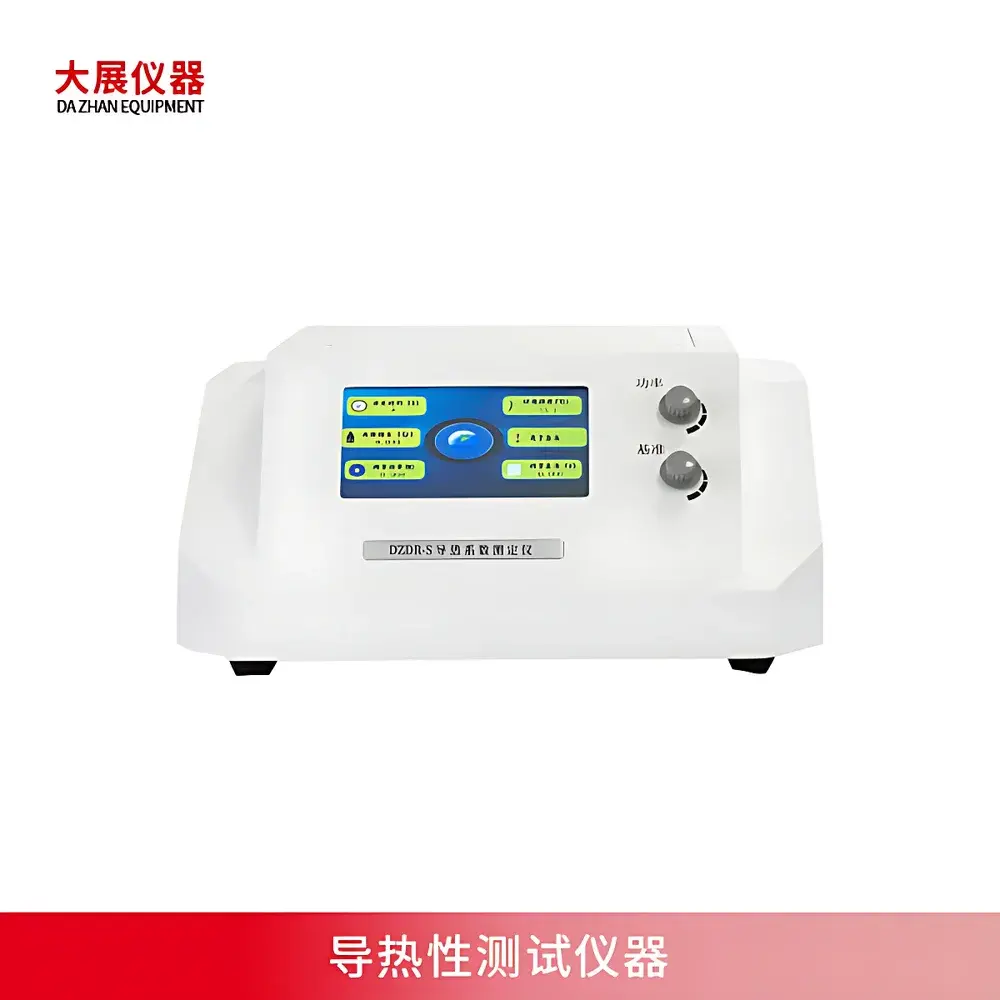
DZDR-S Transient Plane Source (TPS) Thermal Conductivity Analyzer by DAZHAN
| Brand | DAZHAN |
|---|---|
| Origin | Jiangsu, China |
| Manufacturer Type | Authorized Distributor |
| Country of Origin | China |
| Model | DZDR-S |
| Instrument Type | Transient Plane Source (TPS) Method |
| Sample Throughput | Single-sample mode |
| Test Environment | Ambient pressure |
| Thermal Conductivity Range | 0.0001–300 W/(m·K) |
| Accuracy | ±3% |
| Dimensions (L×W×H) | 455 × 390 × 200 mm |
| Repeatability | ≤3% |
| Temperature Range | Room temperature to 130 °C (extendable to 300 °C with optional heating module) |
| Sample Forms | Solids (bulk, film, coating), powders, liquids, pastes, gels, and aerogels |
Overview
The DZDR-S Transient Plane Source (TPS) Thermal Conductivity Analyzer is a precision instrument engineered for rapid, non-destructive determination of thermal conductivity across a broad spectrum of materials. It operates on the well-established transient plane source principle—a standardized method defined in ISO 22007-2 and ASTM D5470—where a thin, resistive sensor acts simultaneously as both a heat source and a temperature probe. Upon application of a constant current pulse, the sensor generates a controlled thermal step input; the resulting time-dependent temperature rise on both sides of the sensor is recorded and analyzed using analytical solutions to Fourier’s heat conduction equation for an infinite medium. This first-principles approach eliminates reliance on calibration standards for most homogeneous or isotropic samples, enabling direct physical measurement with high reproducibility. The DZDR-S is particularly suited for R&D laboratories, quality control departments, and material science facilities requiring traceable, ISO-compliant thermal property characterization under ambient or moderately elevated temperatures.
Key Features
- Three interchangeable TPS probes (7.5 mm, 15 mm, and 50 mm diameter) optimized for varying sample geometries and thermal diffusivity ranges—enabling consistent measurement across low-conductivity insulators (e.g., aerogels, foams) and high-conductivity metals or composites.
- Modular temperature control system supports operation from room temperature up to 130 °C as standard, with optional extension to 300 °C for high-temperature polymer or ceramic characterization.
- Non-invasive, single-sided or dual-sided contact configuration minimizes sample preparation: flatness requirement limited to surface roughness <10 µm; no cutting, polishing, or coating needed for most solid specimens.
- Integrated touch-enabled color LCD interface with real-time curve visualization, intuitive parameter setup, and on-device data review—reducing dependency on external PCs during routine testing.
- Low-power probe excitation design (≤1 W for 7.5 mm probe; ≤22 W for 50 mm probe) ensures minimal thermal perturbation and avoids sample degradation during measurement.
- Robust mechanical sample stage accommodates variable thicknesses (3.75–15 mm depending on probe size) with precision alignment guides and spring-loaded clamping to maintain consistent interfacial contact pressure.
Sample Compatibility & Compliance
The DZDR-S accepts diverse physical forms without phase-specific hardware modification: rigid solids (metals, ceramics, polymers), flexible films and coatings, granular powders (with included custom powder cell), viscous pastes and gels, and Newtonian/non-Newtonian liquids. Its compliance framework aligns with international thermal analysis standards—including ISO 22007-2 (plastics), ISO 18434-1 (condition monitoring), and ASTM C1113 (refractories)—ensuring data acceptability in regulatory submissions and inter-laboratory comparisons. All measurement protocols support full audit trails, timestamped raw data logging, and user-accessible calibration history—meeting GLP and GMP documentation requirements per FDA 21 CFR Part 11 when deployed with validated software configurations.
Software & Data Management
The DZDR-S is supplied with proprietary TPS Analysis Suite v3.x, a Windows-based application supporting automated calculation of thermal conductivity, thermal diffusivity, and volumetric heat capacity via inverse modeling of the TPS response function. Raw voltage-time datasets are stored in HDF5 format for long-term archival integrity and third-party interoperability. The software includes batch processing, statistical reporting (mean, SD, CV%), outlier detection, and export to CSV, PDF, or Excel-compatible XML. Optional API integration enables linkage with LIMS platforms and MES systems for automated result transfer into enterprise QA workflows.
Applications
- Thermal interface material (TIM) qualification for electronics cooling applications
- Quality assurance of insulation materials (aerogels, mineral wool, vacuum panels) in building science
- Development of thermally conductive polymer composites and battery electrode slurries
- Characterization of phase-change materials (PCMs) and thermal energy storage media
- Validation of thermal transport models in computational materials science
- Batch-to-batch consistency testing for pharmaceutical excipients and topical formulations
FAQ
What standards does the DZDR-S comply with for thermal conductivity measurement?
It implements the transient plane source method per ISO 22007-2 and ASTM D5470, with traceable validation against NIST SRM 1470a (fused quartz) and certified reference materials from PTB and NPL.
Can the instrument measure anisotropic materials?
Yes—by orienting the probe normal to principal axes and comparing orthogonal measurements, directional thermal conductivity can be inferred for layered composites or crystalline materials.
Is vacuum or inert gas environment supported?
The base configuration operates at ambient pressure; optional vacuum chamber integration (up to 10⁻³ mbar) and purge ports for nitrogen/argon atmospheres are available upon request.
How is probe-sample interfacial resistance accounted for?
The software applies a dual-layer thermal contact resistance correction model derived from measured baseline impedance and known probe geometry—validated using calibrated thermal grease interfaces.
Does the system support automated temperature ramping during measurement?
Temperature ramping is not performed *during* a single TPS pulse; however, sequential isothermal measurements across a user-defined temperature profile (e.g., 25 °C → 50 °C → 75 °C) are fully automated with thermal equilibration monitoring.



