
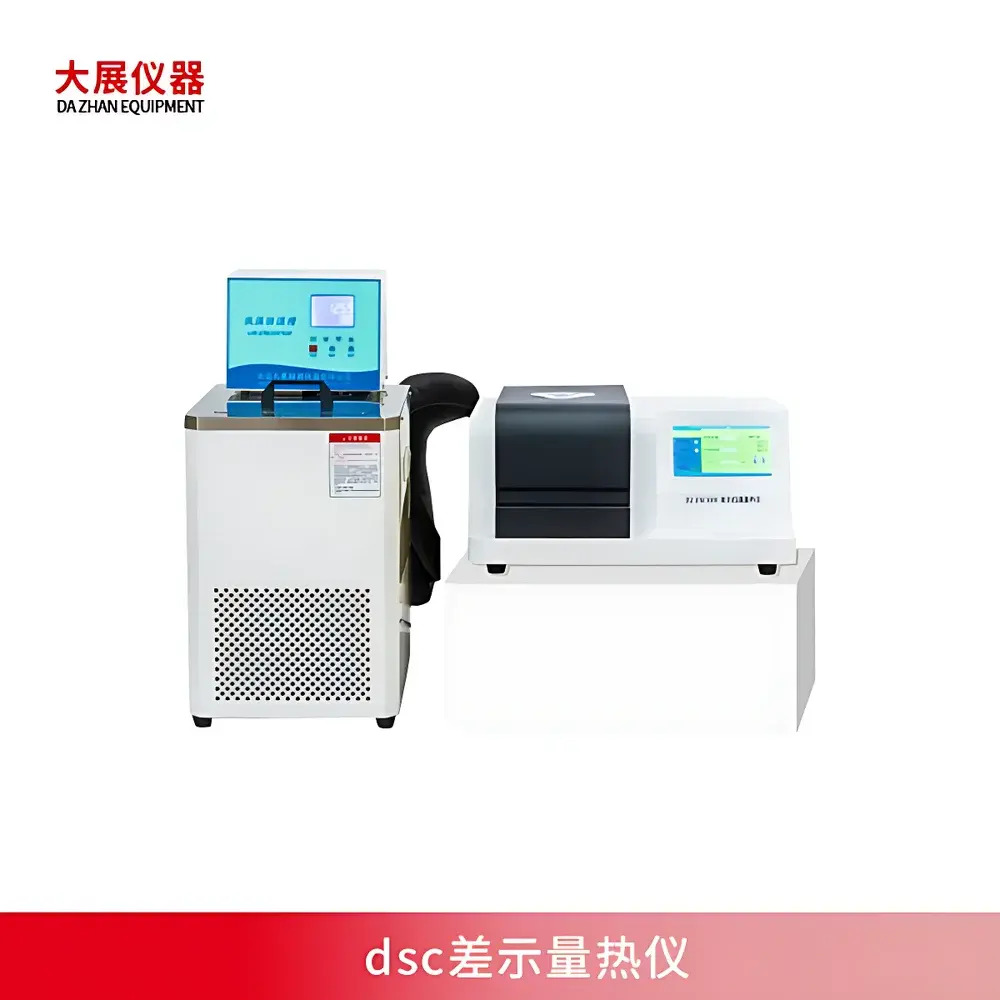
DZHAN DZ-DSC300C Differential Scanning Calorimeter
| Brand | DZHAN |
|---|---|
| Origin | Jiangsu, China |
| Model | DZ-DSC300C |
| Temperature Range | −40 to 600 °C |
| Temperature Accuracy | ±0.0001 °C |
| Heating/Cooling Rate | 0.1–100 K/min |
| DSC Signal Range | 0 to ±600 mW |
| DSC Resolution | 0.01 µW |
| DSC Sensitivity | 0.001 mW |
| Atmosphere Control | Dual automatic gas switching (up to 300 mL/min, ≤5 MPa), plus dedicated purge/protect gas inlet |
| Thermal Control Modes | Programmable multi-segment heating, isothermal hold, and cooling (up to 6 segments) |
| Display | 7-inch 24-bit color capacitive touchscreen |
| Interface | Standard USB 2.0 with auto-reconnect capability |
| Power Supply | AC 220 V / 50 Hz (customizable) |
Overview
The DZHAN DZ-DSC300C is a high-performance, semiconductor-cooled differential scanning calorimeter engineered for precise quantitative thermal analysis of solid and semi-crystalline materials across a broad temperature domain (−40 °C to 600 °C). It operates on the heat-flux DSC principle: two identical sample pans—one containing the test specimen and the other serving as an inert reference—are subjected to identical, programmable thermal profiles while the differential heat flow between them is measured continuously. This enables direct quantification of endothermic and exothermic transitions—including melting, crystallization, glass transition (Tg), solid–solid phase changes, oxidative induction time (OIT), and degree of cure—under controlled atmosphere conditions. Designed for laboratory environments requiring reproducible, GLP-compliant thermal characterization, the DZ-DSC300C integrates a monolithic metal furnace architecture, active semiconductor cooling, and dual-gas management to ensure baseline stability, thermal homogeneity, and measurement fidelity across dynamic and isothermal regimes.
Key Features
- Robust all-metal furnace core with optimized thermal mass and low thermal inertia, delivering superior baseline flatness and long-term signal stability—even during rapid ramping or extended isothermal holds.
- Integrated Peltier-based cooling system enabling rapid sub-ambient operation down to −40 °C without liquid nitrogen, with independent control over heating and cooling rates (0.1–100 K/min heating; 0.1–40 K/min cooling).
- Intuitive 7-inch high-resolution capacitive touchscreen interface supporting full instrument control, real-time curve monitoring, and local data storage—operable standalone or synchronized with PC-based acquisition software.
- Dual automated gas manifold with fast-switching solenoid valves, allowing seamless, user-programmable alternation between two process gases (e.g., N2 and O2) and a dedicated protective inert stream—critical for oxidation studies and moisture-sensitive samples.
- USB 2.0 communication protocol with hardware-level auto-recovery logic, ensuring uninterrupted data streaming and eliminating connection dropouts during multi-hour experiments.
- Multi-segment thermal programming engine supporting up to six independent ramp/hold steps per run, facilitating complex protocols such as modulated DSC (MDSC)-compatible sequences, step-isothermal relaxation, or cyclic aging studies.
Sample Compatibility & Compliance
The DZ-DSC300C accommodates standard hermetic aluminum crucibles (40 µL and 100 µL volumes), sealed or vented, compatible with volatile, hygroscopic, or reactive samples. Optional high-pressure crucibles (up to 5 MPa) and specialized pans for polymer melt rheology or catalytic decomposition are available under OEM configuration. The system complies with core thermal analysis standards including ASTM E794 (melting point), ASTM E1356 (Tg determination), ISO 11357 series (polymer characterization), and USP (pharmaceutical thermal analysis). Its firmware supports audit trail logging, electronic signature-ready method templates, and export formats compliant with FDA 21 CFR Part 11 requirements when deployed in regulated QA/QC environments.
Software & Data Management
Bundled DZHAN Thermal Analysis Suite (v4.x) provides cross-platform acquisition, baseline correction (tangent, sigmoidal, polynomial), peak integration (onset, peak max, enthalpy), and comparative kinetics modeling (Ozawa-Flynn-Wall, Kissinger). Raw data are stored in vendor-neutral ASCII (.txt) and universal HDF5 formats, enabling third-party processing in MATLAB, Python (SciPy/NumPy), or commercial packages such as TA Universal Analysis or Netzsch Proteus. All calibration records—including certified reference materials (indium, tin, lead) traceable to NIST SRMs—are digitally embedded and version-controlled within each experimental file. Export modules support PDF report generation with embedded metadata (operator ID, instrument serial, environmental logs) for internal documentation or regulatory submission.
Applications
- Materials Science: Quantifying crystallinity in polyolefins, assessing crosslink density in thermosets, mapping polymorphic transitions in pharmaceutical actives, and evaluating thermal stability of battery electrode composites.
- Pharmaceutical Development: Confirming polymorph identity, detecting amorphous content in lyophilized formulations, determining dehydration events in hydrates, and validating sterilization-induced degradation.
- Food & Agriculture: Measuring starch gelatinization enthalpy, characterizing fat crystallization behavior in cocoa butter analogs, and assessing protein denaturation temperatures in plant-based meat alternatives.
- Chemical & Polymer Industry: Determining epoxy resin cure kinetics, evaluating filler–matrix interfacial adhesion via Tg shifts, and screening flame-retardant additive efficacy through oxidative onset temperature analysis.
- Academic Research: Supporting graduate-level coursework in physical chemistry and materials engineering, with modular teaching protocols covering Cp measurement, reaction enthalpy derivation, and non-isothermal kinetics modeling.
FAQ
What reference materials are supplied for calibration?
Certified pure indium (melting point 156.5985 °C), tin (231.928 °C), and lead (327.494 °C) reference standards are included, each with individual NIST-traceable certificates of analysis.
Can the DZ-DSC300C perform modulated DSC (MDSC)?
While not a dedicated MDSC platform, its high-speed sampling rate (≥10 Hz), low-noise analog front-end, and programmable dual-ramp capability allow implementation of quasi-modulated protocols for improved separation of reversing and non-reversing heat flow components.
Is remote operation supported?
Yes—the USB interface enables full bidirectional control via Ethernet-to-USB bridge devices; however, native TCP/IP or Wi-Fi connectivity is not integrated and requires external industrial gateway configuration.
What maintenance is required for long-term baseline stability?
Annual verification of furnace alignment and sensor offset using the included calibration kit is recommended; no consumable parts (e.g., thermocouples or heaters) require routine replacement under normal operating conditions.
Does the system meet GMP/GLP documentation requirements?
When operated with enabled audit trail mode and validated software version, it satisfies ALCOA+ data integrity principles and supports 21 CFR Part 11 compliance when paired with institutional electronic signature infrastructure.
Related Products



