
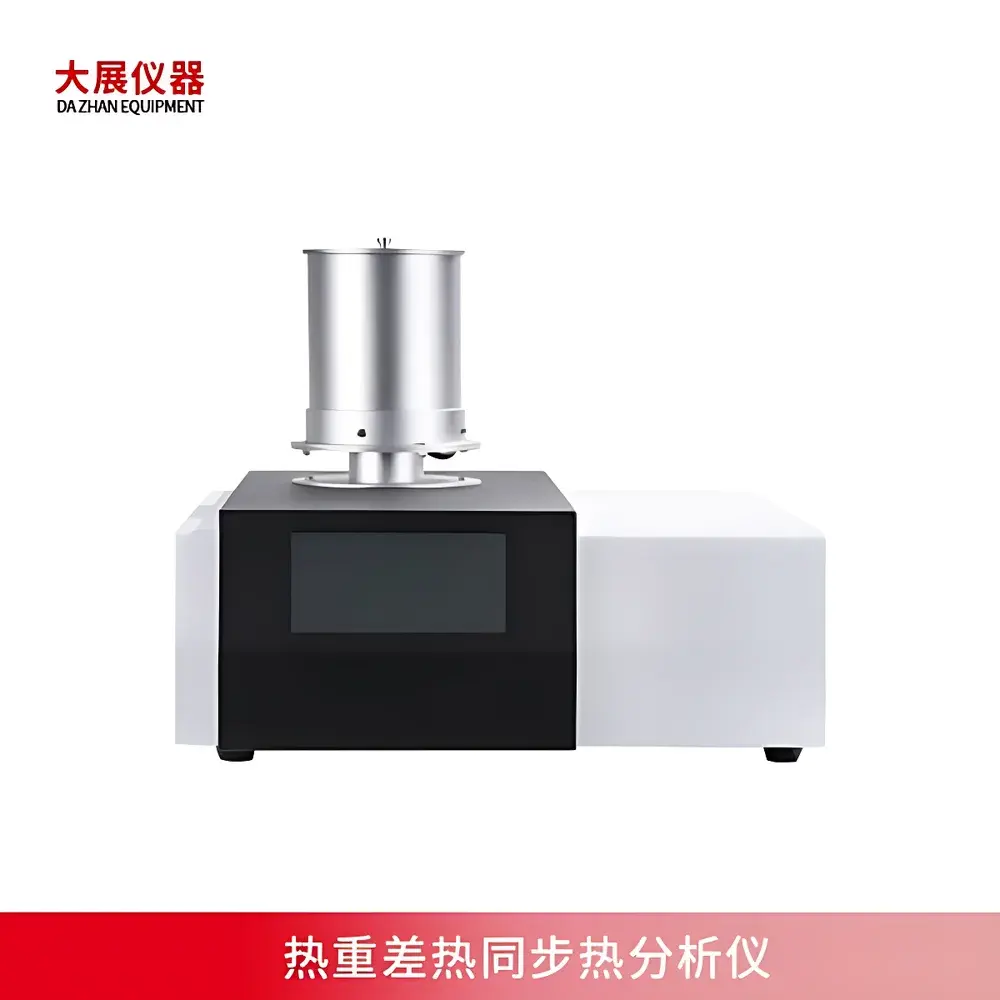
DZHAN DZ-STA200 Simultaneous Thermal Analyzer (TGA-DSC)
| Brand | DAZHAN |
|---|---|
| Model | DZ-STA200 |
| Temperature Range | Ambient to 1200 °C |
| Heating Rate | 0.1–100 °C/min |
| Max Sample Mass | 5 g |
| Atmosphere Control | Dual-gas manifold with integrated mass flow meters and automated switching |
| Temperature Resolution | 0.01 °C |
| Temperature Stability | ±0.1 °C |
| TG Sensitivity | 0.1 µg |
| TG Accuracy | 0.01 mg |
| DSC Range | ±1000 mW |
| DSC Resolution | 0.1 µW |
| DSC Accuracy | 0.01 mW |
| Cooling Time (1000 °C → 100 °C) | ≤15 min |
| Display | 7-inch 24-bit color capacitive touchscreen |
| Data Interface | Standard USB |
| Power Supply | AC 220 V, 50 Hz |
Overview
The DZHAN DZ-STA200 Simultaneous Thermal Analyzer is a precision-engineered instrument that concurrently measures thermogravimetric (TG) and differential scanning calorimetry (DSC) signals under controlled atmospheric conditions. Based on the principle of simultaneous thermal analysis—where mass change (TG) and heat flow (DSC) are recorded in real time within a single furnace environment—the DZ-STA200 enables rigorous quantification of thermal transitions, decomposition kinetics, phase transformations, and reaction enthalpies. Its operational temperature range spans from ambient to 1200 °C, supporting high-temperature applications such as ceramic sintering, metal oxide reduction, and catalyst deactivation studies. The system employs a dual-wound precious-metal alloy heating element for uniform thermal distribution and minimal electromagnetic interference, ensuring high reproducibility across repeated runs. Designed for laboratory environments requiring regulatory compliance and method traceability, the DZ-STA200 supports multi-segment temperature programming, programmable isothermal holds (up to 72 h), and rapid cooling capability—critical for accelerating throughput in QC/QA and R&D workflows.
Key Features
- Open-lid furnace architecture for rapid, contamination-free sample loading and visual alignment—reducing operator-induced variability and enabling routine maintenance without calibration disruption.
- Dual-gas atmosphere control system with integrated mass flow meters, supporting fully automated switching between inert (e.g., N2, Ar), oxidative (e.g., O2, air), or reductive (e.g., H2/N2) environments, with independent flow regulation per channel (0–200 mL/min).
- High-resolution microbalance with 0.1 µg resolution and 0.01 mg accuracy over a 0.1 mg–5 g dynamic range, calibrated using certified reference materials traceable to NIST standards.
- 7-inch capacitive touchscreen interface with intuitive icon-driven navigation, supporting real-time curve overlay (TG, DTG, DSC), manual parameter override, and local data storage (≥1000 test records).
- Bidirectional operation mode: synchronized control via both embedded touchscreen and external PC—enabling remote monitoring, script-based batch testing, and concurrent instrument calibration during active measurement.
- Modular furnace design allows field-replacement of core thermal components (heater, sensor array, crucible holder), minimizing downtime and extending service life beyond 10 years under standard usage.
Sample Compatibility & Compliance
The DZ-STA200 accommodates a broad spectrum of solid and powdered samples—including ceramics, metallic alloys, polymers, pharmaceutical excipients, battery cathode materials, and geological specimens—using standardized alumina, platinum, or custom-designed crucibles (up to 100 µL volume). All thermal protocols adhere to internationally recognized methodologies: ASTM E1131 (TG), ASTM E1269 (DSC), ISO 11358 (polymer degradation), and USP <1231> (thermal stability of drug substances). The system supports GLP-compliant data integrity through secure user authentication, audit-trail-enabled software logging, and export of raw data in ASCII/CSV format for third-party validation. Optional firmware upgrades enable 21 CFR Part 11–compliant electronic signatures and role-based access control for regulated laboratories.
Software & Data Management
DZHAN’s proprietary STA Analysis Suite provides comprehensive post-processing capabilities for TG, DTG, DSC, and combined TG-DSC overlays. Functions include baseline correction, peak integration (onset, peak, endset), kinetic modeling (Friedman, Ozawa-Flynn-Wall), specific heat capacity calculation (via modulated DSC), and oxidation induction time (OIT) determination. Data export options include Excel (.xlsx), PDF reports with embedded metadata (operator ID, timestamp, instrument serial number), and image formats (PNG, SVG). All processed datasets retain full traceability to original acquisition files, with version-controlled software updates distributed via encrypted HTTPS portal. Raw data files are timestamped and checksum-verified to prevent tampering—essential for internal audits and regulatory submissions.
Applications
- Ceramics & Glass: Quantifying sintering onset, binder burnout profiles, and crystallization kinetics in sol-gel precursors.
- Metallurgy: Characterizing phase transformations (e.g., austenite → martensite), oxidation resistance of coatings, and thermal expansion mismatch in composites.
- Pharmaceuticals: Assessing polymorphic stability, hydrate/dehydrate transitions, and compatibility screening in preformulation studies.
- Energy Materials: Evaluating thermal runaway thresholds in Li-ion battery cathodes, decomposition pathways of solid electrolytes, and coke formation on FCC catalysts.
- Polymers & Composites: Determining char yield, flame retardant efficiency, glass transition (Tg), and filler-matrix interfacial degradation.
- Food Science: Monitoring moisture loss, starch gelatinization, lipid oxidation induction periods, and Maillard reaction onset temperatures.
FAQ
What types of crucibles are compatible with the DZ-STA200?
Standard configurations include high-purity α-alumina, platinum, and quartz crucibles. Custom geometries (e.g., pressed-powder holders, sealed capsules) are supported upon request and validated per ASTM E1951.
Can the instrument perform isothermal stability tests for extended durations?
Yes—programmable isothermal segments support dwell times from 1 second to 72 hours, with temperature stability maintained within ±0.1 °C throughout the hold period.
Is calibration traceable to national standards?
Temperature calibration uses NIST-traceable indium, tin, zinc, and aluminum reference materials; mass calibration employs certified weights per ISO/IEC 17025 requirements.
How does the dual-gas system ensure reproducible atmosphere switching during dynamic experiments?
The integrated mass flow controllers feature closed-loop feedback, achieving ±1% full-scale accuracy and sub-second switching latency—validated via online gas chromatography during method development.
Does the software support kinetic analysis for decomposition mechanisms?
Yes—the STA Analysis Suite implements model-free (isoconversional) methods including Kissinger-Akahira-Sunose (KAS) and Friedman analysis, with uncertainty propagation reporting per IUPAC guidelines.



