
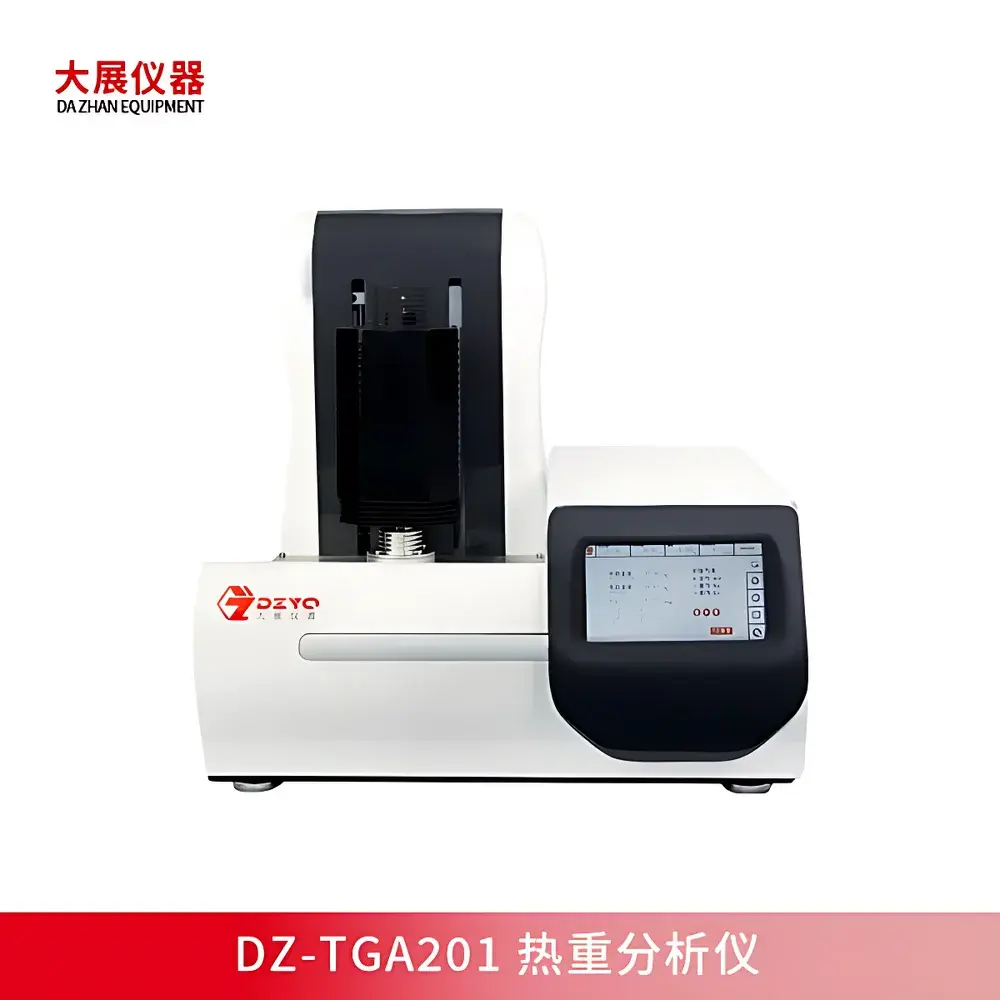
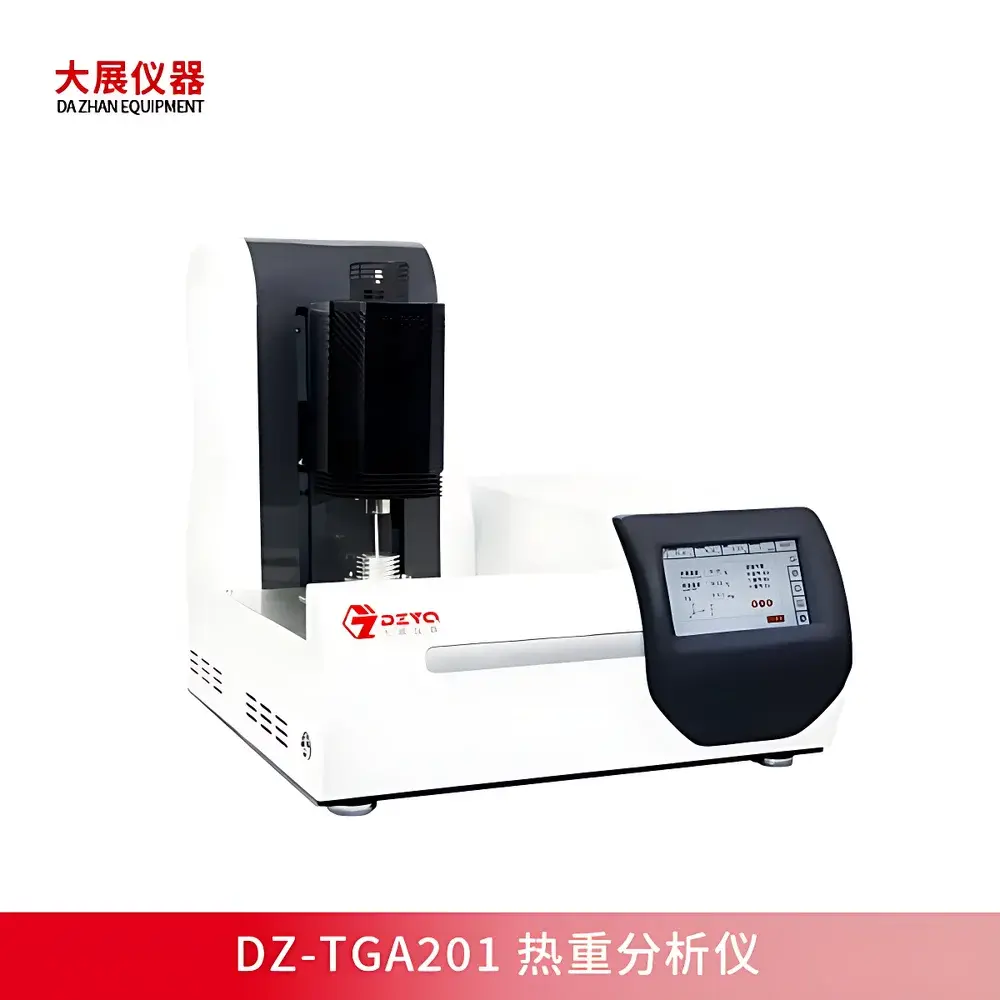
DZHAN DZ-TGA201 Automated-Lift Thermogravimetric Analyzer with FTIR/MS Coupling Interface
| Brand | DAZHAN |
|---|---|
| Origin | Jiangsu, China |
| Manufacturer Type | Authorized Distributor |
| Regional Category | Domestic (PRC) |
| Model | DZ-TGA201 |
| Pricing | Upon Request |
| Operating Environment | Ambient Pressure |
| Sample Capacity | Single Sample |
| Instrument Type | General-Purpose TGA |
| Temperature Range | Room Temperature to 1250 °C |
| Temperature Accuracy | ±0.01 °C |
| Dynamic Weighing Range | 0.01 mg to 3 g (expandable to 50 g) |
| Balance Sensitivity | 1 µg |
| Heating/Cooling Rate | 0.1–100 K/min |
| Maximum Sample Mass | 30 g |
| Temperature Resolution | 0.1 °C |
| Mass Resolution | 0.1 µg |
| Isothermal Hold Duration | Up to 600 min (standard), user-definable |
| Atmosphere Control | Triple-Gas Mass Flow Controller (MFC) System |
| Cooling Time | ≤20 min (1000 °C → 50 °C) |
| Temperature Control Algorithm | Intelligent PID with Self-Tuning & Hybrid Static/Dynamic Optimization |
Overview
The DZHAN DZ-TGA201 is a high-precision, automated-lift thermogravimetric analyzer engineered for rigorous thermal stability and compositional analysis under controlled atmospheres. It operates on the fundamental principle of monitoring real-time mass change as a function of temperature or time under programmable thermal profiles—enabling quantitative characterization of decomposition, oxidation/reduction, desorption/adsorption, and solid-state reaction kinetics. Its integrated coupling interface supports seamless hyphenation with Fourier-transform infrared (FTIR) spectrometers and quadrupole mass spectrometers (MS), permitting concurrent detection and identification of evolved gases during thermal events. Designed for compliance with ASTM E1131, ISO 11358, and USP , the DZ-TGA201 delivers traceable, reproducible data suitable for R&D laboratories, quality control departments, and regulatory submissions in pharmaceuticals, advanced materials, polymers, catalysts, and geochemical research.
Key Features
- Automated vertical furnace lift mechanism enabling rapid thermal quenching (≤20 min from 1000 °C to 50 °C) and minimizing cross-contamination between runs.
- Dual-layer high-efficiency insulation with optimized thermal gradient uniformity, ensuring superior baseline stability and improved linearity across full temperature range (RT–1250 °C).
- Platinum-rhodium alloy dual-coil heating element offering extended service life, minimal electromagnetic interference, and consistent thermal output up to 1250 °C.
- High-stability microbalance with 1 µg sensitivity and 0.01 mg resolution, isolated mechanically and thermally from main chassis via dedicated vibration-dampened subframe.
- Triple-gas mass flow controller system supporting independent regulation of purge, protective, and reactive gas streams (e.g., N₂, O₂, Ar, CO₂, synthetic air) with digital feedback and pressure compensation.
- Dedicated evolved gas transfer line with heated capillary (up to 300 °C) and standardized flange interface (CF-35 or KF-25) for direct coupling to FTIR or MS units.
- Intelligent PID temperature controller incorporating self-tuning algorithms and hybrid static/dynamic optimization—reducing overshoot and stabilizing ramp rates within ±0.5% of setpoint.
Sample Compatibility & Compliance
The DZ-TGA201 accommodates solid powders, granules, thin films, fibers, and small monolithic specimens (max. 30 g total mass; standard crucibles: alumina, platinum, or quartz). It supports inert, oxidative, reductive, and dynamic atmosphere switching protocols required for ASTM D3850 (polymer decomposition), ISO 11358-1 (polymer thermal degradation), and ICH Q5C (protein stability assessment). Data acquisition and instrument operation comply with GLP/GMP documentation standards, including electronic audit trails, user access levels, and secure method storage—fully compatible with 21 CFR Part 11–compliant software extensions when deployed in regulated environments.
Software & Data Management
The bundled DZHAN TGA Analysis Suite provides intuitive method setup, real-time mass/temperature/time plotting, derivative thermogravimetry (DTG), multi-step kinetic modeling (e.g., Friedman, Ozawa-Flynn-Wall), and evolved gas spectral overlay (when coupled to FTIR/MS). Raw data are stored in ASCII-compatible .tdf format with embedded metadata (operator ID, timestamp, calibration history, gas flow logs). Export options include CSV, PDF reports, and XML for LIMS integration. All software modules undergo annual verification against NIST-traceable reference materials (e.g., calcium oxalate monohydrate, copper sulfate pentahydrate).
Applications
- Quantification of moisture, volatiles, filler content, and residual solvents in pharmaceutical excipients and APIs per USP .
- Thermal decomposition profiling of lithium-ion battery cathode/anode materials under argon and air atmospheres.
- Kinetic parameter extraction (Eₐ, A) for catalytic coke burn-off and polymer pyrolysis using model-free isoconversional methods.
- Oxidative induction time (OIT) determination for polyolefin stabilization studies (ASTM D3895).
- Adsorption-desorption hysteresis analysis of MOFs and activated carbons under controlled humidity ramps.
- Reaction stoichiometry validation in ceramic precursor decomposition pathways via evolved gas speciation (CO₂, H₂O, NOₓ, SO₂).
FAQ
What coupling interfaces does the DZ-TGA201 support for hyphenated analysis?
It features a standardized heated transfer line (300 °C max) with CF-35 or KF-25 vacuum flanges, compatible with commercial FTIR and quadrupole MS systems from Thermo Fisher, Bruker, and Shimadzu.
Is the instrument suitable for GLP-regulated environments?
Yes—when configured with optional 21 CFR Part 11 software modules, it supports electronic signatures, audit trails, role-based access control, and data integrity validation per ALCOA+ principles.
Can the weighing range be extended beyond 3 g without sacrificing sensitivity?
The base system supports 0.01 mg–3 g at 1 µg resolution; optional high-capacity balance module extends range to 50 g while maintaining ≤10 µg repeatability under ISO 17025 conditions.
How is thermal crosstalk between furnace and balance minimized?
Through physical separation of power supply and cooling circuits from the main unit, active air-cooled heat shields around the microbalance chamber, and vibration-isolation mounts for the balance subframe.
Does the system include calibration certificates traceable to national standards?
Each unit ships with factory-verified calibration reports for temperature (ITS-90), mass (OIML Class E2 weights), and gas flow (NIST-traceable MFC calibration), valid for 12 months post-installation.



