
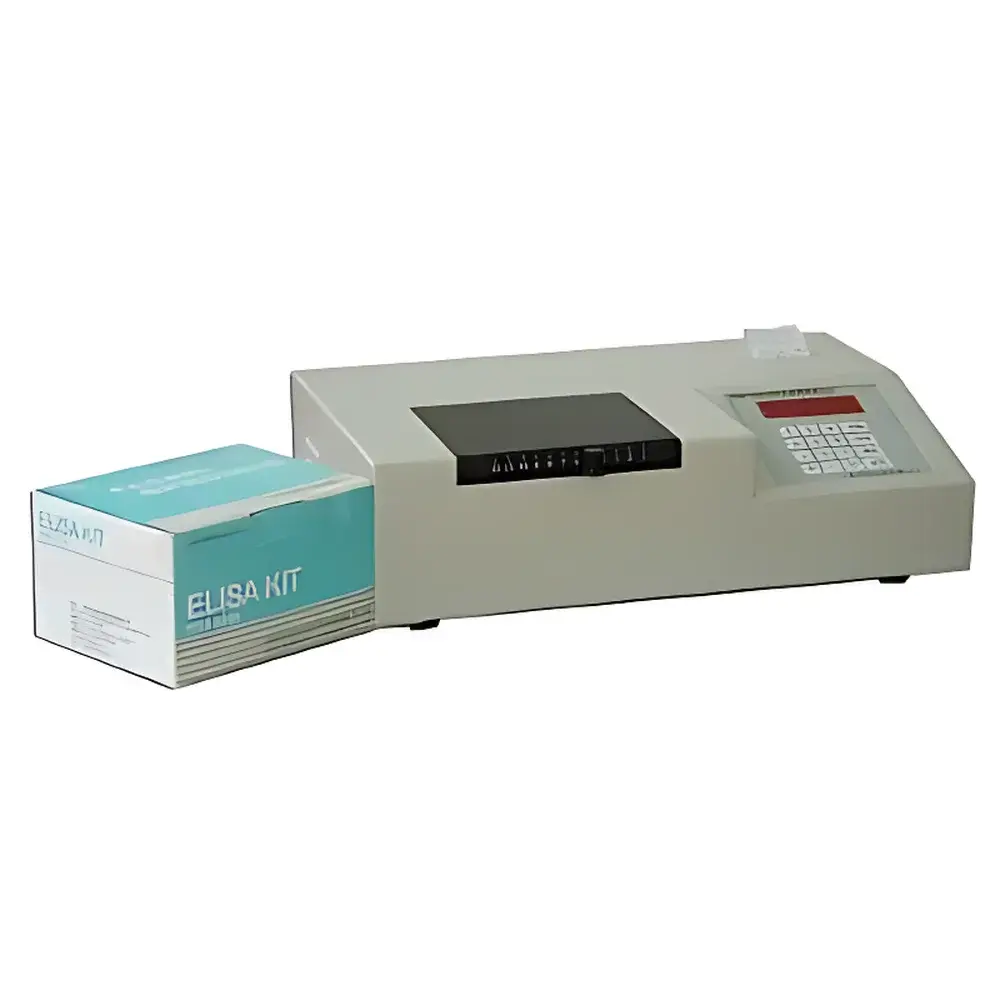
EAB1 Aflatoxin B1 Analyzer (ELISA-Based Microplate Reader)
| Origin | Shanghai, China |
|---|---|
| Manufacturer Type | Authorized Distributor |
| Origin Category | Domestic (China) |
| Model | EAB1-2000 / EAB1-95 |
| Price | USD 1,020 (FOB Shanghai) |
| Instrument Category | Aflatoxin B1 Quantification System |
| Detection Principle | Solid-Phase Enzyme-Linked Immunosorbent Assay (ELISA) |
| Wavelength | 450 ± 2 nm (standard interference filter) |
| Absorbance Range | –0.041 to 1.999 A |
| Detection Limit | 0.1 ng/mL |
| Quantitative Range | 0.1–1.0 ng/mL (ppb) |
| Sensitivity | < 0.1 ng/mL |
| Accuracy | ±0.1 ng/mL |
| Throughput | 20 samples/hour |
| Light Source | LED (3.6 V / 20 mA) |
| Operating Environment | 5–35 °C, ≤85% RH |
| Power Supply | 220 V ±10%, 50–60 Hz |
| Dimensions (EAB1-95) | 350 × 270 × 210 mm |
| Weight (EAB1-95) | 9 kg |
| Dimensions (EAB1-2000) | 410 × 264 × 110 mm |
| Weight (EAB1-2000) | 10 kg |
| Power Consumption | 37 W (EAB1-95), 40 W (EAB1-2000) |
| Transmittance Stability (EAB1-2000) | ≤0.3% T/5 min (bright), ≤0.2% T/5 min (dark) |
Overview
The EAB1 Aflatoxin B1 Analyzer is a dedicated microplate reader engineered for quantitative and semi-quantitative detection of aflatoxin B1 in complex food, feed, and pharmaceutical matrices using the standardized solid-phase enzyme-linked immunosorbent assay (ELISA) methodology. Based on competitive or sandwich immunoassay formats—depending on the companion test kit—the instrument measures absorbance at 450 ± 2 nm, corresponding to the optimal wavelength for tetramethylbenzidine (TMB) substrate chromophore development. Its optical architecture employs stable LED illumination and precision photometric detection to ensure high reproducibility across routine batch testing. Designed specifically for regulatory screening workflows, the EAB1 series complies with core analytical requirements outlined in AOAC Official Method 2005.08, ISO 12463:2012 (aflatoxin determination in cereals), and EU Commission Regulation (EC) No 401/2006 for mycotoxin sampling and analysis. The system does not perform extraction or purification; it functions exclusively as an endpoint or kinetic absorbance reader for pre-processed ELISA plates.
Key Features
- Two platform variants: EAB1-95 (compact benchtop reader) and EAB1-2000 (microprocessor-controlled reader with enhanced data handling)
- Fixed-wavelength photometry at 450 ± 2 nm using calibrated interference filters—optimized for TMB-based ELISA systems
- Wide dynamic absorbance range (–0.041 to 1.999 A) supporting both low- and high-signal assays without manual gain adjustment
- Quantitative detection limit of 0.1 ng/mL for aflatoxin B1, meeting EU maximum residue level (MRL) thresholds for most commodities (e.g., 2 µg/kg in nuts, 5 µg/kg in cereals)
- EAB1-2000 model includes built-in transmittance (T), absorbance (A), and concentration (C) calculation modes with real-time display and thermal printer output
- Integrated linear regression engine for automatic standard curve fitting (4PL or linear) and sample concentration derivation
- Kinetic measurement capability (EAB1-2000 only) for monitoring enzymatic reaction rates in time-resolved ELISAs
- Stable LED light source (3.6 V / 20 mA) with low thermal drift and ≥10,000-hour operational lifetime
- Compliance-ready design: supports manual audit trails, user-defined assay protocols, and hardcopy record retention per GLP and internal QA requirements
Sample Compatibility & Compliance
The EAB1 Analyzer is validated for use with commercially available, CE-marked or AOAC-PTM-certified ELISA kits targeting aflatoxin B1—including kits from suppliers such as Vicam, Romer Labs, R-Biopharm, and Bioo Scientific. When paired with appropriate extraction and cleanup procedures (e.g., immunoaffinity column purification per AOAC 2005.08), the system delivers results traceable to NIST SRM 2370e (Aflatoxin Complex). It accommodates standard 96-well microplates (flat-bottom, UV-transparent polystyrene) and supports single- or dual-wavelength reading (reference wavelength optional via external filter wheel add-on). While the instrument itself is not FDA 21 CFR Part 11–compliant out-of-the-box, its print-and-record functionality satisfies basic documentation needs for HACCP, FSSC 22000, and BRCGS Food Safety Issue 9 audit trails. All operational parameters—including wavelength, incubation time, and curve-fitting method—are manually configured and logged per run.
Software & Data Management
The EAB1-2000 incorporates embedded firmware with non-volatile memory for storing up to 100 assay protocols and 500 result sets. Data export is limited to thermal-printed reports (date/time-stamped, with operator ID field); no USB, Ethernet, or PC connectivity is provided. Each report includes raw absorbance values, calculated concentrations, pass/fail flags against user-defined cutoffs, and regression statistics (R², slope, intercept). For laboratories requiring digital archiving or LIMS integration, third-party plate reader software (e.g., Gen5, Magellan) can be used with compatible analog output adapters—though such configurations fall outside factory validation scope. The EAB1-95 operates in standalone mode with front-panel key navigation and LCD readout only; all calculations must be performed externally using printed absorbance data and kit-provided calibration curves.
Applications
- Routine screening of raw agricultural commodities (corn, peanuts, rice, cottonseed) for aflatoxin B1 contamination prior to processing
- Quality control testing of finished products including edible oils, dairy powders, infant formula, and herbal medicines
- Feed mill compliance verification against EC Directive 2002/32/EC limits for animal feedstuffs
- Contract laboratory support for ISO/IEC 17025-accredited mycotoxin testing (when used within validated kit protocols)
- Research applications in food toxicology, including dose-response studies and antibody affinity characterization
- Cross-reactivity assessment of multi-toxin ELISA kits (e.g., simultaneous detection of B1, B2, G1, G2) when operated with appropriate filter sets
FAQ
Is the EAB1 Analyzer capable of detecting other mycotoxins besides aflatoxin B1?
Yes—provided a compatible ELISA kit with validated cross-reactivity and matching optical detection wavelength (e.g., 450 nm for TMB, 630 nm for ABTS) is used. The instrument itself is analyte-agnostic; specificity derives entirely from the immunoassay reagents.
Does the EAB1-2000 support FDA 21 CFR Part 11 electronic signatures?
No. The device lacks user authentication, electronic audit trail generation, or secure data storage required for Part 11 compliance. It meets only basic GLP documentation expectations via printed records.
What maintenance is required for long-term photometric stability?
Annual verification of absorbance linearity using NIST-traceable neutral density filters is recommended. LED intensity remains stable over time; no lamp replacement is needed. Optical path cleaning with lint-free swabs and isopropanol is advised every 6 months.
Can the EAB1 series be integrated into automated liquid handling workflows?
Not natively. The absence of RS-232, USB, or barcode interfaces prohibits direct communication with robotic handlers or LIMS. Manual plate loading and result transcription are required.
Is temperature control available during plate reading?
No. The instrument operates at ambient temperature and does not include plate incubation or thermoregulation. Pre-incubated plates must be loaded immediately after equilibration to avoid condensation or signal drift.





